.svg&w=384&q=75 "Pitchgist logo")
Sweden's Tactical Dominance Over Tunisia in 5-1 Victory
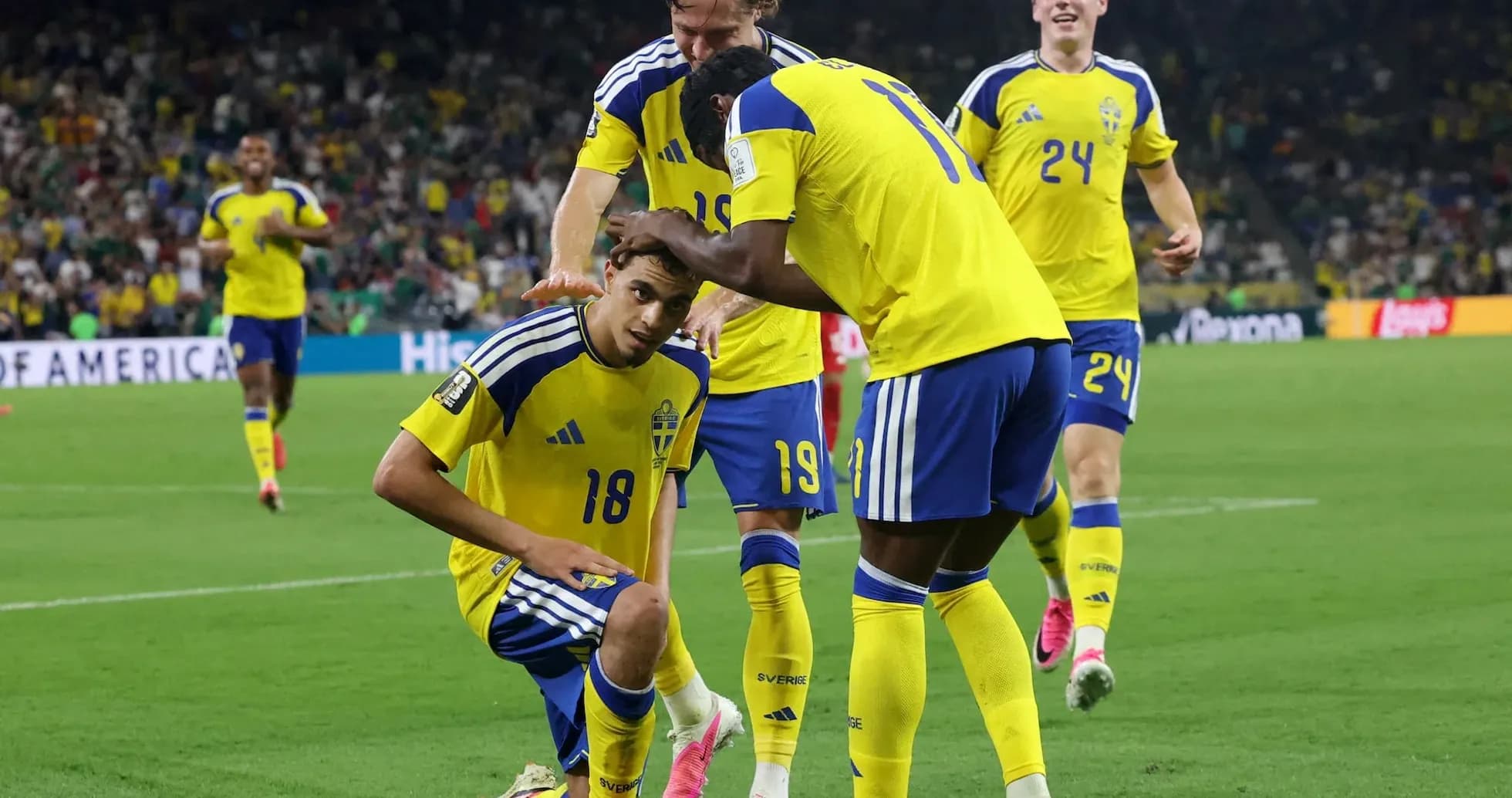
Sweden’s 5-1 win over Tunisia at Estadio BBVA was built on a clear tactical superiority: a proactive 3-1-4-2 that repeatedly pulled apart Tunisia’s 5-3-2 block, combined with ruthless exploitation of transition moments and penalty-box presence. Despite having marginally less of the ball (49% to Tunisia’s 51%), Sweden turned their structure into sustained threat, generating 13 total shots to Tunisia’s 6 and a 7-2 advantage in shots on goal.
Graham Potter’s 3-1-4-2 used Gustaf Lagerbielke, Isak Hien and Victor Lindelöf as the back three, with Jesper Karlström initially anchoring in front of them. Wide midfielders Alexander Bernhardsson and Gabriel Gudmundsson stretched Tunisia’s wing-backs, while Benjamin Nygren and Yasin Ayari operated as advanced interiors behind the strike pair of Viktor Gyökeres and Alexander Isak. This gave Sweden five lanes of occupation in the attacking phase and, crucially, consistent overloads against Tunisia’s midfield three.
Early on, the pattern was clear. Sweden built with a back three plus Karlström, creating a 4v3 against Hannibal Mejbri, Ellyes Skhiri and Rani Khedira. As soon as one of Tunisia’s forwards jumped to press, a vertical lane opened into Ayari or Nygren between the lines. The opening goal at 7 minutes from Yasin Ayari reflected this dynamic: Sweden’s ability to find a free midfielder high between Tunisia’s lines, then attack a retreating back five before it could set.
In wide areas, Sweden’s 3-1-4-2 consistently pinned Tunisia’s wing-backs. Bernhardsson and Gudmundsson stayed high and wide, forcing Ali Abdi and Amine Ben Hmida into deep positions and preventing them from joining counters. That, in turn, left Tunisia’s front two isolated. With only 2 shots inside the box from 6 total, Tunisia rarely progressed with enough numbers to threaten consistently.
The Gyökeres–Isak partnership was central to Sweden’s attacking plan. Isak frequently dropped into the right half-space to link play, while Gyökeres ran the channels and attacked the last line. Their interplay produced Sweden’s second goal on 30 minutes: Isak finishing after Viktor Gyökeres’ service, a mirror of the later 59-minute goal where Gyökeres scored from an Isak assist. Those patterns highlight a deliberate rotation: one striker dropping to overload midfield, the other attacking the depth against a stretched back five.
Defensively, Sweden’s front two and advanced midfield line pressed in a 3-4-1-2 shape, with Ayari stepping up behind the forwards. They were selective rather than constant in their pressing, but when they went, they forced Tunisia long. With only 2 shots on target and an xG of 0.28, Tunisia’s attacks were mostly speculative efforts from outside the box (4 shots from distance) rather than constructed entries.
In goal, Kristoffer Nordfeldt (Sweden) faced only 2 shots on target and made 1 save, underlining how effectively the Swedish block protected its box. At the other end, Abdelmouhib Chamakh (Tunisia) also recorded 1 save, but the underlying numbers are revealing: Sweden’s xG was 1.36 yet they scored 5, while Tunisia’s goals prevented value of -2.99 indicates that Tunisia’s goalkeepers across the competition are underperforming the xG they face by a significant margin. In this match, Sweden’s finishing quality and Tunisia’s defensive fragility combined to produce a scoreline that outstripped the raw chance quality.
The second half accentuated the tactical contrast. Tunisia’s 5-3-2 remained conservative even when trailing, and their attempt to adjust via substitutions around the 72nd minute — introducing Sebastian Tounekti, Mohamed Belhadj Mahmoud and Elias Achouri for Elias Saad, Yan Valery and Ellyes Skhiri — did little to change the structural issues. Removing Skhiri, their most balanced midfielder, further weakened central stability just as Sweden began to rotate fresh legs into their own midfield.
Potter’s changes were targeted and aggressive. At 65 minutes, Elliot Stroud (IN) came on for Gabriel Gudmundsson (OUT), and Lucas Bergvall (IN) for Benjamin Nygren (OUT), injecting energy and maintaining the same positional roles in the wide and central corridors. Later, Mattias Svanberg (IN) replaced Jesper Karlström (OUT) at 84 minutes, adding a more vertical, box-arriving profile at the base. That change was immediately decisive: Svanberg’s late run and finish for Sweden’s fourth goal at 84 minutes, assisted by Isak, reflected a clear instruction to keep attacking the spaces Tunisia were leaving between midfield and defence.
Up front, Anthony Elanga (IN) replaced Alexander Isak (OUT) at 90 minutes, preserving depth and pace in behind as Tunisia tired. Daniel Svensson (IN) for Alexander Bernhardsson (OUT) at 90+1 maintained width on the right. Even at 4-1, Sweden’s substitutions were designed to sustain pressure rather than simply protect the lead, a mindset rewarded when Yasin Ayari, now operating with more freedom and supported by fresh legs, added a fifth goal at 90+6 minutes from a Lucas Bergvall assist.
Discipline also played a subtle tactical role. Tunisia collected the only card of the match: at 54 minutes, Rani Khedira (Tunisia) — Tripping. That booking came in midfield as Sweden continued to break lines centrally, and it further constrained Tunisia’s ability to apply aggressive pressure in the middle third.
Statistically, Tunisia’s 51% possession and 364 total passes (288 accurate, 79%) suggest a relatively even share of the ball, but Sweden’s 353 passes (280 accurate, 79%) were more purposeful. Sweden’s 9 shots inside the box versus Tunisia’s 2 underline the territorial and structural superiority of the Swedish attack. Sweden also managed more corners (4 to 2) and more offsides (3 to 6 in Tunisia’s favour), an indicator of how often Sweden were threatening the last line compared to Tunisia’s more cautious, deeper positioning.
The overall tactical verdict is that Sweden’s system translated slightly less possession into far more dangerous territory and volume of chances. Their 3-1-4-2 consistently broke Tunisia’s 5-3-2 between the lines and in the half-spaces, while the Gyökeres–Isak axis, supported by Ayari and later Svanberg and Bergvall, ensured that those structural advantages became goals. Tunisia, by contrast, never meaningfully altered their shape or pressing scheme, and their substitutions, while numerous, did not address the core issues of midfield overloads and lack of support for the front two.