.svg&w=384&q=75 "Pitchgist logo")
Sweden's Dominance in World Cup Opener Against Tunisia
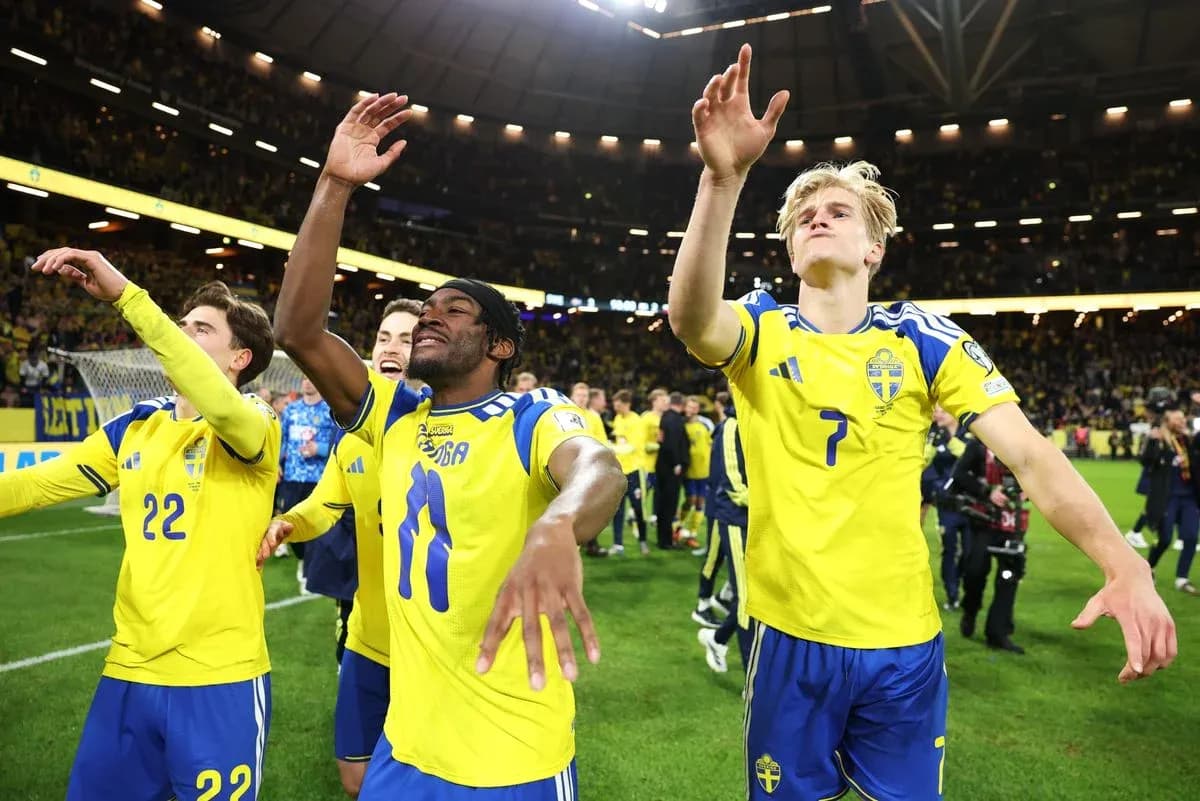
Under the lights of Estadio BBVA in Monterrey, Sweden’s World Cup campaign began not with a cautious step but with a statement. In a Group Stage opener that felt more like a knockout showcase, Graham Potter’s side dismantled Tunisia 5–1, a result that instantly reshaped the balance of Group F and offered a revealing look at both squads’ tactical DNA.
Following this result, Sweden sit top of the group in 1st place with 3 points and a goal difference of +4, built from 5 goals for and 1 against in total. Tunisia, by contrast, are anchored in 4th, still pointless with a goal difference of -4 after conceding 5 and scoring just 1 overall. It is only one match, but the patterns are already stark.
Potter’s choice of a 3-1-4-2 set the tone. With K. Nordfeldt behind a back three of V. Lindelof, I. Hien and G. Lagerbielke, Sweden constructed calmly from deep, using J. Karlstrom as the single pivot in front of the defence. Ahead of him, a fluid four of G. Gudmundsson, Y. Ayari, B. Nygren and A. Bernhardsson linked midfield to attack, feeding the twin threat of V. Gyökeres and A. Isak.
The shape was aggressive: three centre-backs, one dedicated shield, and four advanced midfielders constantly occupying half-spaces. It allowed Sweden to pin Tunisia’s 5-3-2 back into a flat back five, turning the African side’s intended defensive solidity into a reactive, retreating block. Sweden’s season numbers underline that front-foot intent: heading into this game they had not played, but following this result they now average 5.0 goals for at home and 5.0 in total per match, while conceding 1.0 at home and 1.0 overall.
Tunisia’s 5-3-2 under Sabri Lamouchi was built on caution. A. Chamakh was protected by a line of five – A. Abdi, M. Ben Hamida, M. Talbi, O. Rekik and Y. Valery – with a compact midfield trio of R. Khedira, E. Skhiri and H. Mejbri tasked with screening central zones and springing E. Saad and A. Slimane on the counter. In theory, it offered width in defence and numbers in the middle. In practice, it invited Sweden onto them and left their forwards isolated.
The tactical voids were less about missing personnel – there is no recorded list of absentees – and more about structural gaps. Tunisia’s back five struggled to coordinate their line when Sweden’s front four between the lines rotated. Nygren and Bernhardsson repeatedly pulled wing-backs into uncomfortable positions, while Ayari’s freedom to drift inside and outside created pockets that Khedira and Skhiri could not always plug.
Disciplinary trends added another layer. Sweden’s card record so far is clean; there are no yellow or red card timings logged for them in this campaign. Tunisia, however, already show a flashpoint: 100.00% of their yellow cards have arrived between 46-60 minutes. That mid-second-half spike hints at a team that becomes stretched and late into challenges once they chase the game – precisely when Sweden’s intensity and rotation can be most punishing.
Key Matchups
Within this framework, the key matchups told the story of the night and hint at what lies ahead.
The “Hunter vs Shield” duel was embodied by Sweden’s front line against Tunisia’s defensive unit. Gyökeres and Isak are already among the World Cup’s early headline-makers. Following this result, Isak has 1 goal and 2 assists in total from his 89 minutes, hitting the target with both of his shots and completing 82% of his 17 passes. Gyökeres mirrors that influence with 1 goal and 1 assist overall, 4 shots (2 on target) and 19 passes at 84% accuracy.
Together, they spearheaded an attack that averages 5.0 goals in total per game so far. Tunisia’s shield, by contrast, has buckled: on their travels they have conceded 5.0 goals per match, and 5.0 overall, with their heaviest defeat – 5-1 away – already recorded. The numerical clash is brutal: an attack that scores freely versus a defence that, so far, cannot contain.
In the “Engine Room,” Y. Ayari emerged as Sweden’s metronome and match-winner. From midfield he produced 2 goals in total, with both of his shots on target, while also contributing 27 passes (2 key) and 3 tackles. His rating of 8.6 reflects a complete two-way performance: late runs into the box, composure in tight spaces, and the work rate to press Tunisia’s midfield from the front.
Opposite him, E. Skhiri and R. Khedira were asked to absorb waves of pressure and launch transitions. But with Tunisia managing just 1 goal in total and failing to establish sustained possession, their midfield enforcers spent more time retreating than dictating. When they did win the ball, the distances to Saad and Slimane were too great; Sweden’s back three and Karlstrom could step in and recycle possession before Tunisia could breathe.
Potter’s bench options also hinted at depth and flexibility. M. Svanberg came on to telling effect, scoring 1 goal from his only shot and showing that Sweden can change the rhythm from midfield without losing control. L. Bergvall, another substitute, added 1 assist in his 25 minutes, completing 83% of his passes and winning half of his duels. The message is clear: this Sweden side is not reliant on a single star but on a collective structure that amplifies multiple threats.
From a statistical prognosis standpoint, the picture is emphatic. Sweden’s overall goal difference of +4 (5 scored, 1 conceded) is the product of a high-functioning attack and a defence that, while not watertight, is rarely exposed for long spells. Tunisia’s -4 (1 scored, 5 conceded) reflects a side whose current 5-3-2 is neither protecting the box nor enabling meaningful counter-attacks.
There is no penalty narrative to complicate the story – both teams have taken 0 penalties in total, with 0 scored and 0 missed – so the gap is built entirely in open play and structured attacking patterns. That makes Sweden’s dominance even more sustainable.
Following this result, Sweden look every inch a Round of 32 team already playing knockout-level football in the group phase. Tunisia, meanwhile, must decide whether to double down on their back five or pivot towards a braver, more connected shape. If they remain pinned in a passive 5-3-2 against this kind of high-tempo, multi-pronged attack, the numbers – and the narrative – suggest more long nights ahead.