.svg&w=384&q=75 "Pitchgist logo")
Ivory Coast vs Ecuador: World Cup 2026 Opening Match Analysis
Under the lights of Lincoln Financial Field in Philadelphia, Ivory Coast and Ecuador opened their World Cup 2026 journeys with a contest that felt more like a knockout tie than a group curtain-raiser. The stakes were clear: Group E is unforgiving, and an early slip can become a trapdoor. Following this result, Ivory Coast sit 2nd in the section on 3 points with a goal difference of +1 (1 scored, 0 conceded), while Ecuador find themselves 3rd, pointless and with a goal difference of -1 (0 scored, 1 conceded).
Both coaches mirrored each other structurally, sending their sides out in a 4-4-2, but the shared numbers disguised very different footballing identities. Emerse Fae’s Ivory Coast, already wedded to this shape after using it in their only lineup so far, leaned on power and verticality. Sebastian Beccacece’s Ecuador, also in a 4-4-2, looked to compress space and spring into transition.
I. The Big Picture: Structure and Season DNA
Heading into this game, Ivory Coast’s statistical profile was minimalist but telling. In total this campaign they had played 1 match, won 1, drawn 0 and lost 0. At home they had played 1, with 1 win and no draws or defeats. Their attacking return was modest but efficient: in total this campaign they had scored 1 goal, all at home, for an average of 1.0 home goals per match and 1.0 in total. Defensively, they were immaculate: 0 goals conceded overall, 0.0 goals against on average at home and in total, and 1 clean sheet in total. This is a side whose early World Cup identity is built on control and defensive clarity rather than chaos.
Ecuador’s numbers told the inverse story. On their travels they had played 1, with 1 defeat and no wins or draws, losing 1-0 away. In total this campaign they had failed to score (0 goals for, 0.0 goals for on average overall) and conceded 1 goal overall, at an average of 1.0 total goals against. No clean sheets, and a single away loss as their biggest result. The margins are thin, but the pattern is stark: Ivory Coast are already comfortable winning by one; Ecuador are already living on the wrong side of that same knife-edge.
II. Tactical Voids and Discipline
There were no listed absences or injuries in the data, so both coaches had full decks to play with. That made the tactical choices even more revealing.
Ivory Coast’s disciplinary profile is sharp-edged but front-loaded. In total this campaign they have received yellow cards only in the first half: 1 between 16-30 minutes (33.33% of their yellows) and 2 between 31-45 minutes (66.67%). There are no yellow cards recorded after the interval. It suggests a team that starts aggressively, tests limits early, then adjusts. Seko Fofana embodies that edge: in his 77 minutes he committed 1 foul, picked up 1 yellow card, and yet still managed 36 passes at 88% accuracy, 1 key pass, 1 blocked shot and 2 interceptions. He walks the line, but he walks it with purpose.
Ecuador’s discipline is quieter but not spotless. In total this campaign they have a single yellow card, and it arrives in the 61-75 minute window, meaning 100.00% of their cautions come in that mid-second-half band. That timing hints at fatigue fouls, tactical halts when the game begins to stretch. Jackson Porozo is the emblem here: in 28 minutes he committed 2 fouls, took 1 yellow card, and lost both of his duels, despite completing all 12 of his passes. Technically secure, physically stressed.
III. Key Matchups
Hunter vs Shield
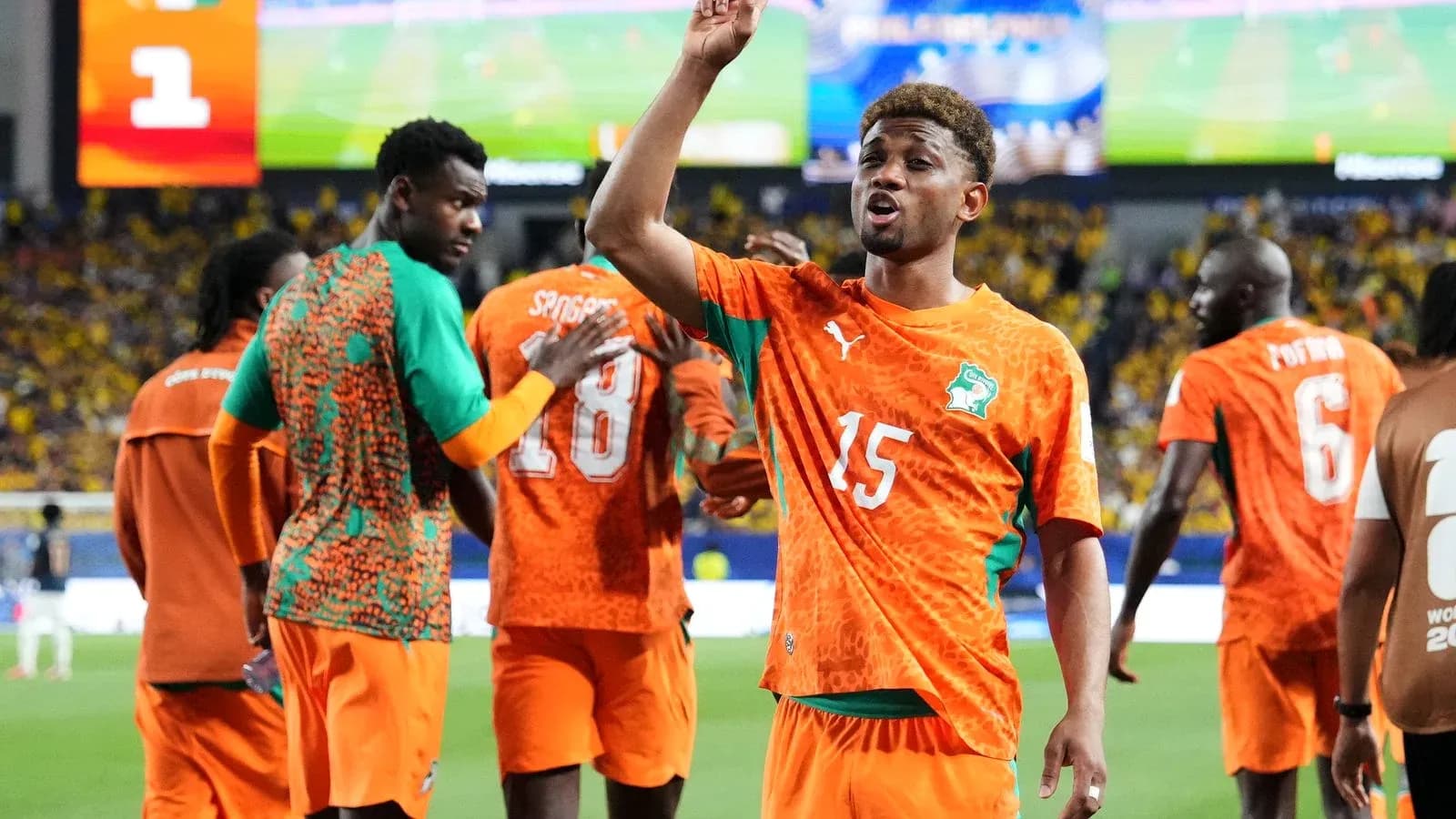
The decisive attacking figure for Ivory Coast is not a starter but a weapon off the bench: A. Diallo. In just 34 minutes, he delivered a performance that already places him 15th by rating among attackers in the competition. He scored 1 goal from 2 shots, both on target, and completed 5 of 6 dribbles, winning 6 of 8 duels. This is a player who can break compact defensive structures on his own, especially in broken-field moments.
Ecuador’s “shield” is collective rather than individual. Their defensive record in total this campaign is 1 goal conceded, 1.0 average goals against overall, with the only loss a 1-0 scoreline away. That suggests they rarely collapse; they simply lack the attacking punch to flip tight games. The centre-back pairing of W. Pacho and J. Ordonez, shielded by M. Caicedo, is built to absorb pressure. But as Diallo showed, a dribbler with that success rate can unpick even a well-drilled block if isolated one-on-one.
Engine Room: F. Kessie and S. Fofana vs M. Caicedo
The midfield battle is the true hinge of Ivory Coast’s campaign. Fae’s 4-4-2 uses F. Kessie and S. Fofana as a double axis: Kessie as the stabiliser, Fofana as the carrier and long-range threat. Fofana’s 4 shots, 1 on target, underline his license to step into the half-spaces behind the forwards E. Wahi and N. Pepe.
On the other side, M. Caicedo is Ecuador’s metronome and firefighter. With P. Vite and A. Minda providing connective tissue out wide and between the lines, Ecuador rely on Caicedo to both screen and initiate. If he is pinned deep by Ivory Coast’s dual forwards and the aggressive positioning of B. Toure and Y. Diomande from wide midfield, Ecuador’s transitions stall before they start.
IV. Statistical Prognosis and Tactical Trajectory
Following this result, the statistical tilt is clear. Ivory Coast have a perfect record in total this campaign: 1 win from 1, 1.0 goals scored on average, 0.0 conceded, 1 clean sheet, and no penalties taken or missed. Their single lineup so far has been in a 4-4-2, and the structure looks settled. The card distribution, heavy in the first half and empty thereafter, suggests they can modulate intensity and manage game states once ahead.
Ecuador, by contrast, have 1 defeat from 1, 0.0 goals for on average and 1.0 goals against overall, with no clean sheets and a single recorded yellow card arriving in the 61-75 minute band. Their own 4-4-2 is less a platform for dominance and more a containment shell, relying on the individual spark of G. Plata and E. Valencia to flip territory into chances.
In xG terms, the profiles hint at low-scoring, narrow margins: Ivory Coast are built to win 1-0 and already have; Ecuador are living in that same scoreline but on the wrong side. Unless Ecuador can unlock more support between the lines for Valencia and Plata, or inject creativity from the bench through players like K. Paez or J. Alcivar, they risk being trapped in a pattern of honourable but costly one-goal defeats.
For Ivory Coast, the path is clearer. Lean into the solidity of Y. Fofana’s back line, trust the midfield engine of Kessie and S. Fofana to manage tempo, and unleash A. Diallo as the late-game scalpel. In a tournament where control and clean sheets often outlive chaos, their early numbers and structural clarity suggest a side built to grow stronger as the stakes rise.