.svg&w=384&q=75 "Pitchgist logo")
Saudi Arabia vs Uruguay: Tactical Analysis of the 1-1 Draw
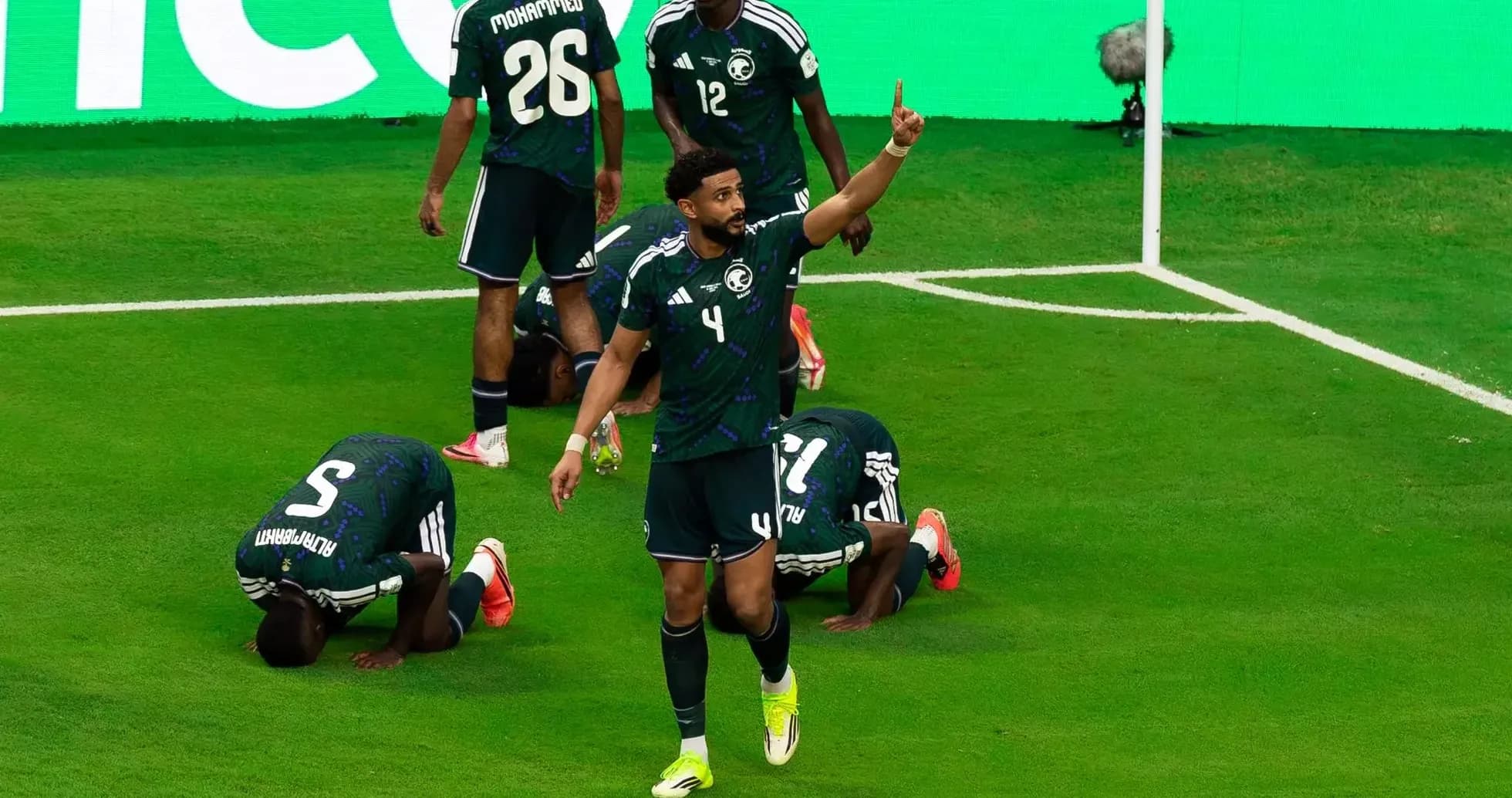
Saudi Arabia’s 1-1 draw with Uruguay at Hard Rock Stadium was a classic contrast of compact defending versus high-possession territorial dominance. Saudi Arabia, in a 4-4-2 under Georgios Donis, accepted a deep, low-possession game (33% of the ball, 322 passes at 73%) and tried to compress the central lane, while Marcelo Bielsa’s Uruguay, in a 4-2-3-1, imposed long phases of circulation (67% possession, 612 passes at 88%) and relentless shot volume (27 total shots, 16 inside the box).
The expected goals split underlines the tactical story: Uruguay at 1.72 xG to Saudi Arabia’s 0.66, yet the score stayed level because of defensive density and elite goalkeeping.
Mohammed Al-Owais (Saudi Arabia) was structurally the key figure. Behind a narrow back four, he faced 10 shots on goal and produced 9 saves, operating as both shot-stopper and final sweeper against cut-backs and second balls. Saudi Arabia’s defensive block was designed to funnel Uruguay into crowded central zones, trusting Al-Owais to handle efforts that came through. The negative goals prevented figure (-0.35) suggests that, despite the high save count, at least one of the chances Uruguay created was of a type he might usually be expected to stop; tactically, that points to the risk Saudi Arabia accepted by allowing so many touches inside their own area.
In front of him, the Saudi 4-4-2 was very flat without the ball. Full-backs Saud Abdulhamid and Moteb Al-Harbi (before his late substitution) stayed tight to the centre-backs Abdulelah Al-Amri and Hassan Altambakti, leaving the wings relatively open and prioritising compactness between the posts. The single yellow card — Abdulelah Al-Amri’s “Foul” at 44' — encapsulates their approach: aggressive protection of the box, willing to concede contact to break Uruguay’s rhythm. Eleven fouls to Uruguay’s six reflect a reactive, destruction-first defensive plan.
On the ball, Saudi Arabia’s structure was conservative. With only 7 total shots (4 inside the box, 3 on goal), they attacked in quick, vertical bursts. The midfield line of Mohammed Abu Al-Shamat, Mohamed Kanno, Abdullah Al-Khaibari and Salem Al-Dawsari had limited time in possession and mainly looked for early passes into the front two, Firas Al-Buraikan and Musab Al Juwayr. The low shot volume and modest xG (0.66) indicate that their attacking plan was based more on efficiency and set-piece or isolated moments than on sustained pressure.
Uruguay’s 4-2-3-1, by contrast, was built to dominate territory and volume. With Manuel Ugarte and Rodrigo Bentancur as the double pivot, Uruguay could keep the ball high and recycle pressure, which is reflected in their 14 corners and 27 shots. The 16 shots inside the box show how often they managed to reach advanced positions, particularly through the half-spaces occupied by Federico Valverde and Maximiliano Araújo behind Darwin Núñez.
The shot profile was aggressive but not always clean. Seven blocked shots highlight how often Saudi Arabia managed to get bodies in front of attempts, especially with the central defenders holding their line just inside the box. Uruguay’s lack of cards and only six fouls underline a different defensive posture: they largely defended in counter-pressing moments and in higher zones, rarely needing emergency tackles in their own area. Fernando Muslera (Uruguay) had a relatively quiet night in terms of workload — 2 goalkeeper saves — which aligns with Saudi Arabia’s limited attacking threat.
The substitution pattern adds a layer to the tactical picture. Bielsa’s early double change at 46' — Agustín Canobbio (IN) came on for Darwin Núñez (OUT), and Juan Sanabria (IN) came on for Matías Viña (OUT) — indicates a shift in pressing dynamics and width rather than a structural overhaul. Canobbio’s introduction offered more mobility and pressing from the front, while Sanabria provided fresh legs on the flank, helping maintain Uruguay’s intensity in wide zones as they chased the equaliser and then the winner.
Later, at 72', Nicolás de la Cruz (IN) came on for Manuel Ugarte (OUT), tilting the balance further towards creativity and line-breaking from midfield. That change is consistent with Uruguay’s growing urgency: they already had territorial control, but needed more incision between Saudi Arabia’s lines, which is reflected in the rising shot count and eventual 1.72 xG.
On the Saudi side, Nasser Al-Dawsari (IN) for Musab Al Juwayr (OUT) at 63' suggested a desire to reinforce midfield legs and protect the lead rather than chase a second goal. Subsequent late changes — Nawaf Boushal (IN) for Mohammed Abu Al-Shamat (OUT), Ali Lajami (IN) for Saud Abdulhamid (OUT), Ala'a Al-Hejji (IN) for Firas Al-Buraikan (OUT), and Abdullah Al-Hamdan (IN) for Moteb Al-Harbi (OUT) — were consistent with game management: fresh defenders and midfielders to sustain the low block and add physical presence for defending crosses and set plays.
Statistically, Uruguay’s profile — 67% possession, 612 passes (540 accurate, 88%), 27 shots, 14 corners and 1.72 xG — is that of a side that controlled almost every structural aspect of the match. Saudi Arabia’s 33% possession, 322 passes (236 accurate, 73%), 7 shots and 4 corners describe a team that accepted being outplayed territorially in exchange for compactness and the possibility of nicking the game on a small number of chances.
The final 1-1 scoreline, with Saudi Arabia leading 1-0 at half-time and Uruguay levelling late, reflects the tension between process and outcome. From a tactical lens, Uruguay’s mechanisms — high volume, strong field tilt, high passing accuracy — would normally be associated with a win, but Saudi Arabia’s disciplined 4-4-2 block, willingness to foul, and the workload absorbed by Mohammed Al-Owais (Saudi Arabia) in goal ensured that the statistical superiority did not translate into a decisive scoreboard advantage.