.svg&w=384&q=75 "Pitchgist logo")
Germany's Dominant 7–1 Victory Over Curaçao in World Cup 2026
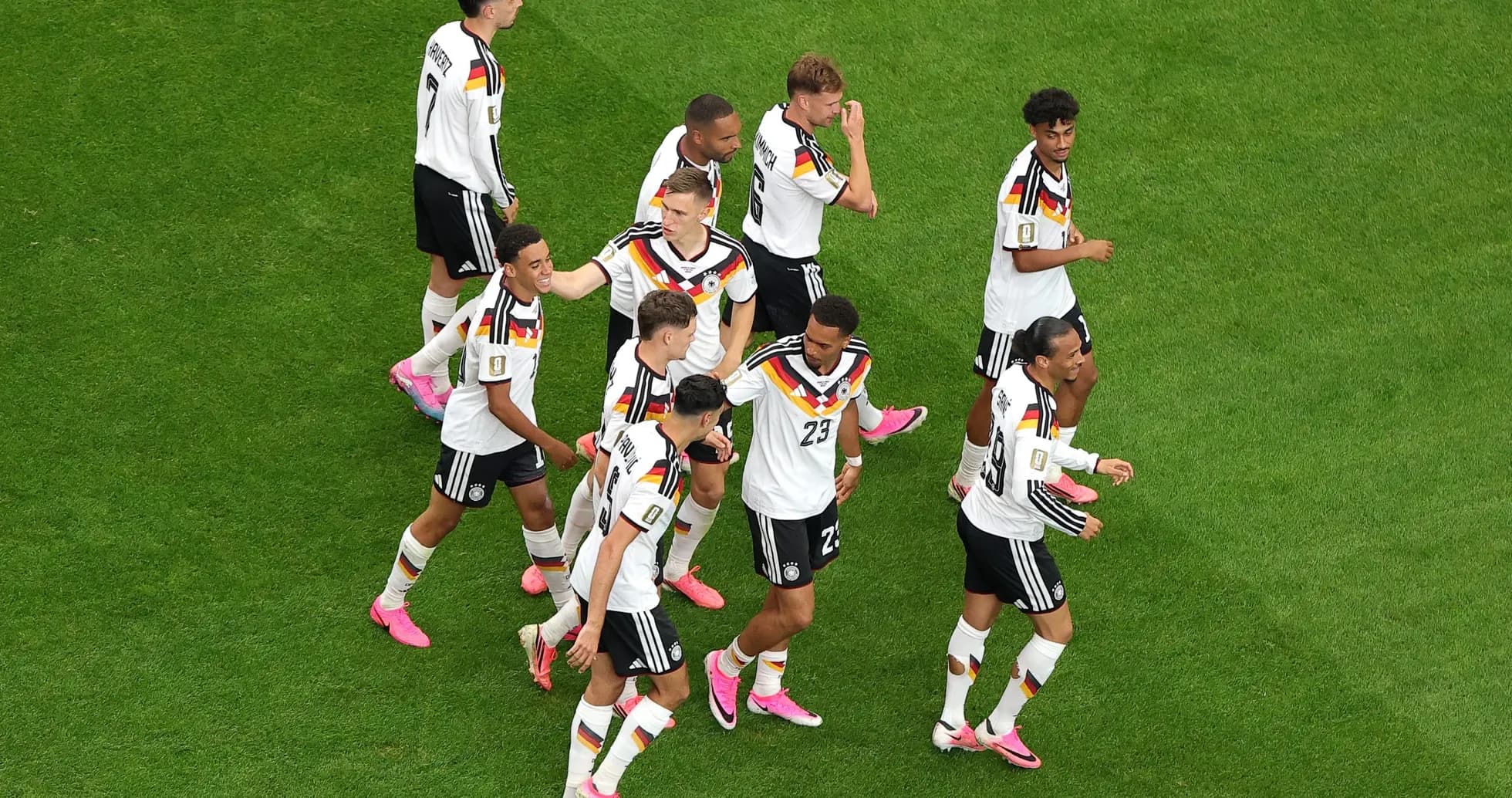
Under the closed roof of NRG Stadium in Houston, Germany opened their 2026 World Cup with a statement: a 7–1 demolition of Curaçao in Group Stage – 1. The scoreline echoed through Group E and the standings confirmed the scale of it. Following this result, Germany sit 1st in the group on 3 points, with a goal difference of +6 after scoring 7 and conceding 1 overall. Curaçao, beaten heavily, are 4th with 0 points and a goal difference of -6 from 1 goal for and 7 against overall.
Julian Nagelsmann’s Germany arrived with a clear seasonal identity already forming: in total this campaign they have played 1 match, won 1, with 7.0 goals for on average and 1.0 against. The 4-2-3-1 that has defined their early World Cup blueprint was on full display: positional rotations, an aggressive front four, and full-backs stepping high.
Curaçao, under Dick Advocaat, are at the opposite end of the spectrum. On their travels they have played 1 game, lost it 7–1, and their averages away stand at 1.0 goal for and 7.0 against. Their 4-3-1-2 was designed to compress the middle and spring two forwards, but against this level of German precision it became a flat, suffering back line.
Tactical voids and discipline
There is no formal injury or suspension list in the data, which means both coaches essentially had full squads at their disposal. That makes the tactical choices even more revealing.
Nagelsmann trusted experience at the back and exuberance ahead of the ball. Manuel Neuer anchored the side, shielded by a back four of Joshua Kimmich, Jonathan Tah, Nico Schlotterbeck and Nathaniel Brown. Ahead of them, the double pivot of F. Nmecha and Aleksandar Pavlovic gave the platform for an electric band of three – Leroy Sané, Jamal Musiala and Florian Wirtz – behind Kai Havertz as the lone forward. The bench was stacked with alternatives in every line: Antonio Rüdiger and Waldemar Anton as defensive options, Leon Goretzka and A. Stiller in midfield, and a cluster of forwards including Deniz Undav, M. Beier, N. Woltemade and J. Leweling.
Curaçao’s 4-3-1-2 was more constrained. Eloy Room started in goal behind a back four of Shurandy Floranus, Riechedly Bazoer, Armando Obispo and D. Fonville. The midfield trio of L. Comenencia, Leandro Bacuna and Juninho Bacuna tried to screen the defence, with Tahith Chong operating as a narrow No. 10 behind the front pair of Jürgen Locadia and S. Hansen. The bench contained a mix of Eredivisie and lower-league experience – B. Kuwas, K. Gorre, J. Antonisse, G. Kastaneer among the attacking options – but the gap in depth compared to Germany was stark.
From a disciplinary standpoint, both teams emerged statistically clean: the season card distributions for each side show no recorded yellow or red cards in any minute band. That hints at a game decided not by chaos or ill-discipline, but by structural superiority and technical execution.
Key matchups
The headline duel was always going to be Germany’s attacking spear against a Curaçao defence stepping onto the world stage. Kai Havertz embodied the “Hunter” role. In total this campaign he has 2 goals from 2 shots, both on target, plus 1 penalty scored from 1 taken – a flawless record so far. He completed 41 passes at 92% accuracy and even contributed defensively with 1 interception, underlining how Nagelsmann’s “9” is a complete reference point rather than a static finisher.
Against that, Curaçao’s “Shield” – the central pairing of Bazoer and Obispo in front of Room – simply could not absorb the volume and variety of German attacks. The raw team numbers tell the story: overall Curaçao have conceded 7 goals in 1 match, for an average of 7.0 against on their travels. With no clean sheets and no match yet in which they have failed to concede, the defensive platform is fragile.
Germany’s full-backs added another layer to the Hunter vs Shield narrative. Kimmich, nominally a right-back, produced the distribution of a deep playmaker: in total this campaign he has 73 passes with 5 key passes and 2 assists, at 89% accuracy. On the opposite side, Brown attacked with similar intent, scoring 1 goal and providing 1 assist, from 36 passes at 88% accuracy. When both full-backs are effectively auxiliary creators, a back four like Curaçao’s – used to more linear threats – is dragged apart both horizontally and vertically.
Engine room
The “Engine Room” battle was fought between Germany’s double pivot and Curaçao’s central three. Nmecha and Pavlovic sat at the base of the 4-2-3-1, tasked with recycling possession and protecting transitions so that Musiala, Wirtz and Sané could stay high between the lines. Musiala in particular blurred the line between engine and artist: in total this campaign he has 1 goal, 2 key passes, 5 dribble attempts with 4 successful, and 9 duels won from 14. Those numbers show a midfielder who not only receives between the lines but drives past pressure and wins his battles.
For Curaçao, the Bacuna brothers and Comenencia were overrun. Their 4-3-1-2 narrowed the pitch, but with Germany’s full-backs and advanced midfielders constantly overloading the half-spaces, the Curaçao trio were forced into reactive defending rather than proactive pressing. Chong, nominally their link player, was pinned back by Germany’s territorial control, leaving Locadia and Hansen isolated.
Nagelsmann’s ability to refresh the engine from the bench is another looming storyline. Deniz Undav came on and immediately stamped himself as a high-impact weapon: 1 goal, 2 assists, 3 key passes and 1 shot on target in just 26 minutes overall. He is also the leading assist provider in the competition so far. When a substitute striker can transform the tempo and productivity of attacks that late in games, Germany possess a second wave that many opponents simply cannot match.
Statistical prognosis
With only one match played for each side, the sample is small, but the trends are already emphatic. Germany’s overall profile is that of an elite contender: 1 win from 1, 7 goals scored, 1 conceded, a goal difference of +6, and a 100.00% conversion from the penalty spot with 1 scored and 0 missed. They have yet to keep a clean sheet, but the sheer volume of attacking output – supported by a deep bench and multiple creative outlets – suggests that their path through the group will be dictated by how ruthlessly they continue to attack rather than by defensive caution.
Curaçao’s numbers are brutal but honest: 1 defeat on their travels, 1.0 goal scored on average, 7.0 conceded, no clean sheets, and no penalties yet awarded. Their 4-3-1-2 has some offensive promise in theory, especially if Chong can connect more consistently with Locadia and Hansen, but structurally they must find ways to protect their centre-backs and full-backs from the kind of overloads Germany created.
Following this result, the tactical narrative is clear. Germany look every inch a Round of 32 side in waiting, their 4-2-3-1 already humming with synergy between Havertz, Musiala, Wirtz, Sané and the creative full-backs Kimmich and Brown, with Undav as a devastating closer. Curaçao, by contrast, face an urgent recalibration: Advocaat must either compact further and play for control of space, or lean into the attacking instincts of his forwards and accept more open games.
The xG numbers are not provided in the data, but the shot and goal patterns point toward a German attack performing at or above expectation and a Curaçao defence conceding chances in high-value areas. If those trends persist, the prognosis is that Germany will continue to dominate territorially and on the scoreboard, while Curaçao’s survival in Group E will depend on tightening the Shield and extracting every ounce of efficiency from their limited attacking moments.