.svg&w=384&q=75 "Pitchgist logo")
Iran and New Zealand Battle to 2-2 Draw at SoFi Stadium
Iran and New Zealand produced a tactically balanced 2-2 draw at SoFi Stadium, a match defined by contrasting structures and evolving control rather than chaos. Iran, in a 4-4-2 under Amir Ghalenoei, leaned on width and full-back aggression, while New Zealand’s 4-2-3-1 under D. Bazeley prioritised central stability and vertical service into Chris Wood. The statistical profile — 52% possession and superior pass accuracy for New Zealand against Iran’s higher shot volume — underlines a duel between territorial control and direct penetration.
First Half
New Zealand struck first through a classic 4-2-3-1 pattern. With Chris Wood as the reference point, the visitors used their double pivot of Joe Bell and Marko Stamenić to progress cleanly and then find the No 9 between the lines. The opening goal at 7' — Elijah Just finishing from a Wood assist — reflected that plan: Wood dropping and combining, Just attacking the half-space from the left side of the three behind the striker. New Zealand’s eight shots on goal from just 14 total attempts show how efficiently they converted structured possession into clear looks.
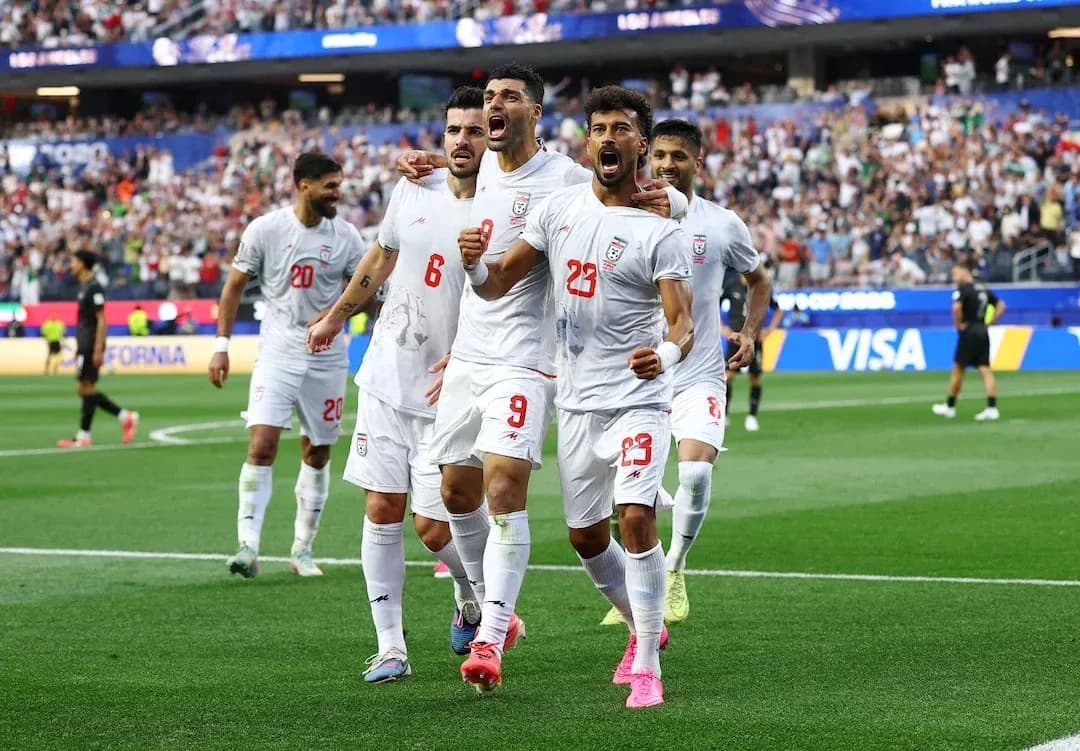
Iran’s 4-4-2 had a slower start but gradually imposed itself through the full-backs and second-line runners. The equaliser from Ramin Rezaeian at 32' was emblematic of Ghalenoei’s intent to push his right-back high, effectively turning the shape into a 3-5-2 in possession with Milad Mohammadi tucking slightly and Saeid Ezatolahi holding. With ten shots inside the box and 17 total, Iran consistently managed to pin New Zealand’s back four deep, forcing Tim Payne and Liberato Cacace into long defensive sequences.
Second Half
The second half highlighted both coaches’ in-game adjustments. At 46', Amir Ghalenoei introduced Mehdi Ghayedi (IN) for Aria Yousefi (OUT), a clear shift toward more direct attacking threat from the left midfield band. This adjustment aimed to support the front two of Shahriar Moghanlou and Mehdi Taremi with more dribbling and combination play. Shortly after, at 53', Ali Alipour (IN) came on for Shahriar Moghanlou (OUT), adding fresher movement in behind and slightly altering the dynamic of Iran’s front line toward more depth runs rather than pure target play.
New Zealand’s second goal at 54', again E. Just from a C. Wood assist, underlined how dangerous their primary pattern remained even as Iran pushed higher. The 4-2-3-1’s central spine — Surman and Boxall behind Bell and Stamenić — allowed them to absorb pressure and then release Wood early, with Just timing his runs beyond Iran’s back line. That New Zealand needed only 14 shots to generate two goals, with an xG of 1.24, shows a high level of chance quality.
Iran’s response was swift and structurally coherent. At 64', Mohammad Mohebi scored from a Rezaeian assist, a sequence that blended the right-back’s advanced positioning with Mohebi’s tendency to drift inside from the right of midfield. This was a textbook overload: Rezaeian overlapping, Mohebi attacking the half-space, and New Zealand’s right side stretched between ball and runners. The xG figure of 1.5, combined with ten shots inside the box, suggests Iran’s 4-4-2 successfully created repeated high-value situations, particularly from wide service and second balls.
Closing Phase
Personnel changes in midfield and full-back zones shaped the closing phase. At 65', Ehsan Hajsafi (IN) came on for Saman Ghoddos (OUT), adding defensive balance and experience on the left side as Iran sought to manage transitions while still chasing a winner. For New Zealand, a triple substitution window between 68' and 78' refreshed the defensive line and attacking width: Benjamin Old (IN) for Liberato Cacace (OUT), Ryan Thomas (IN) for Callum McCowatt (OUT), and Callan Elliot (IN) for Tim Payne (OUT). These moves suggested Bazeley’s priority had shifted toward protecting the draw and maintaining legs in the wide and full-back channels to cope with Iran’s crossing threat.
In the final minutes, Amirhossein Hosseinzadeh (IN) replaced Mehdi Taremi (OUT) at 80', a sign that Iran were willing to trade a classic penalty-box presence for more mobility and pressing from the front. The only booking of the match — 89' Ehsan Hajsafi (Iran) — Tripping — reflected Iran’s increasingly aggressive attempts to disrupt New Zealand’s late transitions. New Zealand’s added-time substitutions, Jesse Randall (IN) for Sarpreet Singh (OUT) and Tyler Bindon (IN) for Marko Stamenić (OUT) at 90+2', further tilted their shape toward game management, adding fresh legs and defensive security.
Goalkeeper Performance
Goalkeeper performance subtly framed the tactical story. Alireza Beiranvand (Iran) faced eight shots on goal and made 6 saves, with a goals prevented figure of -0.2, indicating New Zealand’s finishing slightly outperformed the underlying shot quality. His workload was a consequence of Iran’s aggressive full-back play, which at times left central channels exposed to direct passes into Wood. At the other end, Max Crocombe (New Zealand) registered 2 saves against 4 shots on goal and a similar goals prevented mark of -0.2, reflecting that Iran’s best chances were either converted or missed the target rather than being repeatedly denied by the goalkeeper.
Possession Statistics
In possession, New Zealand’s 446 total passes, 377 accurate (85%), show a side comfortable circulating the ball through its double pivot, using Bell and Stamenić to dictate tempo and pull Iran’s midfield apart horizontally. Iran, with 405 passes, 312 accurate (77%), played more vertically and accepted a lower completion rate in exchange for faster progression. The fouls count (Iran 10, New Zealand 8) and corner profile (4-1 to Iran) further underscore the pattern: Iran forcing the issue territorially, New Zealand more selective but clinical when they did advance.
Overall, the 2-2 draw mirrored the tactical balance: Iran’s width, crossing and volume of box entries against New Zealand’s structured possession and devastating Wood–Just connection. Neither coach fully solved the other’s primary weapon, and the statistical verdict suggests a result broadly in line with the underlying patterns of play.