.svg&w=384&q=75 "Pitchgist logo")
Saudi Arabia vs Uruguay: World Cup 2026 Opening Draw Analysis
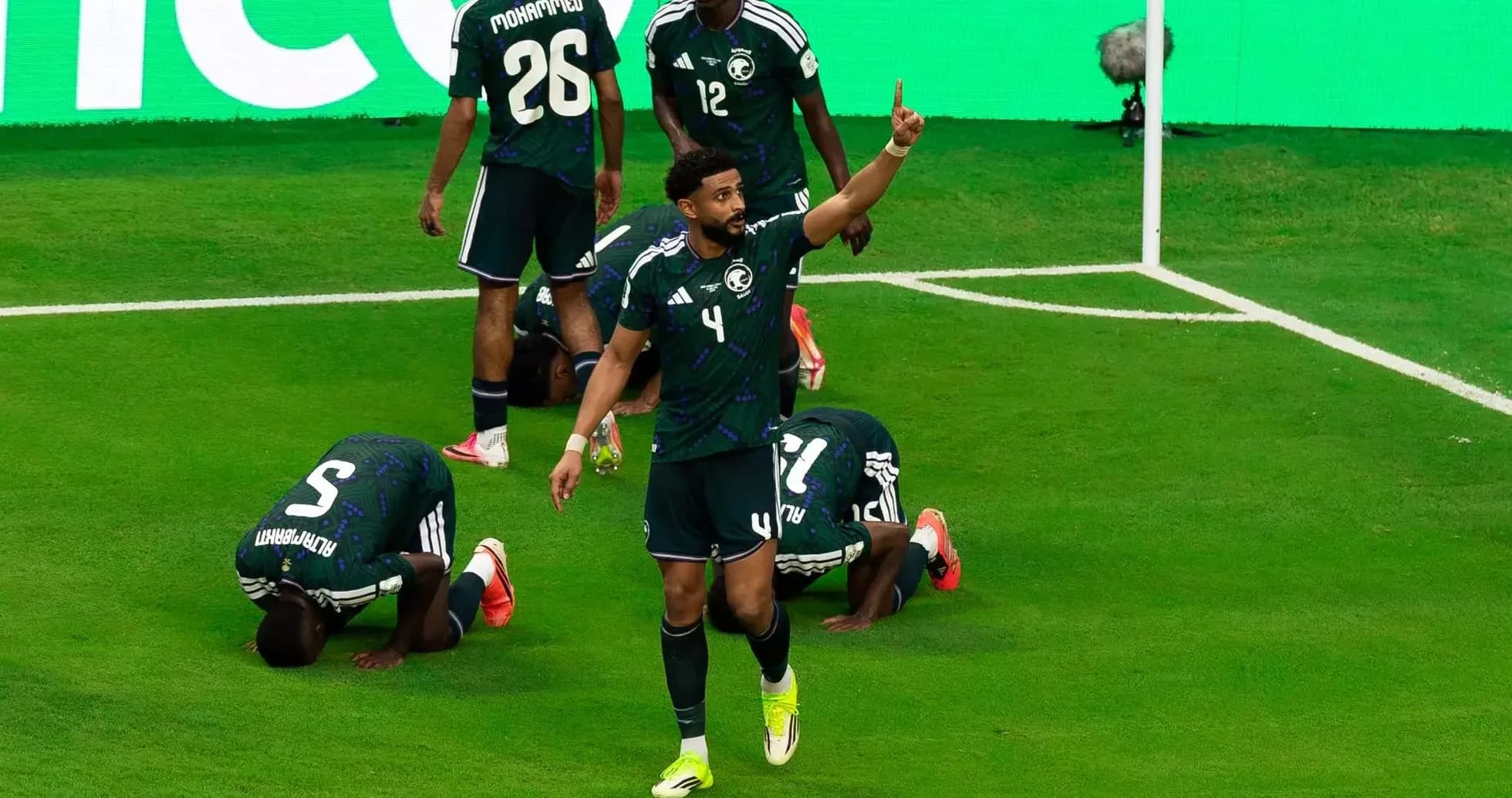
Under the Miami lights at Hard Rock Stadium, Saudi Arabia and Uruguay opened their World Cup 2026 journeys with a 1–1 draw that felt less like a gentle introduction and more like a statement of intent from both benches. Following this result, Group H has an oddly symmetrical look: Uruguay top on 1 point, Saudi Arabia second on 1 point, both with a goal difference of 0 after scoring and conceding 1 goal in total. The numbers say parity; the tactical shapes tell a more nuanced story.
I. The Big Picture – Two Identities, One Stalemate
Saudi Arabia, nominally the “home” side in this neutral-venue World Cup, leaned into a classic 4-4-2 under Georgios Donis. It was a structure built on clarity: two banks of four, narrow and disciplined, with F. Al Buraikan and M. Al Juwayr leading the line. Their overall record now reads 1 match played at home, 1 draw, 1 goal for and 1 against, for a total average of 1.0 goal scored and 1.0 conceded at home. It is a small sample, but it underlines a side that can hurt opponents without collapsing defensively.
Uruguay, coached by Marcelo Bielsa, arrived in a 4-2-3-1 that carried his signature: vertical, aggressive, and restless. On their travels they have played 1 match, drawing it, with 1 away goal scored and 1 conceded, an away average of 1.0 for and 1.0 against. For a Bielsa team, that balance is almost conservative, but the structure hints at what they want to become as the group unfolds.
II. Tactical Voids and Disciplinary Undercurrents
There were no official absences listed, so both managers had their full squads at their disposal. That made the selection choices revealing.
Donis trusted a back four of S. Abdulhamid, A. Al Amri, H. Tambakti and M. Al Harbi in front of M. Al Owais. The midfield quartet – M. Abu Al Shamat, M. Kanno, A. Al Khaibari and the talismanic S. Al Dawsari – formed a compact, horizontally connected unit. The “void” in Saudi Arabia’s setup was intentional: they sacrificed a natural No. 10 to maintain defensive density in central areas and to protect transitions against Uruguay’s counter-press.
Uruguay’s double pivot of M. Ugarte and R. Bentancur was designed to control the middle third, freeing F. Valverde, F. Vinas and M. Araujo to orbit behind D. Nunez. Yet the cost of that structure was visible between the lines: at times, the three advanced midfielders were caught high, leaving Ugarte and Bentancur isolated when Saudi Arabia broke quickly through Al Dawsari and the front two.
From a disciplinary standpoint, Saudi Arabia’s season profile already flashes a warning. Heading into this game they had a single yellow card in the 31–45 minute window, accounting for 100.00% of their total bookings so far. That pattern held symbolically in Miami: the Saudis again walked a tightrope before the interval, aggressive in duels but always a challenge away from undermining their own solidity. Uruguay, by contrast, reached this point without a single yellow or red card recorded in any minute range of their World Cup campaign. Their aggression was channelled more into pressing lanes than into reckless tackles – a crucial distinction in tournament football.
III. Key Matchups – Hunter vs Shield, Engine Room vs Engine Room
The central duel of the night was the “Hunter vs Shield” battle: Uruguay’s attacking spearhead against Saudi Arabia’s defensive shell.
D. Nunez, flanked and serviced by Valverde, Vinas and Araujo, was the obvious hunter. Uruguay’s season stats show they have scored 1 away goal in total, with that 1.0 away goals-for average underpinned by direct, vertical play. The plan was clear: use Valverde’s late surges and Varela’s overlaps to drag Saudi’s back line horizontally, then find Nunez in the resulting gaps.
The shield, however, was impressively compact. A. Al Amri and H. Tambakti anchored the line, with Al Harbi and Abdulhamid tucking in to form a narrow four. Saudi Arabia have conceded 1 goal at home in total, an average of 1.0, but the eye test here suggested a unit capable of punching above those raw numbers. They defended the box in numbers, funnelling Uruguay into low-percentage crosses rather than clean central entries.
The “Engine Room” contest was just as compelling. For Saudi Arabia, the axis of M. Kanno and A. Al Khaibari operated as both shield and springboard. Kanno stepped out to engage Valverde, while Al Khaibari stayed deeper, screening passing lanes into Nunez’s feet. Their task was to disrupt Uruguay’s rhythm without surrendering the ball cheaply.
Opposite them, M. Ugarte and R. Bentancur tried to dictate the game’s tempo. Bentancur, with his capacity to turn under pressure, was Uruguay’s metronome, while Ugarte hunted Saudi transitions. The problem for Uruguay was spacing: when Valverde and M. Vina both pushed on, Ugarte was left covering wide spaces in rest-defence, and Saudi Arabia’s 4-4-2 was primed to counter into those channels.
IV. Statistical Prognosis – What This Draw Really Says
Following this result, both teams share an identical statistical skeleton: 1 match played, 0 wins, 1 draw, 0 losses, 1 goal scored and 1 conceded overall, with a goal difference of 0 (1 scored minus 1 conceded). Neither side has yet kept a clean sheet, and neither has failed to score. Penalties remain an unopened chapter for both: 0 penalties awarded, 0 scored, 0 missed, so no narrative of spot-kick reliability or trauma has emerged.
Without explicit xG values, we read the probabilities through structure and patterns. Uruguay’s 4-2-3-1, with a lone striker and three advanced creators, is built to generate a higher volume of shots and, over time, a higher xG total than a more conservative 4-4-2. Their away average of 1.0 goals for suggests that, even when not fully fluid, they create enough to score. Saudi Arabia’s home average of 1.0 goals for hints at a side that will not be prolific but will be ruthlessly selective in their attacks.
Defensively, both sit on an overall average of 1.0 goals against. The difference lies in how those goals are likely to be conceded. Uruguay’s risk profile – full-backs high, wide midfielders aggressive – suggests they may leak chances in transition, especially late on as fatigue hits Bielsa’s high-energy model. Saudi Arabia, with their compact 4-4-2 and a track record of first-half bookings concentrated in the 31–45 minute window, are more likely to suffer from individual lapses or set-piece pressure rather than systemic collapse.
Projecting forward, the statistical prognosis leans slightly towards Uruguay as the side with the higher attacking ceiling. Their structure is designed to push their total goals-for average above the current 1.0 as the group progresses. But Saudi Arabia’s organisation, discipline and ability to keep every game within a single-goal margin make them a classic tournament spoiler.
This 1–1 draw, then, is less a deadlock and more a blueprint. Uruguay’s ceiling is higher, but their margin for error in transition is thin. Saudi Arabia’s floor is solid, and if they can manage their discipline around that dangerous 31–45 minute window, their blend of structure and opportunism gives them every chance to turn similar contests into narrow wins rather than honourable draws.