.svg&w=384&q=75 "Pitchgist logo")
Lionel Messi's Historic Hat Trick in World Cup Opener
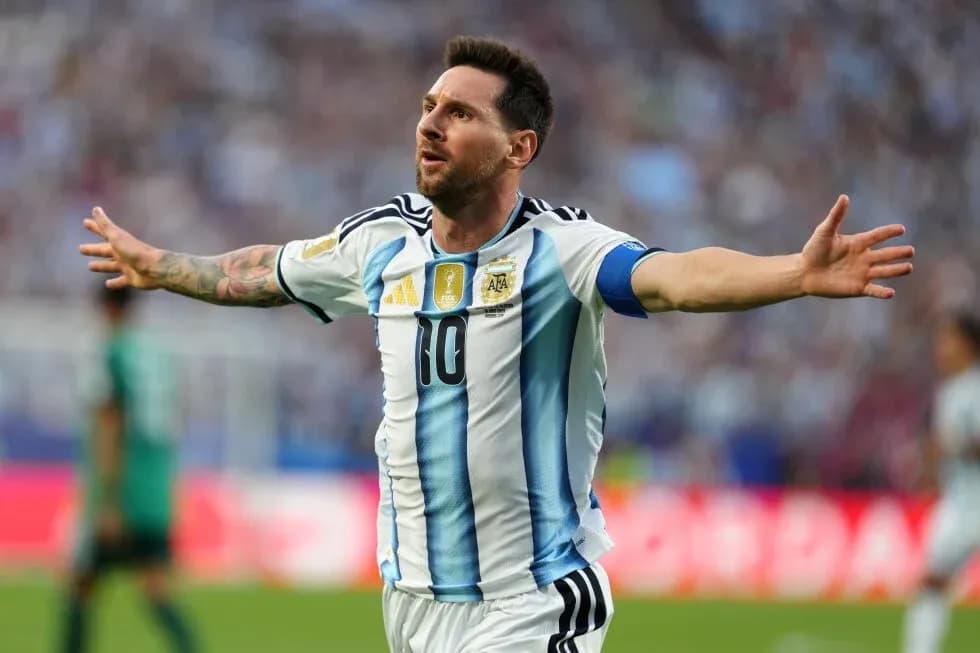
KANSAS CITY, Mo. — Lionel Messi stood alone for a moment inside a roaring NFL stadium, his white-and-blue shirt clinging to him, his face buried in the fabric as he wiped away tears.
Not after a trophy. Not after a farewell.
After a group-stage goal against Algeria.
He had just given Argentina the lead in its World Cup opener. The emotion hit him like a late tackle.
“I’ve had some tough days. It wasn’t related to football,” Messi said later, choosing not to go deeper. “I thank my teammates, the coaching staff and the delegation for helping me.”
Then he did what he has done for two decades on this stage.
He scored again. And again.
By the final whistle of Argentina’s 3–0 win over Les Fennecs, the questions about his hamstring, his age, and his ability to drag a nation toward back‑to‑back World Cups felt almost insulting. At 38, with his 39th birthday a week away, Messi had just produced a hat trick in a World Cup opener and pulled level with Miroslav Klose as the joint top scorer in men’s World Cup history.
Sixteen goals. Same as Klose. The record now feels like a formality.
“At a loss for words about Leo. What can I say?” Argentina coach Lionel Scaloni said. “He’s incredible.”
A night heavy with history
This was not just any treble. The timing carried its own poetry.
Exactly 20 years to the day since a teenage Messi stepped onto a World Cup pitch for the first time — and scored against Serbia and Montenegro — he was back on the biggest stage, still deciding games, still bending tournaments to his will. He is now only the second man to score in five editions of the World Cup.
This is his sixth. No one has played in more.
Messi’s first goal came early, the kind of move Argentina have rehearsed for years. Rodrigo De Paul, his Inter Miami teammate and long-time national-team lieutenant, slipped him a clever pass. Messi did the rest, finishing with the inevitability that has defined his career.
The second arrived early in the second half, born from pure predatory instinct. A rebound spilled loose in the box; Messi pounced before anyone in green could react.
The third was the cleanest. A crisp strike, hit with that familiar left-foot certainty, just moments before he walked off to a standing ovation from 69,045 fans, the vast majority draped in sky blue and white.
It was the 61st hat trick of his career, his 11th for Argentina and, remarkably, his first in a World Cup. It also extended his scoring streak at the tournament to five consecutive games.
“It makes me very happy to have lived through everything that came my way. What I’m living through now is the cherry on top,” Messi said. “I’m very happy and grateful for this wonderful group. I enjoy it so much.”
The engine still purrs
For weeks, the conversation around Messi had been dominated by a nagging hamstring issue at Inter Miami. He had been managed carefully, minutes trimmed, sprints measured. A World Cup is unforgiving; it does not wait for anyone’s rehab plan.
But in a sharp tuneup against Iceland last week, he looked loose, scoring a penalty in a 20‑minute cameo. In Kansas City, under the summer glare and the weight of expectation, he looked something else entirely: free.
“This is my sixth World Cup, and I still feel like I’m in good shape,” he said. “Fortunately, I’m doing well, and today we managed to win a tough match. It’s important to start the tournament with a victory in the first game, as that’s never easy in a World Cup.”
His appearance against Algeria was his 200th for Argentina, a number that feels almost absurd when you say it out loud. Only Cristiano Ronaldo (228 caps heading into Wednesday, with his 229th to come) and Kuwait’s Bader al-Mutawa (202) have played more times for their country.
Messi and Ronaldo stand alone in another category, too: the only men to have scored in five World Cups.
“Class is permanent,” Algeria coach Vladimir Petkovic said. “He’s fortunate to have the privilege that the entire Argentina team works for him, and supports him, and for a number of years now — decades — he’s done incredible things.”
Sharing the stage, stealing the night
Elsewhere, two of the sport’s other giants were busy making their own marks on the tournament.
Kylian Mbappé scored twice in France’s 3–1 win over Senegal, moving to 14 World Cup goals and into a tie for fourth on the all-time list. Erling Haaland also hit a brace, powering Norway past Iraq 4–1.
On most days, those numbers would dominate the headlines.
Not this one.
“Messi is a madman,” Haaland posted on Snapchat while Argentina were still dismantling Algeria.
The next generation is here, hungry and relentless. Yet the old master, hamstring doubts and all, remains the man everyone else is still chasing.
Kansas City turns Albiceleste
Argentina chose the Kansas City metro as one of four base camps for this World Cup. The American Midwest is more used to the crunch of pads and helmets, to Patrick Mahomes and the Chiefs, than to the rhythmic chants of “Argentina, Argentina” echoing through the streets.
Messi changed that in a hurry.
Since La Albiceleste arrived in the Heartland two weeks ago, the area has been swept up in a version of the same fever that has followed him from Barcelona to Paris to Miami. On match day, thousands of fans in No. 10 shirts poured into the Chiefs’ stadium on the city’s edge, turning it into a slice of Buenos Aires.
Downtown, at the Power & Light District watch party, the symbolism went from subtle to literal. A live goat was led onto the stage by former NFL quarterback and Fox broadcaster Jameis Winston, wearing an Argentina jersey. The crowd roared at the joke.
An hour later, Messi scored. The joke felt less like comedy and more like prophecy.
Every touch from him drew a swell of noise. Every sprint, every shimmy, every pause on the ball carried the sense that something might happen. By the time he walked off, applauding the stands as they roared his name, the argument over his status as the GOAT felt more settled than ever.
“It’s an advantage to have Leo because of how he handles the group and pushes it forward. Because of who he is,” De Paul said. “He doesn’t care about individual records. He prioritizes the group, and for us it’s incredible.”
The records will fall soon enough. Klose’s mark, the last great World Cup number left for Messi to claim, is within a single swing of that left foot.
The real question now is not whether he will stand alone at the top of the scoring charts.
It’s whether anyone can stop him from lifting the trophy again.