.svg&w=384&q=75 "Pitchgist logo")
Iran and New Zealand Share Points in World Cup 2026 Opener
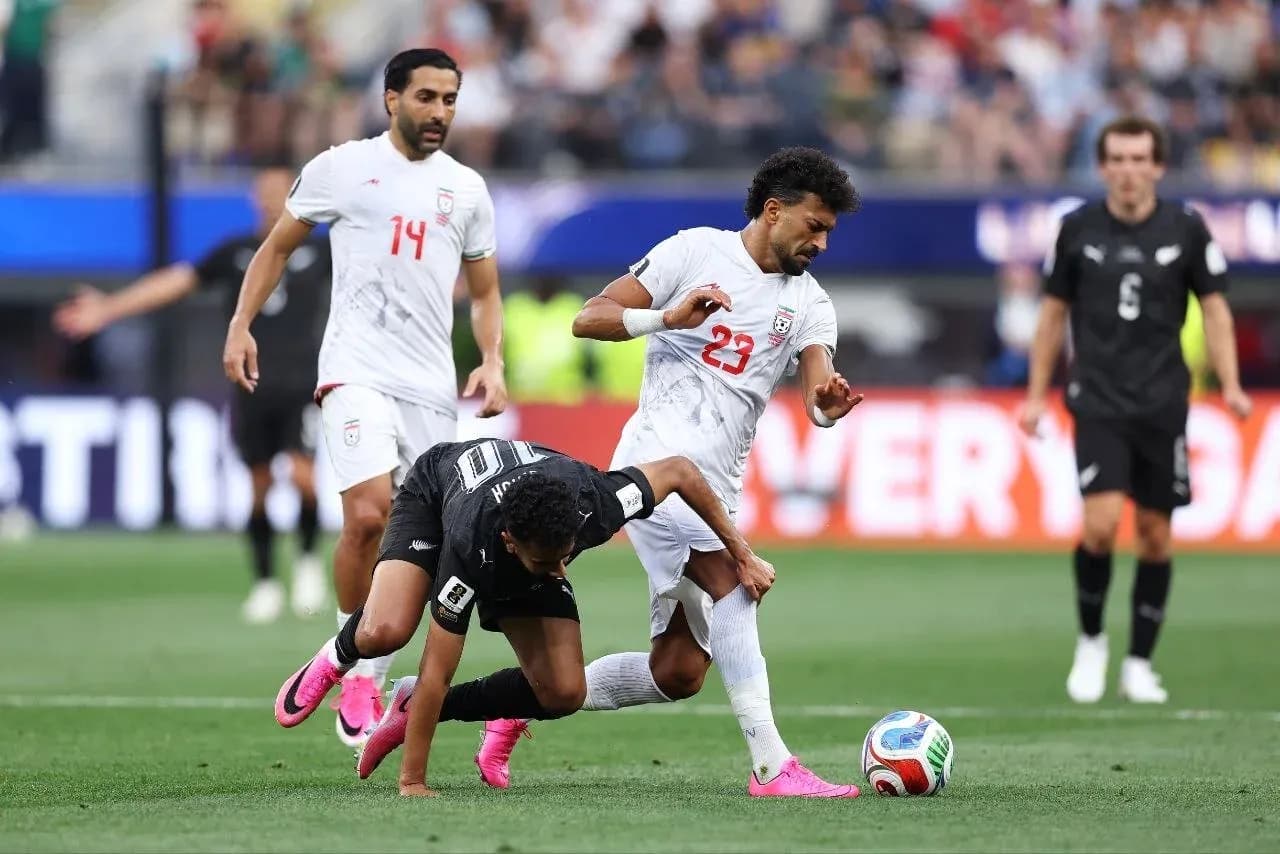
Under the California lights at SoFi Stadium, Iran and New Zealand opened their World Cup 2026 journeys with a 2-2 draw that felt less like a settling of accounts and more like the first chapter of an unfinished story. Following this result, Group G is delicately poised: New Zealand sit 1st and Iran 2nd, both on 1 point, both with a goal difference of 0 after scoring 2 and conceding 2 overall. The table says “even”; the football told a more nuanced tale.
Iran’s seasonal profile is already clear. At home they have played 1 match, drawing it, with 2 goals for and 2 against. Their averages at home – 2.0 goals scored and 2.0 conceded – point to a side that leans into chaos rather than control. New Zealand, on their travels, mirror that volatility almost perfectly: 1 away game, 1 draw, 2 goals scored, 2 conceded, and an away average of 2.0 for and 2.0 against. Two teams, one shared DNA of openness.
Tactical Setup
Tactically, Amir Ghalenoei’s Iran stepped into the World Cup with a classic 4-4-2 that looked anything but old-fashioned in execution. Alireza Beiranvand anchored the back, shielded by a defensive line that tilted its personality heavily to the right. Ramin Rezaeian at right-back was not merely a defender; he was Iran’s leading creator and one of the tournament’s standout performers so far. His 9.3 rating, 1 goal, 1 assist, 41 passes with 3 key balls, and 7 duels won out of 8 underline how much of Iran’s attacking identity flowed through him.
Ahead of him, a balanced midfield four – Mohammad Mohebi, Saman Ghoddos, Saeid Ezatolahi, and Aria Yousefi – tried to stitch together control and verticality. But the true spearhead was the front pair of Shahriar Moghanlou and Mehdi Taremi, a partnership built on contrast: Moghanlou’s physicality and penalty-box presence, Taremi’s movement between the lines and penalty-area craft. With Iran having failed to keep a clean sheet and having yet to fail to score this campaign, their 4-4-2 felt like a calculated gamble: “we’ll trade chances, and trust our forwards and full-backs to outgun you.”
On the opposite side, New Zealand lined up in a 4-2-3-1 that was far more ambitious than the stereotype of a conservative underdog. Max Crocombe stood in goal behind a back four of Tim Payne, Finn Surman, Michael Boxall, and Liberato Cacace. The double pivot of Joe Bell and Marko Stamenic gave the All Whites a calm, structured core, but it was the band of three behind Chris Wood that lit up the evening.
Elijah Just, Sarpreet Singh, and Callum McCowatt formed a fluid, intelligent trio, and Just in particular announced himself as one of the early stars of the tournament. In total this campaign, he has 2 goals from 2 shots on target, with 26 passes at 84% accuracy, 1 key pass, and 11 duels contested, winning 5. His 9 rating is not just a number; it reflects a wide midfielder who constantly asked questions between Iran’s full-backs and centre-backs, drifting into pockets that Iran’s 4-4-2 struggled to track.
If Just was New Zealand’s finisher, Chris Wood was the architect. Without scoring, he left a deep imprint on the game and the wider group narrative. With 2 assists overall, 4 key passes, and 16 total passes at 87% accuracy, Wood’s performance redefined the “target man” cliché. He dropped into midfield, pinned centre-backs, and released runners – especially Just – into the spaces Iran’s adventurous full-backs vacated. His duel numbers (8 contested, 2 won) show the physical battle he embraced, even if he didn’t dominate it statistically.
Disciplinary Aspects
The disciplinary thread of the match adds another layer to Iran’s tactical story. Their season card profile shows a sharp late-game spike: 100.00% of their yellow cards so far have arrived in the 76-90 minute window. Ehsan Hajsafi embodies that edge. Coming off the bench, he logged 25 minutes, completed 7 passes at 100% accuracy, engaged in 3 duels (winning 2), and collected a yellow card. Listed among both the top yellow and red card charts, he personifies Iran’s willingness to walk the disciplinary tightrope in pursuit of territorial control and defensive aggression late on.
New Zealand, by contrast, emerge from this first group match with a clean disciplinary slate. No yellow cards, no reds, no penalties conceded or taken. Their penalty record – 0 taken, 0 scored, 0 missed – underlines a side that has not yet needed set-piece lifelines; their attacking productivity has come from open play structure and combination work, not dead-ball chaos.
Match Dynamics
The “Hunter vs Shield” dynamic in this fixture was fascinatingly symmetrical. Iran’s main offensive “hunter” from deep, Rezaeian, attacked a New Zealand defence that had, on their travels, already conceded 2 goals in 1 match. At the same time, New Zealand’s most clinical figure, Just, targeted an Iran back line that had also allowed 2 goals at home. Neither “shield” truly held: both teams ended with 2 conceded, their goal differences locked at 0. For future group matches, that suggests both back fours are vulnerable when asked to defend wide overloads and second-phase crosses.
In the “Engine Room” duel, Ezatolahi and Ghoddos on one side, Bell and Stamenic on the other, traded control and disruption. Bell’s tidy passing and Stamenic’s positional discipline gave New Zealand a platform to play through pressure, while Ghoddos and Ezatolahi tried to tilt the pitch in Iran’s favour with line-breaking passes and second-ball wins. Neither side fully subdued the other; instead, the midfield became a corridor of constant transitions, perfectly in tune with both teams’ season-long patterns of scoring and conceding at identical rates.
Statistically, the prognosis for the rest of Group G is a story of balance on a knife-edge. Both teams sit on identical overall records: 1 match played, 0 wins, 1 draw, 0 losses, 2 goals for, 2 against, goal difference 0. Iran’s home average of 2.0 scored and 2.0 conceded, and New Zealand’s away average of 2.0 scored and 2.0 conceded, suggest that any future meeting with more clinical opponents could tilt heavily either way.
Without xG data, the eye test and available metrics point to this: Iran’s ceiling is tied to how much they can unleash Rezaeian and Taremi without exposing their centre-backs, while New Zealand’s path forward depends on sustaining Just’s end product and Wood’s creative influence. Both have shown they can trade punches at World Cup level; the question for the matches to come is who can finally tighten the shield without blunting the hunter.