.svg&w=384&q=75 "Pitchgist logo")
Saudi Arabia and Uruguay Share Points in Group H Clash
Saudi Arabia 1-1 Uruguay at Hard Rock Stadium leaves Group H finely poised, with both sides moving to 2 points from two draws and maintaining identical goal differences. Saudi Arabia stay second in the section on 2 points (GF 2, GA 2, GD 0), while Uruguay remain top also on 2 points (GF 2, GA 2, GD 0), the shared spoils reflecting a contest where Uruguay’s territorial and shooting dominance was checked by Saudi Arabia’s compact defensive structure and goalkeeping.
Match Report
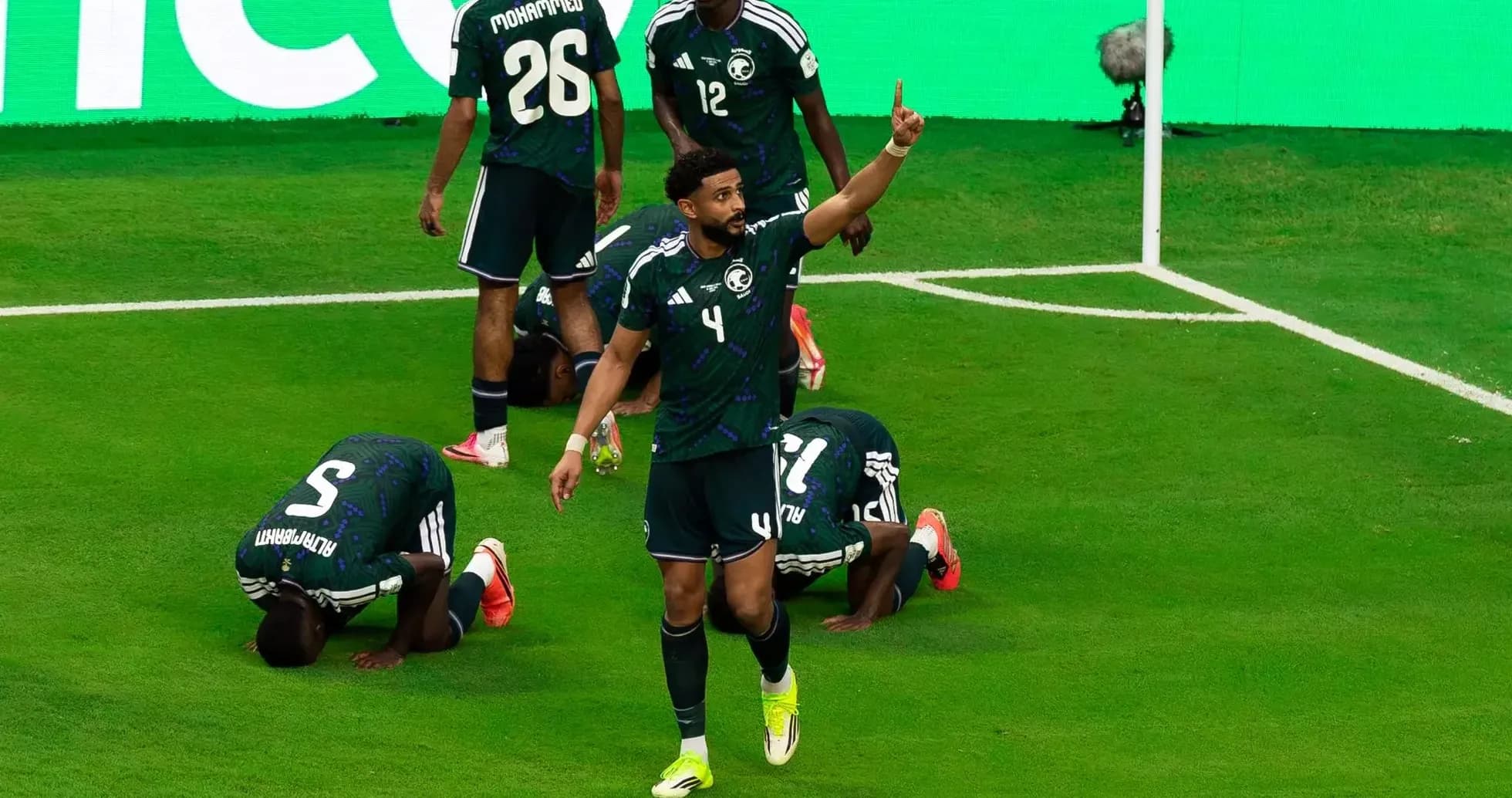
The match’s first major incision came on 41 minutes as Saudi Arabia struck against the run of play. A set-piece situation broke kindly in the box and 41' Saudi Arabia goal — A. Al Amri (unassisted) lashed home from close range, an unassisted finish that gave Saudi Arabia a 1-0 lead.
Just three minutes later the goalscorer went into the book: 44' A. Al Amri (Saudi Arabia) — yellow card (Roughing), punished for an overly aggressive challenge as Uruguay pushed to respond before the interval.
At half-time Marcelo Bielsa moved quickly to add more thrust on the flanks and energy at left-back. At the restart, 46' J. Sanabria replaced M. Vina (Uruguay), refreshing the left side, and simultaneously 46' A. Canobbio replaced D. Nunez (Uruguay) to inject more direct running and pressing in the front line.
Saudi Arabia’s first change came on 63 minutes, aiming to add legs in attack and help relieve pressure: 63' N. Al Dawsari replaced M. Al Juwayr (Saudi Arabia), a like-for-like adjustment in the forward line.
As Uruguay’s control of possession deepened, Bielsa sought more line-breaking passing and shooting threat from midfield. On 72 minutes, 72' N. de la Cruz replaced M. Ugarte (Uruguay), a shift from a pure holding profile to a more creative presence in the double pivot.
The pressure finally told on 80 minutes when Uruguay levelled. A sustained attack down the left saw a loose ball fall to Maximiliano Araújo, who drove inside and finished without assistance: 80' Uruguay goal — M. Araujo (unassisted), making it 1-1 and reflecting the visitors’ sustained attacking volume.
Immediately after scoring, Uruguay refreshed their wide options: 81' B. Rodriguez replaced M. Araujo (Uruguay), preserving intensity on the flank. In the same minute, Saudi Arabia adjusted on the right side of midfield, with fresh defensive support for their tiring full-back: 81' N. Boushal replaced M. Abu Al Shamat (Saudi Arabia).
Chasing a late winner, Uruguay altered their central attacking reference at 90 minutes: 90' R. Aguirre replaced F. Vinas (Uruguay), adding a more physical presence up front for the final moments.
Deep into stoppage time, Saudi Arabia made a triple defensive and structural reshuffle to lock in the point. At 90+3', 90+3' A. Lajami replaced S. Abdulhamid (Saudi Arabia) to reinforce the back line, 90+3' A. Al Hamdan replaced M. Al Harbi (Saudi Arabia) to add fresh legs on the flank, and 90+3' A. Hejji replaced F. Al Buraikan (Saudi Arabia) to provide additional work rate and defensive coverage from the front. No further goals or cards followed, and the match closed at 1-1.
Fixture Statistics & Tactical Audit
- xG: Saudi Arabia 0.99 vs 1.48 Uruguay
- Possession: Saudi Arabia 35% vs 65% Uruguay
- Shots on Target: Saudi Arabia 3 vs 9 Uruguay
- Goalkeeper Saves: Saudi Arabia 8 vs 2 Uruguay
- Blocked Shots: Saudi Arabia 1 vs 5 Uruguay
Uruguay were territorially dominant (65% possession, 24 total shots to 7) and consistently pinned Saudi Arabia in their own half, especially after the interval. Their higher xG (1.48 vs 0.99) and volume of shots on target (9 vs 3) suggest they generated the better and more frequent chances, forcing Mohammed Al-Owais into 8 saves. Saudi Arabia’s approach was compact and reactive, conceding space but protecting central zones, and relying on counters and set plays. Given the xG gap and shot profile, a draw was slightly generous to Saudi Arabia, but their defensive discipline and goalkeeping made the 1-1 scoreline defensible rather than purely fortunate.
Standings Update & Seasonal Impact
With this draw, Saudi Arabia move to 2 points in Group H (previously 1), with their goals for rising to 2 and goals against to 2, keeping their goal difference at 0. They remain in second place in a qualification position for the Round of 32, but still without a win, leaving little margin for error in their final group match.
Uruguay also advance to 2 points (up from 1), with goals for increasing to 2 and goals against to 2, likewise preserving a goal difference of 0. They stay top of Group H due to tiebreak criteria within the section, but the failure to convert clear superiority in both xG and chances into victory keeps the group open and applies pressure ahead of their last fixture.
Lineups & Personnel
Saudi Arabia Starting XI
- GK: Mohammed Al-Owais
- DF: Saud Abdulhamid, Abdulelah Al-Amri, Hassan Altambakti, Moteb Al-Harbi
- MF: Mohammed Abu Al-Shamat, Mohamed Kanno, Abdullah Al-Khaibari, Salem Al-Dawsari
- FW: Firas Al-Buraikan, Musab Al Juwayr
Uruguay Starting XI
- GK: Fernando Muslera
- DF: Guillermo Varela, Sebastián Cáceres, Mathías Olivera, Matías Viña
- MF: Manuel Ugarte, Rodrigo Bentancur, Federico Valverde, Federico Viñas, Maximiliano Araújo
- FW: Darwin Núñez
Post-Match Verdict
Saudi Arabia delivered a resilient, low-possession performance built on defensive concentration and goalkeeping. Despite being clearly outshot (7 total shots to 24) and spending long spells without the ball (35% possession), they restricted Uruguay’s xG to 1.48 and relied on Mohammed Al-Owais’s workload of 8 saves to preserve the point. Their attacking play was sporadic but opportunistic, with Al-Amri’s unassisted first-half strike capitalising on one of few meaningful entries into the final third (3 shots on target, xG 0.99).
Uruguay were dominant in territory and volume (65% possession, 9 shots on target, 10 corners), but lacked the clinical edge to turn control into a win. The post-interval substitutions increased their attacking variety, and Araújo’s equaliser reflected the pressure they built, yet their finishing underperformed relative to their shot quality. From a tactical standpoint, Uruguay’s structure and pressing worked, but their inability to convert superiority into a second goal leaves them vulnerable in a tight group, while Saudi Arabia can be satisfied with a point earned through compact organisation and high defensive output.