.svg&w=384&q=75 "Pitchgist logo")
William Saliba’s Injury: Impact on France and Arsenal’s Defense
William Saliba’s World Cup heartbreak has sent a jolt through both France’s camp and Arsenal’s pre-season plans.
The centre-back suffered a serious back injury during Les Bleus’ 2-0 semi-final defeat to Spain and is expected to miss four to five months, according to L’Equipe. For Mikel Arteta, that is not just bad news. It is a structural problem.
“My back is dead”
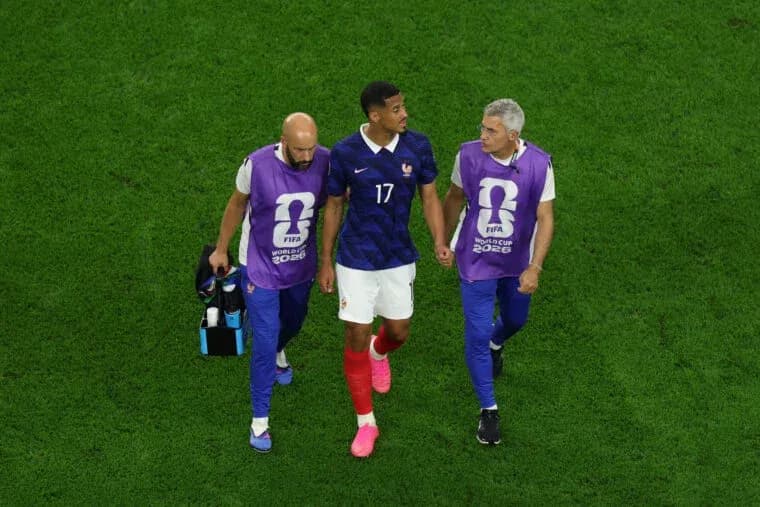
Saliba had been battling discomfort throughout the game before finally signalling that he could not continue. Moments before he was withdrawn in the 30th minute, he reportedly turned to France team-mate Dayot Upamecano and delivered a blunt verdict: “I can’t take it anymore, my back is dead.”
He walked off, but the damage was done — to France’s defensive stability and, potentially, to Arsenal’s early-season ambitions.
Saliba has a history of chronic back pain, and this latest setback deepens concerns about his long-term physical resilience. For club and country, he is not just another name on the team sheet. He is the anchor.
The contrast was brutal. Once Maxence Lacroix came on to replace him, France’s back line lost its authority. The cohesion went. The calm went. The sense of control went. It underlined, again, how Saliba operates on a different level.
Arsenal’s defensive pillar removed
At Arsenal, his importance is almost impossible to overstate. Since breaking into Arteta’s side, Saliba has grown into one of the Premier League’s standout defenders, central to both their domestic push and their Champions League campaigns.
He gives Arsenal height, pace, timing in the tackle, and a serenity in possession that allows the team to squeeze high and suffocate opponents. When he is missing, the entire defensive structure feels more fragile.
Now, with his recovery projected to run well into the new season, Arsenal face a familiar question: how do you replace the irreplaceable?
They may not need to look far.
Mosquera’s moment
Cristhian Mosquera is the name that will not go away inside the club. The young Spanish defender impressed last season, showing a blend of composure on the ball, positional awareness and physical presence that marks out a modern centre-back.
He does not need to be Saliba. Nobody does. But he has the raw materials to hold that space, to give Gabriel Magalhaes a reliable partner and to keep Arteta’s high line intact.
Mosquera reads the game early. He steps in front of strikers rather than chasing them. He looks comfortable under pressure, willing to receive the ball in tight areas and play through the lines instead of simply clearing his lines. Those are non-negotiable traits in this Arsenal side.
The risk is obvious. Replacing one of the league’s elite defenders with a relatively inexperienced player is a leap. Yet the opportunity is just as clear.
A fast track to the heart of the defence
Regular minutes alongside Gabriel could accelerate Mosquera’s development in a way no training session ever could. Partnerships at centre-back are built on repetition — the same movements, the same triggers, the same trust, over and over again.
If Arteta backs Mosquera now, he is not only patching over a crisis. He might be shaping the core of his defence for years to come.
The timing is harsh. Saliba’s injury leaves a void at precisely the moment Arsenal would have wanted continuity and momentum. But football rarely waits for the perfect moment.
For Saliba, the next few months will be about recovery, management and the hope that chronic pain does not define his peak years.
For Mosquera, they might be about something else entirely: the chance to walk into the biggest vacancy at Arsenal and prove he belongs there.