.svg&w=384&q=75 "Pitchgist logo")
Argentina's Dramatic Comeback Against England in World Cup Semifinal
They might need to check the foundations of Mercedes-Benz Stadium.
When Lautaro Martinez’s 92nd‑minute header ripped past Jordan Pickford, the noise from the Albiceleste end felt less like a celebration and more like a structural test. Blue-and-white shirts blurred into a single, shaking mass. England dropped to their knees. Argentina, somehow, are back in a World Cup final.
A 2-1 comeback in Atlanta, carved out of pure stubbornness and a refusal to die. Breathless. Nerve-shredding. Utterly Argentinian.
Messi at 39, still pulling the strings
At 39, Lionel Messi is not supposed to be dictating World Cup semifinals. He did it anyway.
For long spells, he floated on the fringes, dragged into traffic, surrounded by white shirts. Then, with the clock strangling Argentina’s hopes, he went to work. First came the slide-rule involvement in Enzo Fernandez’s thunderous 85th‑minute equaliser, a move that finally cracked open England’s packed defence. Then, in stoppage time, the killer touch: the assist for Lautaro, the header, the eruption.
Messi will own the headlines again. Yet this night was not just about his artistry. It was about a team choosing chaos over control and winning a war of attrition.
Scaloni tears up the script
All tournament, the defending champions have been accused of sleepwalking. Second gear. Heavy legs. Waiting for late magic to bail them out.
Not here. Lionel Scaloni walked into a semifinal against England and lit a fuse.
He turned the game into a street fight. Enzo Fernandez, Alexis Mac Allister, Leandro Paredes, Nicolas Tagliafico — they didn’t just compete; they collided. They pressed high, they fouled smart, they dragged England into a tempo they clearly didn’t want.
At the heart of it all, though, was a name that sent a shiver through English football before a ball was even kicked.
The Simeone surname returns
Seeing “Simeone” on the team sheet against England is enough to trigger a generation of memories. Saint‑Etienne, 1998. Diego Simeone on the turf, David Beckham sent off, and a rivalry deepened by controversy.
This time, it wasn’t the Atletico Madrid coach. It was his 23‑year‑old son, Giuliano, thrown into a World Cup semifinal as if it were a family inheritance.
His selection felt like a psychological jab before kickoff. Once the whistle blew, it became something much more serious.
Giuliano Simeone played as if someone had wound him too tight and snapped the key. Stationed on the right, doubling up with Nahuel Molina while his Atletico teammate Julian Alvarez led the line, he turned England’s left flank into a running track of suffering.
He chased everything. Not just the obvious passes, but the half-chances, the ricochets, the hopeless balls that most players jog after. Four ball recoveries tell part of the story. The rest was written in the way England’s defenders kept glancing over their shoulders, knowing he was coming again.
Three years ago, he suffered a horrific leg fracture. On this stage, in this kind of match, he looked like a man who had spent every day since waiting to fight this exact battle.
His relentless pressing acted as a shield, buying Messi the pockets of space he needs to do Messi things. Argentina fed off his energy. The crowd felt it. So did England.
England strike, then retreat
For all Argentina’s fury, it was England who drew first blood.
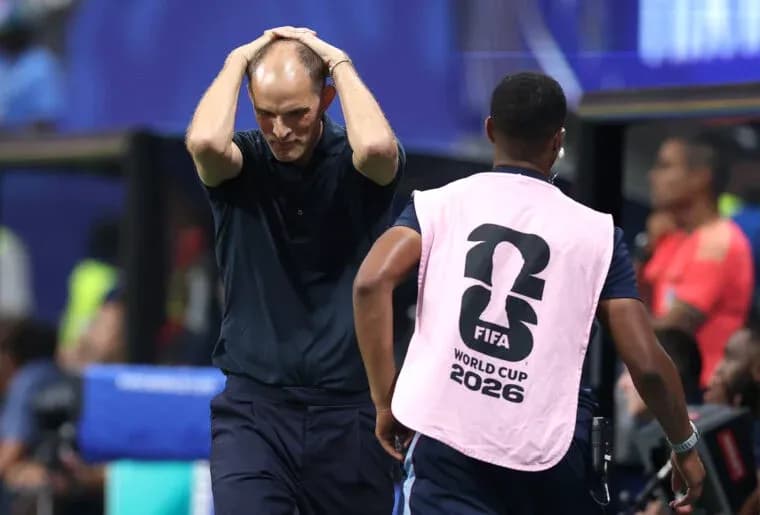
In the 55th minute, Anthony Gordon struck, and suddenly the Three Lions had the platform they craved. Thomas Tuchel’s side dropped deep, tightened the lines, and effectively parked the bus in front of Pickford.
Argentina faced the familiar nightmare: chasing a knockout game against an organised block, time slipping away. The chaos had done the heavy lifting, but now Scaloni needed clarity.
Giuliano Simeone had emptied the tank. In the 73rd minute, he trudged off, spent, with those four ball recoveries and a performance that had tilted the emotional balance of the night. In his place came a player who knows all about this kind of war.
De Paul steps into a familiar fight
Rodrigo De Paul, once Diego Simeone’s on-field lieutenant at Atletico and now Messi’s trusted ally at Inter Miami, stepped into the fray. The substitution carried its own poetry: the master of controlled aggression replacing the young Simeone who had taken his starting spot.
De Paul immediately mirrored the intensity he was brought on to sustain. Four ball recoveries of his own in a frantic cameo, plus a near-assist from a curling effort that almost broke England’s resistance before Enzo did.
The momentum turned. England’s clearances grew more desperate. Argentina’s attacks, once wild, became sharper, more targeted. The pressure finally told.
Fernandez’s equaliser arrived like a bolt. A rocket, low and true, that ripped through the tension and reset the entire night. From that moment, there was only one team truly playing to win.
Lautaro, pandemonium, and a rivalry renewed
Stoppage time in a World Cup semifinal is not a place for the faint-hearted. Argentina didn’t flinch.
Messi found the angle, Lautaro found the header, and the stadium exploded. Pickford beaten, England broken, Argentina surging towards another final. On the touchline, Scaloni’s staff scattered in all directions. In the stands, it was bedlam.
This was not a comeback built on patience or control. Argentina dragged themselves back from the brink by refusing to ease off for even a heartbeat. No waiting for fate. No coasting. Just a relentless insistence that the game would be played on their terms, right to the last second.
All of it came layered on top of a rivalry that runs far deeper than football. Argentina and England carry decades of political and historical tension, from the Falklands (Las Malvinas) conflict of 1982 to every meeting since that has felt heavier than a normal international.
Nights like this only add to that history.
Messi will, rightly, dominate the storylines. Another final. Another decisive contribution. Another chapter in a career that should have run out of superlatives years ago.
But in Atlanta, Giuliano Simeone carved out a space of his own. In a match dripping with symbolism, the 23‑year‑old ran until he had nothing left, turned a semifinal into a personal crusade, and walked off having etched his name into Argentine folklore.
The father haunted England in 1998. The son has just helped send them home from a World Cup semifinal. And Argentina, noisy, bruised, and unbreakable, march on to another shot at the trophy.