.svg&w=384&q=75 "Pitchgist logo")
Golden Boot Race Heats Up at the 2026 World Cup
“Sometimes in football, you have to score goals.”
Thierry Henry tossed that line out in 2008. Eighteen years on, with four games left at the 2026 World Cup, it feels less like a quip and more like the tournament’s central truth.
The trophy is the prize everyone came for. But in the shadows of the semi-finals, another race is running hot: the battle for the Golden Boot. And unlike the World Cup itself, this one rarely goes to the champion.
Not since Ronaldo’s eight-goal blitz in 2002 has the tournament’s top scorer finished the job with the trophy in his hands. Just Fontaine’s 13-goal avalanche in 1958 still stands untouched, a record from another era. Yet with 16 extra teams and 40 more matches than Qatar 2022, the net has never bulged this often on football’s biggest stage.
The numbers are wild. The storylines are better.
How the Golden Boot is decided
The rules are clear, and ruthless.
If players finish level on goals, the first tiebreak is assists — a system in place since 1992. It decided the 2010 award, when David Villa, Diego Forlan and Wesley Sneijder all matched Thomas Muller’s five goals. Muller walked away with the Golden Boot because he had three assists; the others managed just one each.
In 2006, another layer was added. If goals and assists are identical, the award goes to the player who needed fewer minutes to score them. Efficiency, not just volume, can crown a winner.
With that in mind, the current race looks like this.
1. Lionel Messi (Argentina) – 8 goals
(4 assists – 712 minutes)
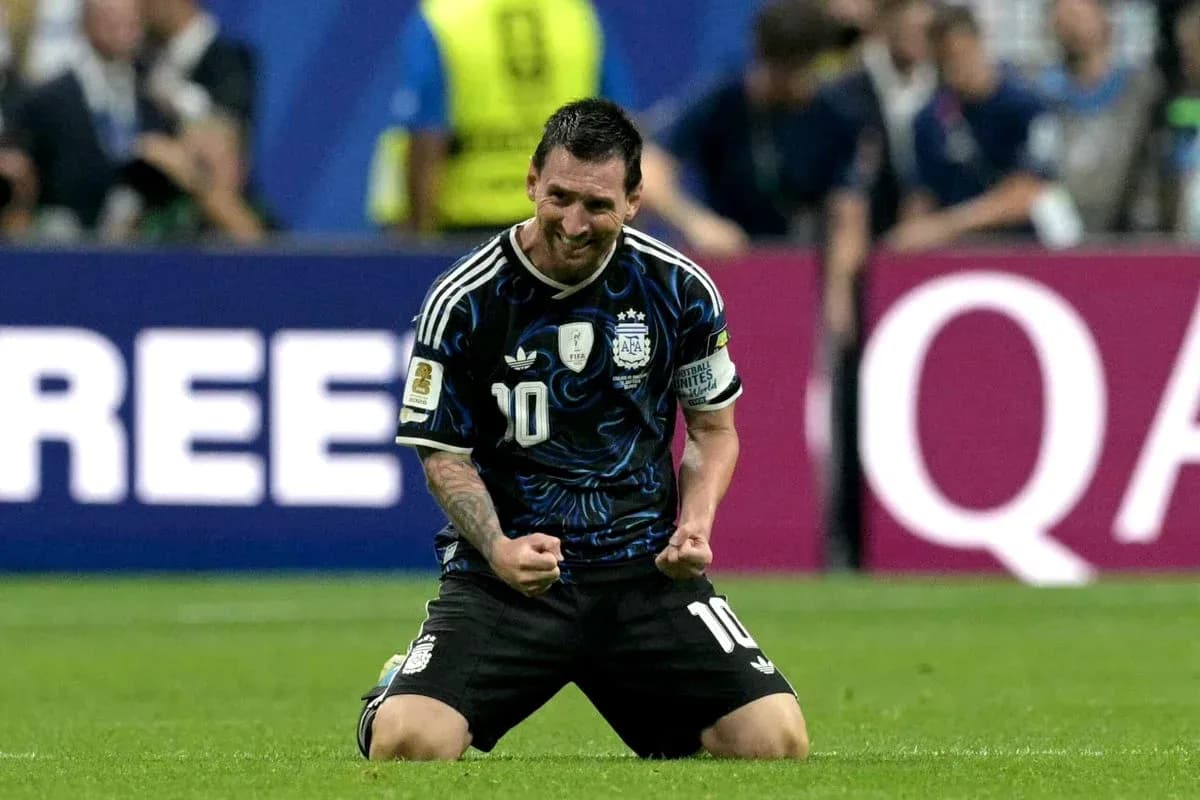
At 39, Lionel Messi arrived at what is almost certainly his final World Cup with every record within touching distance. He has spent the tournament collecting them.
His campaign began with frustration. An early strike against Algeria was ruled out for offside, a reminder that even Messi has to wait his turn. He didn’t wait long. Later in the first half, he stepped in from 20 yards and whipped the ball in with that familiar left-footed curl, a shot that seemed inevitable the moment he shaped to hit it.
The second came from pure opportunism. Luca Zidane spilled a low drive from Alexis Mac Allister, and Messi, alive to the chaos, pounced for a simple finish. The third was pure theatre: a trademark bending effort from the edge of the box, shaped like a pass to a phantom runner behind the goal, Zidane rooted and helpless.
He missed a penalty against Austria in game two, then responded as he so often has. A first-time finish from a Facundo Medina pass brought his fourth of the tournament and pushed him clear as the men’s World Cup all-time top scorer. His fifth arrived late in the same match, Messi reacting quickest after his own effort had been blocked to stab home from close range.
Rested from the start against Jordan, he still found time to add another. With 10 minutes left, he bent a free kick into the net, the kind of set piece everyone in the stadium knew was coming but still couldn’t stop.
Knockout football did not slow him. He struck again in the round of 32 against Cape Verde, then delivered an eighth in dramatic style with a late equaliser against Egypt in the following round.
Eight goals. Four assists. A deep run still alive. The numbers are monstrous, but the manner of them feels familiar: a career of decisive moments, condensed into one last World Cup charge.
2. Kylian Mbappe (France) – 8 goals
(3 assists – 666 minutes)
Kylian Mbappe arrived in North America as the defending Golden Boot holder and the face of France’s new era. He has played like a man intent on keeping the crown.
He opened with a brace in a 3-1 win over Senegal, blending his usual acceleration with ruthless finishing. Then came Iraq: another opener, rifled in from range, before a lengthy weather delay in Philadelphia broke the rhythm of the night. It didn’t break his. When play resumed, Mbappe struck again to double France’s lead.
The knockout rounds brought more of the same. Two fine goals against Sweden in the round of 32, one from the penalty spot against Paraguay, another against Morocco in the quarter-final. Each strike felt like a confirmation: if France were going to go all the way, it would be on his terms.
Spain had other ideas. In the semi-final, they shut him out in a 2-0 win, snapping France’s run and freezing Mbappe on eight goals. His tournament will end in the third-place play-off on Saturday.
He sits level with Messi on goals, one behind on assists, but ahead on minutes played. Every touch in that final outing could tilt the race.
3. Erling Haaland (Norway) – 7 goals*
(0 assists – 537 minutes)
Erling Haaland’s first World Cup felt like an inevitability finally realised. Once he arrived, he did exactly what everyone expected: he scored.
Two goals against Iraq in Norway’s opener set the tone. The first was quintessential Haaland, sliding in inside the six-yard box to meet a low David Moller Wolfe cross. The second came from relentless pressing, the Manchester City striker closing down the goalkeeper and forcing the ball over the line.
Against Senegal, he added his third with a calm second-half finish, then his fourth with a sharp, volleyed effort. The power was there, but so was the timing.
His fifth may prove to be the most important of his international career so far, a late winner from close range against Ivory Coast in the round of 32 that dragged Norway into the next phase.
Then came Brazil. Norway stunned the five-time champions, and Haaland scored twice more, his sixth and seventh of the tournament. The second was a surprise in its execution, but not its outcome: Haaland, again, on the scoresheet.
Norway are out, which freezes his tally at seven. No assists. Fewer minutes than both Messi and Mbappe. If the leaders falter in the final stretch, his efficiency could still loom large over the final calculation.
4. Jude Bellingham (England) – 6 goals
(1 assist – 574 minutes)
Jude Bellingham has turned this World Cup into a statement of authority.
From midfield, he scored in both of England’s group-stage wins — a 4-2 victory over Croatia and a 2-0 win against Panama — driving into the box with the timing of a seasoned No 10 and the conviction of a centre-forward.
The knockouts elevated him again. Two goals in the last-32 win over Mexico, then another brace in the quarter-final against Norway. Each run into the area felt like a warning; each finish, a reminder that he is not content to dictate games from distance.
He stands on six goals, one assist, and edges ahead of his captain Harry Kane by virtue of minutes played: 574 to 627. If England keep advancing and the chances keep falling to him, his surge up the rankings may not be done.
5. Harry Kane (England) – 6 goals
(1 assist – 627 minutes)
Harry Kane knows this territory. The 2018 Golden Boot winner has quietly built another formidable tally.
He opened with a brace in the 4-2 win over Croatia, finishing with the icy precision that has defined his career. The next match, a 0-0 draw with Ghana, was a grind for England and for their centre-forward.
He corrected course against Panama, scoring England’s second in the final group game. Then came the knockouts, where Kane’s influence sharpened.
Against DR Congo in the round of 32, he scored twice in the second half, dragging England through with the kind of composure that has made him his country’s record scorer. He followed that with a penalty against Mexico in the next round, taking his total to six.
Same goals as Bellingham. Same assists. Slightly more minutes. The margins, as ever at this stage, are thin.
=6. Ousmane Dembele (France) – 5 goals
(2 assists – 492 minutes)
For years, Ousmane Dembele’s international story was one of missed opportunities. Nineteen major tournament appearances without a goal told its own tale.
That changed in an instant.
He scored France’s third in the 3-0 win over Iraq, a neat finish that seemed to lift a weight off his shoulders. Then he exploded. Against Norway, the PSG winger produced a first-half hat-trick, darting into spaces, finishing with confidence, and turning a long-running question mark into an exclamation point.
His fifth arrived in the quarter-final against Morocco, a reminder that Mbappe is not France’s only attacking weapon. Five goals, two assists, under 500 minutes on the pitch. For a player who once struggled to find rhythm on this stage, it has been a startling transformation.
=6. Mikel Oyarzabal (Spain) – 5 goals
(1 assist – 519 minutes*)
Spain’s opening draw with Cape Verde felt flat, a familiar story of possession without penetration. Mikel Oyarzabal helped rip up that script.
In the 4-0 win over Saudi Arabia, the Real Sociedad forward scored twice, finding the angles and timing his runs to perfection. He repeated the trick in the round-of-32, another brace in a 3-0 win over Austria as Spain found their cutting edge.
His most important contribution, though, came in the semi-final against France. From the spot, he opened the scoring, a calm penalty in a match heavy with tension and history.
That strike took him to five for the tournament. Like Haaland, his work is done; Spain’s elimination fixes his numbers in place.
=8. Vinicius Junior (Brazil) – 4 goals*
(1 assist – 505 minutes)
Vinicius Junior arrived as Brazil’s creative spark and left as one of their most reliable finishers.
He spared Brazil’s blushes in their opener against Morocco, smashing in an emphatic equaliser after the underdogs had taken a shock lead. Against Haiti, with Brazil already cruising thanks to two Matheus Cunha goals, he added his second of the tournament, a flourish in a dominant display.
The third came against Scotland, capitalising on a mistake from Scott McKenna to slide the ball past Angus Gunn and open the scoring. His fourth was a classic winger’s goal: a simple back-post header from a teasing Bruno Guimaraes cross.
Four goals, one assist, and flashes of the ruthlessness Brazil will expect him to carry into future tournaments.
=8. Ismaila Sarr (Senegal) – 4 goals*
(1 assist – 419 minutes)
Ismaila Sarr has been one of the World Cup’s most direct threats.
The Crystal Palace winger struck twice in Senegal’s second Group I game against Norway. The first was improvised brilliance, a clipped finish while tumbling to the turf. The second was more orthodox but just as sharp in a 3-2 defeat that showcased both his danger and his side’s vulnerability.
He added a third in Senegal’s final group match against Iraq, then a fourth against Belgium in the round of 32. Four goals, one assist, and a reminder that his pace and unpredictability travel well to the biggest stages.
=8. Julian Quinones (Mexico) – 4 goals*
(1 assist – 440 minutes)
Julian Quinones struck the first goal of this World Cup and never looked overawed.
He opened Mexico’s campaign by scoring in a 2-0 win over South Africa, setting the tone with a composed finish. He struck again in a 3-0 victory over Czech Republic, then once more in the last-32 clash with Ecuador, again providing the opener.
His fourth came against England in the knockout rounds, another sharp reminder of his instincts in front of goal. For those who watched him top the Saudi Pro League scoring charts with 33 goals in 31 games, this World Cup output will not have come as a shock.
The chasing pack
Behind them, 11 players sit on three goals, all hoping for one last surge or already resigned to what might have been. For those whose teams are out, the asterisk beside their names is a harsh mark: no more minutes, no more chances.
The Golden Boot itself has evolved. Officially introduced as the Golden Shoe in 1982, it formalised an honour that had been recognised, if unofficially, since the 1930s. Mbappe’s eight goals in 2022 matched Ronaldo’s 2002 haul, but like so many modern top scorers, he watched someone else lift the trophy. Four years earlier, Kane’s six were enough to win it as England fell in the semi-finals to Croatia.
Now the stage narrows again. Messi and Mbappe are level on eight, Haaland lurks on seven, Bellingham and Kane are both within striking distance. Some have one game left, some two. Some are finished.
The goals that matter most are usually the ones that decide titles. But in the coming days, every shot, every penalty, every deflection will also carry another weight.
Who scores enough — and fast enough — to leave this World Cup not just as a champion, but as its most ruthless finisher?