.svg&w=384&q=75 "Pitchgist logo")
Qatar and Switzerland Draw 1-1 in World Cup 2026 Opener
Under the cool evening light of Levi’s Stadium, Qatar and Switzerland opened their World Cup 2026 journeys with a 1–1 draw that said as much about their tactical identities as it did about the scoreline. Following this result, both sides sit level on 1 point in Group B, Switzerland ranked 1st and Qatar 3rd in the group snapshot, each with a goal difference of 0 after 1 match played (1 goal for, 1 against overall).
I. The Big Picture – Two 4-3-3s, two different ideas
Both coaches leaned into a 4-3-3, but the systems could hardly have felt more different in texture.
Julen Lopetegui’s Qatar, playing at “home” in Santa Clara, used their 4-3-3 as a compact, almost continental structure. Mahmud Abunada in goal sat behind a back four of H. Al Amin, Boualem Khoukhi, Pedro Miguel and A. Al Oui, with Jassem Gaber, A. O. Madibo and I. Laye forming a narrow midfield triangle. Ahead of them, Edmilson Junior and Y. Abdurisag flanked A. Afif in a front line designed less for sheer volume of attacks and more for quick, decisive surges.
Murat Yakin mirrored the shape on paper but not in spirit. Switzerland’s back four of Ricardo Rodriguez, Manuel Akanji, Nico Elvedi and D. Zakaria, shielded by a midfield of Remo Freuler, Granit Xhaka and M. Aebischer, provided the platform for a dynamic front three: Ruben Vargas wide, Dan Ndoye stretching the right, and Breel Embolo as the central spearhead. On their travels this campaign, Switzerland have played 1 match, drawn it, scored 1 and conceded 1, with an away goals-for average of 1.0 and away goals-against average of 1.0 – a neat statistical reflection of this finely balanced opener.
Qatar’s numbers at home tell their own story. At home they have played 1, drawn 1, scored 1 and conceded 1, with a home goals-for average of 1.0 and a home goals-against average of 1.0. For a side often stereotyped as reactive, there was a quiet confidence in how they matched Switzerland’s structure.
II. Tactical Voids and the Discipline Line
There were no listed absentees, so both managers entered with full decks. That made selection choices – and in-game discipline – even more revealing.
Qatar’s statistical profile heading into this game already hinted at an edge in the tackle. They finished with 0 clean sheets overall and 0 matches failed to score, but their card map is telling: 100.00% of their yellow cards so far have come between 16–30 minutes. That early spike was embodied by Jassem Gaber and Mahmud Abunada. Gaber, who logged 60 minutes, took a yellow and committed 2 fouls; Abunada also saw yellow and committed 1 foul, his aggression culminating in conceding the penalty that Switzerland converted.
On the Swiss side, the disciplinary line was straighter but still visible. Denis Zakaria, nominally at right-back, took Switzerland’s only yellow card, also reflective of their card distribution: 100.00% of their yellows have arrived in the 31–45 minute window. His 3 tackles and 2 interceptions underlined a defender operating on the edge of risk to keep Qatar’s wide players in check.
III. Key Matchups – Hunter vs Shield, Engine Room vs Engine Room
Hunter vs Shield
This fixture’s clearest “Hunter vs Shield” duel came between Breel Embolo and the Qatar defensive unit anchored by Boualem Khoukhi.
Embolo, already on the top scorers list with 1 goal in 1 appearance, was clinical. He needed just 2 shots (1 on target) to find the net, and he did it from the spot – Switzerland’s penalty statistics now show 1 penalty total, 1 scored, 0 missed, a perfect 100.00% conversion rate so far. Beyond the goal, his 5 key passes from only 8 total passes hint at a forward who doesn’t just finish moves but also initiates them, dropping off to combine with Vargas and Ndoye.
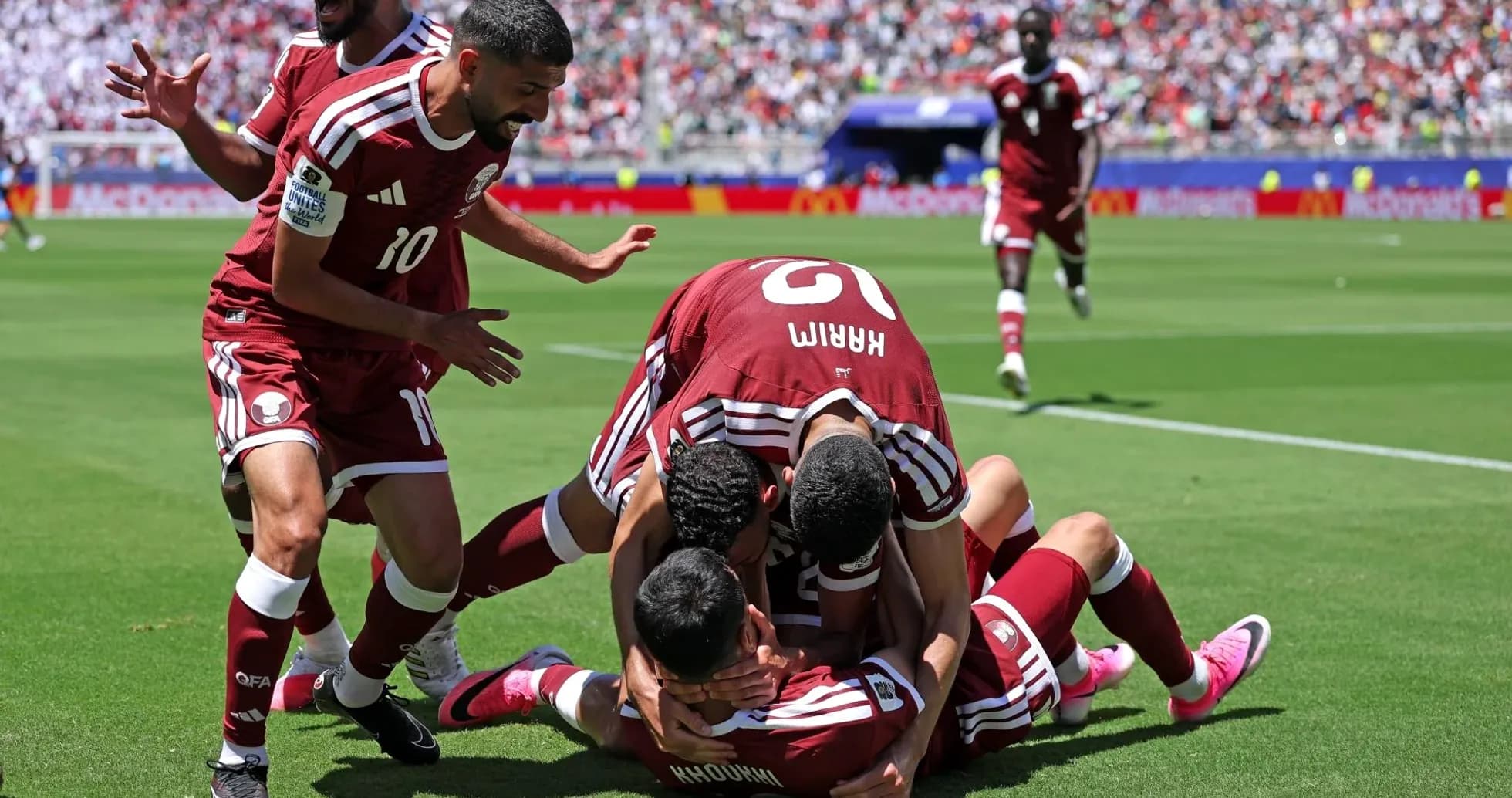
Opposite him, Khoukhi was the shield and, remarkably, also Qatar’s scorer. His World Cup line is quietly outstanding: 1 appearance, 90 minutes, 1 goal from 1 shot on target, 34 passes at 70% accuracy, and a defensive contribution of 1 tackle, 1 blocked shot and 2 interceptions. In a single game he has become both Qatar’s leading scorer and their defensive reference point. Every time Embolo looked to spin into the inside-right channel, he met Khoukhi’s timing and positioning.
Engine Room vs Engine Room
If Embolo vs Khoukhi was the headline, the subtext was written in midfield.
For Qatar, Gaber’s 8 duels (3 won), 1 tackle and 2 blocked shots painted him as the disruptor in front of the back four. He didn’t set the passing tempo – just 5 passes – but he set the emotional one, flying into challenges until his yellow card and eventual withdrawal shifted the tone of the Qatari press.
Switzerland’s response came through Granit Xhaka and Zakaria. Xhaka’s presence, even without explicit stat lines here, was the metronome that allowed Zakaria to step out aggressively. Zakaria’s 56 passes at a remarkable 96% accuracy, plus 10 duels (6 won), showed a defender-midfielder hybrid who could both build and break. He repeatedly engaged Afif and Edmilson Junior in wide zones, cutting off Qatar’s attempts to spring early balls into the channels.
IV. Statistical Prognosis – A Draw that Feels Like a Blueprint
With both teams having played 1 match in total, drawn 1, scored 1 and conceded 1, their overall Expected Goals narratives – though not numerically provided – can be inferred. Switzerland, with a penalty goal and a front three that generated shots and dribbles (Embolo completing 1 dribble from 1 attempt), likely shaded the xG tally through higher-quality central chances. Qatar, by contrast, appear to have maximised a smaller volume of opportunities, leaning on set pieces and transitional moments where Afif and Edmilson Junior could isolate defenders.
Defensively, neither side has yet found a clean sheet overall, but both have demonstrated resilience. Abunada’s 5 saves in his 90 minutes suggest Switzerland forced him into action, yet he conceded only once, from the spot. Switzerland’s back line, marshalled by Akanji and Elvedi with Zakaria’s aggressive support, restricted Qatar to just the single breakthrough.
Following this result, the tactical prognosis is of two teams whose 4-3-3s are stable platforms rather than finished products. Qatar’s reliance on Khoukhi at both ends is unsustainable but encouraging: if Afif and Edmilson Junior can add end product, their home average of 1.0 goals for could climb. Switzerland, with a perfect penalty record and Embolo already on the scoresheet, look like a side whose away average of 1.0 goals for will rise as patterns between Xhaka, Vargas and Ndoye mature.
In a World Cup group where margins are thin, this 1–1 felt less like a stalemate and more like an opening chapter. The hunter has scored, the shield has answered, and both midfields have sketched out how they intend to control the story from here.