.svg&w=384&q=75 "Pitchgist logo")
Mexico's Tactical Mastery in 2-0 Victory Over South Africa
Mexico’s 2-0 win over South Africa at Estadio Azteca was built on structural control and superior use of the ball rather than sheer volume of chances. Javier Aguirre’s side, in a 4-1-4-1, translated 61% possession and 16 total shots into a measured, territorial dominance that slowly squeezed Hugo Broos’ 5-3-2 into a deep, reactive block. South Africa’s plan hinged on compactness and counter-attacks through Lyle Foster and Iqraam Rayners, but a low shot volume (3 attempts, 1 inside the box) and two red cards left them defending survival more than contesting the result.
Opening Phase
The opening phase set the tactical tone. Mexico’s single pivot Erik Lira anchored the build-up, dropping close to the centre-backs CésAR Montes and Johan Vásquez to create a 3v2 against South Africa’s front line. Full-backs Israel Reyes and Jesús Gallardo pushed high and wide, pinning Khuliso Mudau and Aubrey Modiba, while the advanced midfield line of Roberto Alvarado, Brian Gutiérrez and Álvaro Fidalgo operated between South Africa’s midfield and defence. Julián Quiñones’ early goal on 9 minutes, assisted by Lira, was a direct product of this structure: Mexico circulating patiently, then breaking the last line once the block had been stretched.
South Africa’s Defensive Structure
South Africa’s 5-3-2 was conservative from the outset. The back five stayed narrow, with Jayden Adams and Siphephelo Sithole tucking in beside Teboho Mokoena to clog the central lane. The idea was to show Mexico outside, then defend crosses. In practice, however, Mexico’s wide overloads and rotations dragged the wing-backs into repeated 1v2s, and the visitors struggled to convert regains into progressive passes; they completed 272 accurate passes at 81%, but mostly in their own half and with little verticality, reflected in an xG of just 0.07.
Mexico’s Possession Profile
Mexico’s possession profile underlined their control: 520 total passes, 467 accurate (90%), with a clear emphasis on patient circulation rather than constant direct penetration. The 16 shots included 9 from inside the box and 5 blocked, illustrating how often they managed to play through or around the first defensive line and force South Africa’s centre-backs into last-ditch interventions. Yet the xG of 1.41 shows the chances were steady rather than spectacular; this was a game of positional dominance, not relentless high-quality chances.
Second Half Tactical Changes
The second half’s key tactical hinge was discipline. At 49 minutes, Siphephelo Sithole’s red card for “Professional foul last man” fundamentally altered South Africa’s structure. Reduced to 10, they had to compress even deeper, effectively morphing into a 5-3-1 with one forward sacrificed in transition. Broos responded with a double substitution: Thalente Mbatha (IN) came on for Lyle Foster (OUT) at 56', and Themba Zwane (IN) came on for Jayden Adams (OUT) at 61'. The idea was to stabilise midfield and retain some technical outlet through Zwane, but the loss of a forward further blunted any counter-attacking threat.
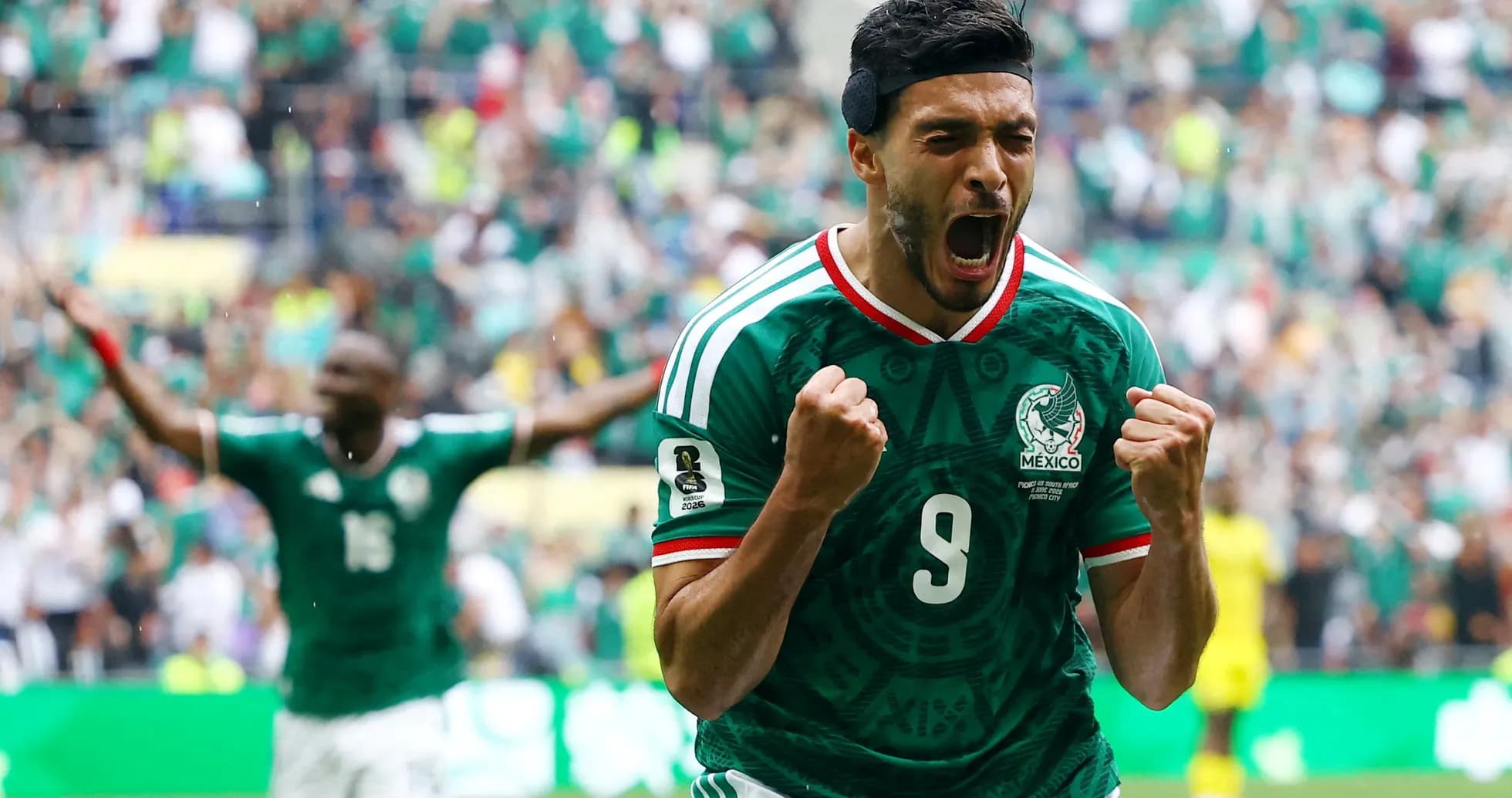
Aguirre reacted intelligently to the new game state. On 66 minutes, Gilberto Mora (IN) came on for Álvaro Fidalgo (OUT), and Luis Chávez (IN) came on for Brian Gutiérrez (OUT), refreshing the interiors without altering the 4-1-4-1 structure. Within a minute, the second goal arrived: Raúl Jiménez finished from a Roberto Alvarado assist at 67', effectively sealing the contest. From there, Mexico managed the game, prioritising control over risk. Jiménez (OUT) was replaced by Armando González (IN) at 76', and Edson Álvarez (IN) came on for Erik Lira (OUT) in the same minute, adding fresh legs and defensive security in midfield. Alexis Vega (IN) then replaced Julián Quiñones (OUT) at 79', giving Mexico a direct runner to threaten a tiring, undermanned back line.
South Africa’s Late Reshaping
South Africa’s late reshaping was forced rather than proactive. Oswin Appollis (IN) came on for Aubrey Modiba (OUT) at 77', and Evidence Makgopa (IN) replaced Iqraam Rayners (OUT) in the same minute, but any attacking intent was undermined by further disciplinary collapse. A VAR “Card upgrade” review on Themba Zwane at 82' was followed by his red card for “Violent conduct” at 84', leaving South Africa with nine men. By then, their 5-3-2 had effectively become a 5-2-1, and the remaining minutes were about damage limitation.
Goalkeeper Performances
Individually, the goalkeepers were lightly tested but told different stories. Raúl Rangel (Mexico) faced only 2 shots on goal and made 2 saves, aligning with South Africa’s minimal attacking output. Mexico’s defensive line, despite CésAR Montes’ late red card for “Professional foul last man” at 90+2', largely protected Rangel by restricting South Africa to just 3 total shots and 1 effort inside the area. Ronwen Williams (South Africa), meanwhile, also recorded 2 saves despite facing 4 shots on goal, a reflection of Mexico’s finishing efficiency rather than goalkeeping error. The goals prevented metric at -0.47 for South Africa’s goalkeeper unit indicates they conceded slightly more than the modelled expectation from the chances faced.
Disciplinary Context
Discipline played a decisive contextual role. Mexico committed 12 fouls to South Africa’s 11, but the visitors’ infractions were far more costly: two red cards (Sithole’s “Professional foul last man” and Zwane’s “Violent conduct”) compared with one for Mexico (Montes, also “Professional foul last man”). Yellow cards to Teboho Mokoena and Nkosinathi Sibisi, both for “Foul”, further underlined South Africa’s reactive, last-ditch defending. Brian Gutiérrez’s caution for “Foul” was Mexico’s only booking before Montes’ dismissal, and came in a phase where they were pressing aggressively to sustain territorial pressure.
Statistical Verdict
Statistically, the verdict is clear. Mexico’s 2-0 win aligns closely with the underlying numbers: a 1.41 xG versus South Africa’s 0.07, 16 shots to 3, and 61% possession to 39%. The blocked shot count (5-0) illustrates how often Mexico forced South Africa into emergency defending inside their own box. Passing efficiency — 520 passes, 467 accurate (90%) for Mexico against 335 passes, 272 accurate (81%) for South Africa — reflects a superior technical base and more stable build-up. Even with both teams’ goalkeepers showing a goals prevented value of -0.47, the structural difference in chance creation meant Mexico could manage the game from a position of comfort once the early lead was established, and South Africa’s disciplinary collapse only widened the tactical gulf.