.svg&w=384&q=75 "Pitchgist logo")
Manchester United Edges Nottingham Forest in Thrilling 3-2 Clash
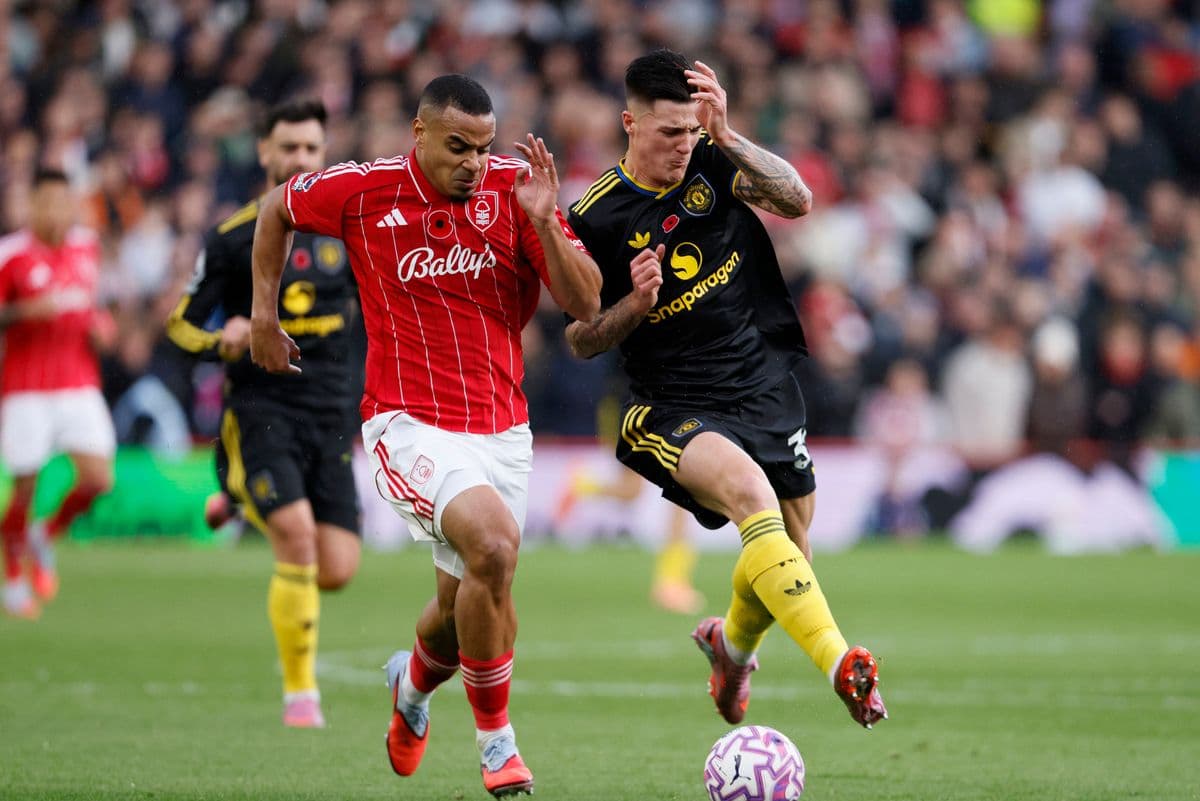
Old Trafford felt less like a theatre and more like a proving ground as Manchester United edged a 3-2 win over Nottingham Forest, a result that crystallised the seasonal identities of both sides heading into the final week of the Premier League campaign.
The Big Picture – A comeback that fits the season’s script
Following this result, United sit 3rd on 68 points, their campaign neatly captured by a goal difference of 16 (66 scored, 50 conceded). At home they have been expansive and imperfect: 39 goals for and 24 against across 19 matches, an average of 2.1 goals scored and 1.3 conceded at Old Trafford. This 3-2 encapsulated that balance of attacking flair and defensive vulnerability.
Forest, by contrast, remain 16th with 43 points and a goal difference of -3, the product of 47 goals for and 50 against overall. On their travels they have been braver than their league position suggests: 7 away wins, 3 draws and 9 defeats, scoring 28 and conceding 28, an away average of 1.5 goals both for and against. Losing by a single goal at Old Trafford is consistent with a team that can hurt opponents but rarely controls them.
The formations told their own story. Michael Carrick doubled down on United’s now-familiar 4-2-3-1, the shape they have used in 19 league matches this season, while Vitor Pereira rolled out a 4-4-2 that has been less common for Forest but made sense as an away puncher’s stance.
Tactical Voids – Absences that shaped the contest
Both managers were forced to redraw their plans before a ball was kicked.
For United, the absence of B. Šeško and M. de Ligt removed a vertical spearhead and a defensive organiser. Šeško’s 11 league goals and aerial presence usually stretch back lines and create space between the lines for Bruno Fernandes and Matheus Cunha. Without him, Carrick leaned into mobility: Bryan Mbeumo as the nominal 9, Cunha drifting from the left half-space, and Amad Diallo offering incision from the right. De Ligt’s calm distribution and penalty-box dominance were missed, pushing Harry Maguire and Lisandro Martínez into a partnership that had to defend higher and more aggressively.
Forest’s voids were even more structural. O. Aina, W. Boly, Murillo and N. Savona all missing stripped Pereira of both depth and variety in his back line. The absence of C. Hudson-Odoi removed a direct outlet on the flank, leaving Anthony Elanga off the teamsheet entirely and placing more creative burden on Morgan Gibbs-White and the wide midfielders. With defensive leaders like Boly and Murillo out, Forest’s back four – Neco Williams, Nikola Milenkovic, Morato and Luca Netz – had to play without a natural on-field organiser.
Disciplinary trends framed the risk. United’s season-long card profile shows yellow peaks between 46-60 minutes and 76-90 minutes (both 20.63%), with a notable red-card spike between 46-60 minutes at 66.67% of their reds. Casemiro, on 10 yellow cards and 1 yellow-red this season, embodies that edge: a destroyer whose timing of challenges can tilt a match. Forest, meanwhile, collect 25.42% of their yellows between 46-60 minutes and 22.03% between 61-75 minutes, with a red-card incident in the 31-45 range highlighted by Neco Williams’ season profile (1 red). This created a second-half minefield where aggression and fatigue were always likely to collide.
Key Matchups – Hunter vs Shield, Engine Room battles
Hunter vs Shield: United’s multi-pronged attack vs Forest’s makeshift defence
United’s attacking “committee” has been the story of their season. Bruno Fernandes, with 8 goals and a league-leading 20 assists, is the creative axis. Cunha and Mbeumo both sit on 10 league goals, while Casemiro adds 9 from midfield. Heading into this game, United’s overall scoring average of 1.8 goals per match, powered by 2.1 at home, meant Forest’s back four were always likely to be overworked.
Forest’s shield on their travels has been inconsistent: 28 goals conceded away at an average of 1.5 per game, but with 5 away clean sheets hinting at the capacity to shut games down when their block is intact. Without Boly and Murillo, though, the central pairing of Milenkovic and Morato had to cope with Cunha’s drifting, Mbeumo’s diagonal runs and Fernandes’ late arrivals from zone 14. Williams and Netz, both aggressive full-backs, were constantly tempted to step high, leaving channels for United to attack.
On the flip side, Forest’s own “hunter” was unmistakable. Gibbs-White, with 14 goals and 4 assists from midfield, has been their leading scorer and creative heartbeat. His 47 key passes and 59 dribble attempts (28 successful) show a player who lives between the lines. Against a United side conceding 1.4 goals per match overall and 1.3 at home, his role was to exploit transitions behind Casemiro and Kobbie Mainoo.
Engine Room – Casemiro & Mainoo vs Dominguez & Gibbs-White
The midfield duel was as much about control of tempo as it was about tackles. Casemiro’s numbers – 90 tackles, 27 blocked shots, 32 interceptions – underline a player who still reads danger better than most. He blocked 27 shots this season, often the last line of resistance in front of his centre-backs. Alongside him, Mainoo offers a calmer passing rhythm and the ability to progress play under pressure.
Forest’s response was a blend of industry and invention. Nicolás Dominguez is the metronome, tasked with screening the back four and launching counters. Gibbs-White, nominally a midfielder, often pushed into pockets between United’s lines, trying to drag Casemiro into awkward lateral spaces. With Emmanuel Anderson and Omari Hutchinson wide, Forest’s 4-4-2 could morph into a 4-2-3-1 in possession, giving Gibbs-White a free role and asking Chris Wood and Igor Jesus to pin Maguire and Martínez.
Given United’s tendency to collect cards in the middle phases of the second half and Forest’s own spike in bookings between 46-75 minutes, the engine room was always likely to be littered with fouls and broken rhythm. That suited United more: every stoppage allowed them to reset their high block and re-establish positional dominance.
Statistical Prognosis – Margins, xG shadows and defensive reality
We do not have explicit xG values, but the statistical scaffolding around this fixture points to a narrow United win with chances at both ends – exactly what unfolded in a 3-2.
United’s home scoring average of 2.1 and Forest’s away scoring average of 1.5 intersect almost perfectly with a five-goal contest. Defensively, neither side is watertight: United concede 1.3 at home, Forest 1.5 away. The combined defensive profile suggests that both attacks were likely to generate multiple high-quality opportunities.
United’s penalty record – 4 taken, 4 scored in total this season – removed the usual variance from spot-kicks. Forest, likewise, had scored all 3 of their penalties, with no misses on either side to skew Expected Goals from the spot.
Where the match tilted decisively was in structure rather than finishing. United’s 4-2-3-1 is now deeply embedded, used in 19 league games, and the relationships between Fernandes, Cunha, Mbeumo and Diallo are rehearsed. Forest, using 4-4-2 far less frequently than their default 4-2-3-1 this season, were always at greater risk of spacing errors, especially without their first-choice centre-backs.
Following this result, the numbers and the narrative converge. United remain an attacking force with Champions League-level firepower but a defence that invites drama. Forest leave Old Trafford with their identity reaffirmed: dangerous, courageous on their travels, but still a side whose defensive frailties and disrupted back line keep them living on the edge of the relegation conversation.