.svg&w=384&q=75 "Pitchgist logo")
Sassuolo vs Lecce: A Tense 3–2 Finish in Serie A
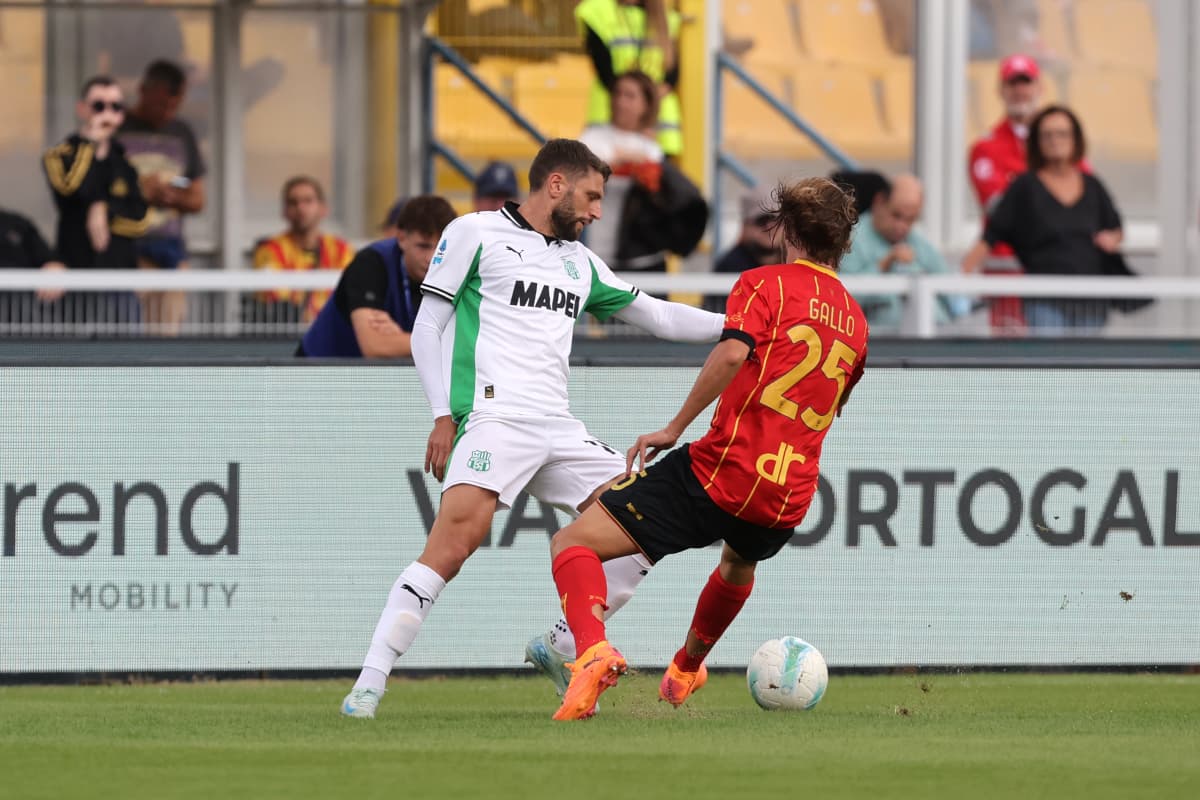
The evening at MAPEI Stadium – Città del Tricolore closed on a knife‑edge, the scoreboard frozen at 3–2 to Lecce and the regular time whistle confirming a result that felt bigger than a single match. Following this result, Sassuolo sit 11th in Serie A with 49 points and a goal difference of -3, their 46 goals for and 49 against encapsulating a season of bold attacking intent and defensive fragility. Lecce, meanwhile, cling to 17th on 35 points, their own goal difference of -23 (27 scored, 50 conceded) underlining why survival has been a grind rather than a glide.
This was Round 37, the penultimate act of the campaign, and both line‑ups told a story before a ball was kicked. Fabio Grosso stayed loyal to Sassuolo’s seasonal DNA, rolling out the familiar 4‑3‑3 that has started 35 of their 37 league fixtures. Eusebio Di Francesco mirrored his own broader pattern, sending Lecce out in a 4‑2‑3‑1 – the shape he has used more than any other this season.
Sassuolo’s starting XI was built on continuity and star power. S. Turati in goal, a back four of W. Coulibaly, Pedro Felipe, T. Muharemovic and U. Garcia, with a midfield three of K. Thorstvedt, N. Matic and I. Kone. Ahead of them, the front line that defines this team’s identity: D. Berardi cutting in from the right, A. Lauriente from the left, and M. Nzola through the middle.
The absences, though, carved out tactical voids. D. Boloca’s muscle injury removed a versatile midfielder who could have alternated with Matic in tempo control. F. Cande and E. Pieragnolo, both sidelined with knee injuries, along with F. Romagna and A. Vranckx listed as inactive, stripped Grosso of defensive depth and rotation options. S. Walukiewicz’s leg injury further thinned the centre‑back pool, forcing faith in a relatively fixed back line.
Lecce’s issues were fewer but still significant. M. Berisha’s thigh injury robbed Di Francesco of a midfield alternative with energy between the lines, while R. Sottil’s back injury took away a wide option who could have shared some of the creative load with L. Banda and S. Pierotti. Yet the XI that walked out – W. Falcone behind a defence of D. Veiga, J. Siebert, Tiago Gabriel and A. Gallo; a double pivot of Y. Ramadani and O. Ngom; a line of Pierotti, L. Coulibaly and Banda behind W. Cheddira – had a clear purpose: compress space, then spring.
Heading into this game, the numbers framed an intriguing clash of styles rather than a mismatch. At home, Sassuolo averaged 1.3 goals for and 1.4 against, a slight negative edge that echoed their -3 overall goal difference. They had 9 home wins from 19, but also 8 defeats, and had failed to score at home 6 times. Lecce, on their travels, averaged 0.8 goals for and 1.4 against, with 5 away wins offset by 11 defeats and 9 away games without scoring.
Where Sassuolo leaned on attacking quality, Lecce’s survival bid has been about grit. Across the season, they have kept 9 clean sheets in total, 5 of them away, a testament to a defensive unit that often bends but occasionally refuses to break. Yet that -23 overall goal difference is the brutal arithmetic of a side that still concedes too often.
In midfield, the “Engine Room” battle was always going to be decisive. N. Matic, with 1,699 passes at 86% accuracy this season and 43 tackles plus 27 interceptions, is Sassuolo’s metronome and screen. His 7 yellow cards and a red tell of a player willing to foul to stop transitions. Opposite him, Y. Ramadani has been Lecce’s relentless enforcer: 90 tackles, 46 interceptions, and 343 duels contested, winning 190. His 9 yellow cards make him one of Serie A’s most frequently booked players, and his presence in the double pivot gave Lecce the ballast to absorb Sassuolo’s waves.
Alongside Matic, K. Thorstvedt offered vertical thrust and steel. With 4 goals, 4 assists, 1,029 passes at 82% accuracy and 32 interceptions, he is both a carrier and a disruptor. His 8 yellow cards underline his willingness to step into the dark arts when necessary. Together, Matic and Thorstvedt tried to dictate rhythm against Ramadani and Ngom, a clash of passing lanes and second balls.
Higher up, the “Hunter vs Shield” storyline revolved around Sassuolo’s attacking trio and Lecce’s much‑criticised defence. A. Lauriente entered the fixture as one of Serie A’s premier creators, with 9 assists and 7 goals, 54 key passes and 79 dribble attempts (29 successful). His duel with D. Veiga down Sassuolo’s left was a key pressure point: Veiga, a defender who has made 95 tackles and 14 successful blocks this season and drawn 46 fouls, is aggressive and proactive. Could he step out to confront Lauriente without leaving channels for Nzola?
On the opposite flank, D. Berardi brought 8 goals and 4 assists, 33 shots (20 on target) and 32 key passes into this contest. His ability to drift inside threatened the half‑spaces between Tiago Gabriel and Siebert, particularly dangerous for a Lecce side that, away, concede 1.4 goals per match. Behind them, Falcone had to manage not just shots but cut‑backs and second‑phase chaos.
Lecce’s own cutting edge was more selective but still sharp. L. Banda, with 4 goals, 4 assists and 83 attempted dribbles (32 successful), offered direct running that could expose Sassuolo’s full‑backs, especially as the home side pushed high in their 4‑3‑3. His disciplinary record – 6 yellows and 1 red – added volatility: a winger who can change a game in both directions. If Banda isolated W. Coulibaly, Lecce had an outlet; if he was trapped by Matic’s cover and Thorstvedt’s pressing, their counters risked stalling.
Discipline was always likely to colour the narrative. Both teams show a pronounced late‑game edge in bookings: Sassuolo’s yellow‑card peak is in the 76–90 minute window with 29.63% of their cautions, while Lecce’s is similar late on with 29.85% of their yellows in the same period. In a match that finished 3–2 and remained live until the final whistle, that propensity for late cards hinted at rising tension, tactical fouls and the emotional strain of a season’s work hanging in the balance.
From a statistical prognosis standpoint, this game played roughly to type. Sassuolo, a side with 46 goals overall and an attacking structure built around creative wide forwards and a penalty‑area striker, found a way to score twice but could not mask their defensive leaks, conceding three more to reach 49 against for the season. Lecce, whose 27 overall goals before this fixture painted them as blunt, found rare cutting edge against a defence that has kept only 8 clean sheets in total.
Overlaying expected‑goals logic on these profiles, the likely pre‑match model would have tilted towards a marginal Sassuolo advantage at home, with their 1.3 home goals‑for average outpacing Lecce’s 0.8 away. But defensive solidity – or the lack of it – was always the swing factor. Sassuolo’s tendency to concede 1.4 at home and Lecce’s ability to scrap their way to 5 away wins meant that if Di Francesco’s side could turn a low‑xG chance or two into goals, an upset was on.
Following this result, the narrative is clear. Sassuolo remain a high‑variance side whose 4‑3‑3 can thrill but not always control. Lecce, for all their flaws, showed that structure, discipline from the likes of Ramadani and Veiga, and the direct threat of Banda and Cheddira can still tilt tight margins their way. In a season where every point matters, this 3–2 in Reggio Emilia felt like the purest expression of both teams’ statistical identities: one expansive and porous, the other limited but stubborn enough to survive.