.svg&w=384&q=75 "Pitchgist logo")
Roma Dominates Lazio in Derby della Capitale
The Derby della Capitale returned to the Stadio Olimpico with a familiar edge but a very different hierarchy. Following this result, AS Roma sit 4th in Serie A on 70 points, their goal difference a convincing +26 (57 scored, 31 conceded overall), while Lazio remain 9th on 51 points with a perfectly flat goal difference of 0 (39 for, 39 against overall). A 2–0 Roma win in regular time, built on structure as much as emotion, underlined how the balance of power has shifted across the city.
I. The Big Picture – Gasperini’s Roma, Sarri’s compromise
Roma’s season-long identity was written clearly into the teamsheet. Piero Gasperini Gian again trusted his 3-4-2-1, a system he has used in 29 league matches this season, and it framed the derby in familiar terms: aggressive wing-backs, a back three comfortable stepping into midfield, and two creative forwards underneath a mobile striker.
Mile Svilar anchored the build-up behind a trio of Gianluca Mancini, Evan Ndicka and Mario Hermoso. Ahead of them, Zeki Çelik and Wesley Franca patrolled the flanks, with Bryan Cristante and N. El Aynaoui forming the double pivot. Paulo Dybala and the young N. Pisilli floated between the lines behind Donyell Malen, Serie A’s 4th-ranked scorer this season with 13 goals and 2 assists in 17 league appearances.
On their travels, Lazio arrived in a more fragile state, tactically and emotionally. Maurizio Sarri kept faith with his 4-3-3, a structure he has used in 35 league games, but absences forced compromises. First-choice goalkeeper Ivan Provedel (shoulder injury) and defensive leader Alessio Romagnoli (suspended after a red card) were both missing, as were creative outlet Mattia Zaccagni (knee injury) and midfielder E. Motta. That pushed A. Furlanetto into goal and left Mario Gila to marshal a reshaped back line with O. Provstgaard, Nuno Tavares and Adam Marusic.
Heading into this game, Roma’s seasonal DNA already pointed to a clear narrative: at home they averaged 1.7 goals scored and only 0.5 conceded, with 11 clean sheets at the Olimpico. Lazio’s away profile was more cautious – 0.7 goals scored and 0.8 conceded on their travels – but underpinned by 9 away clean sheets and 11 away matches where they failed to score. This was always likely to be a derby defined by Roma’s initiative against Lazio’s risk management.
II. Tactical Voids – Absences and discipline
The team news told its own story. Roma’s attacking depth was slightly thinned by the absence of E. Ferguson (ankle injury) and B. Zaragoza (knee injury), but Gasperini could still turn to S. El Shaarawy, A. Dovbyk and Matías Soulé from the bench. The structure and spine of the side remained intact.
Lazio’s voids, by contrast, cut through the core of Sarri’s game model. Without Provedel’s distribution and Romagnoli’s leadership, the visitors lost two of their most secure outlets under pressure. Romagnoli’s season numbers underline the scale of that loss: 1 red card and 6 yellows, yes, but also 19 successful blocks and 31 interceptions, and 1,942 completed passes at 93% accuracy. He is the defender who steps out, breaks lines and calms chaos. In his absence, Gila – excellent this season with 17 blocked shots, 46 tackles and 134 duels won – had to both defend and organise.
Discipline has been a live wire for both clubs. Roma’s yellow-card profile shows a late-game surge: 23.88% of their bookings arrive between 76-90 minutes, with another 22.39% between 61-75. Lazio are even more combustible late on: 26.32% of their yellows and a remarkable 55.56% of their reds come in that 76-90 window. In a derby, where emotional temperature spikes as the clock ticks, this pattern always threatened to tilt the contest if Roma could drag the game into those chaotic final minutes with a lead.
III. Key Matchups – Hunter vs Shield, the Engine Room
The headline duel was Donyell Malen against Lazio’s improvised central defence. Heading into this game, Roma averaged 1.5 goals per match overall, with Malen responsible for 13 of their 57 league goals. His 46 shots (29 on target) and 3 penalties scored make him the pure finisher in Gasperini’s system.
Lazio’s overall defensive record – 39 conceded in 37 matches, 1.1 per game overall – looks solid, but it has been built on structure and a settled back line. Away from home they conceded 15 in 19, only 0.8 per match on their travels. Removing Provedel and Romagnoli from that framework meant Gila and Provstgaard had to contain Malen’s diagonal runs into the right channel, with Furlanetto asked to command a high line against Roma’s vertical passing.
Behind Malen, the “engine room” battle pitted Roma’s double pivot and inside creators against Lazio’s midfield three. Cristante and El Aynaoui offered the platform, but Wesley and Çelik were just as important, providing width and overloads against Marusic and Tavares. On Lazio’s side, N. Rovella and T. Basic were tasked with screening the back four, while K. Taylor tried to connect midfield to a front three of M. Cancellieri, B. Dia and T. Noslin.
Here, the numbers favoured Roma. Their 3-4-2-1 has delivered 17 clean sheets overall and only 31 goals conceded in 37 matches (0.8 per game overall), while still sustaining a 1.7-goals-per-game attack at home. Lazio’s 4-3-3 has been more brittle in transition, and without Zaccagni – who draws 82 fouls and carries the ball upfield – they lacked a natural outlet to relieve pressure and win territory.
IV. Statistical Prognosis – Why the 2–0 made sense
Following this result, the 2–0 scoreline felt like the logical expression of the season’s underlying numbers. Roma’s home record – 13 wins, 3 draws, 3 defeats, with 33 scored and only 10 conceded at the Olimpico – was always likely to translate into territorial dominance and sustained pressure. Their penalty record remained perfect this campaign, with 5 penalties taken and 5 scored overall, removing one of the classic derby variables.
Lazio’s away profile suggested a narrow margin for error. On their travels they had scored just 14 and conceded 15, with 11 away matches where they failed to find the net. Their reliance on defensive solidity and clean sheets – 9 away shutouts – was undermined by the absence of Provedel and Romagnoli, and by a disciplinary trend that spikes dangerously in the final quarter of matches.
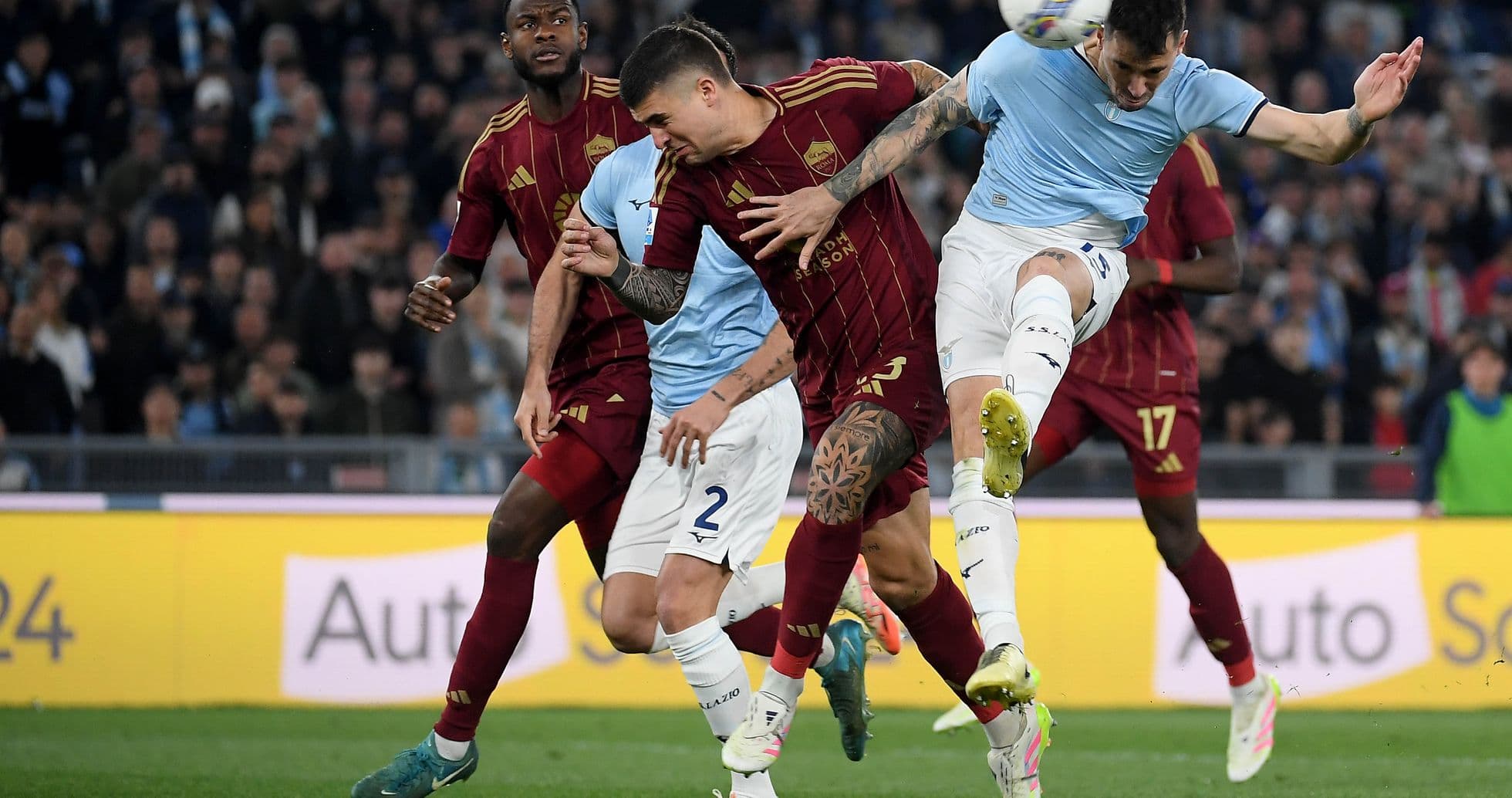
In narrative terms, Roma’s back three, led by Mancini and Hermoso, provided the shield; Malen, Dybala and Pisilli provided the cutting edge. Lazio’s Gila fought a brave rearguard, but without his usual partners and with limited attacking relief, the structure eventually gave way. The derby ended not with chaos but with confirmation: Roma’s numbers, shape and momentum all pointed towards a controlled, two-goal victory – and that is exactly what unfolded on the pitch.