.svg&w=384&q=75 "Pitchgist logo")
Cagliari Clinches Victory Over Torino in Serie A Showdown
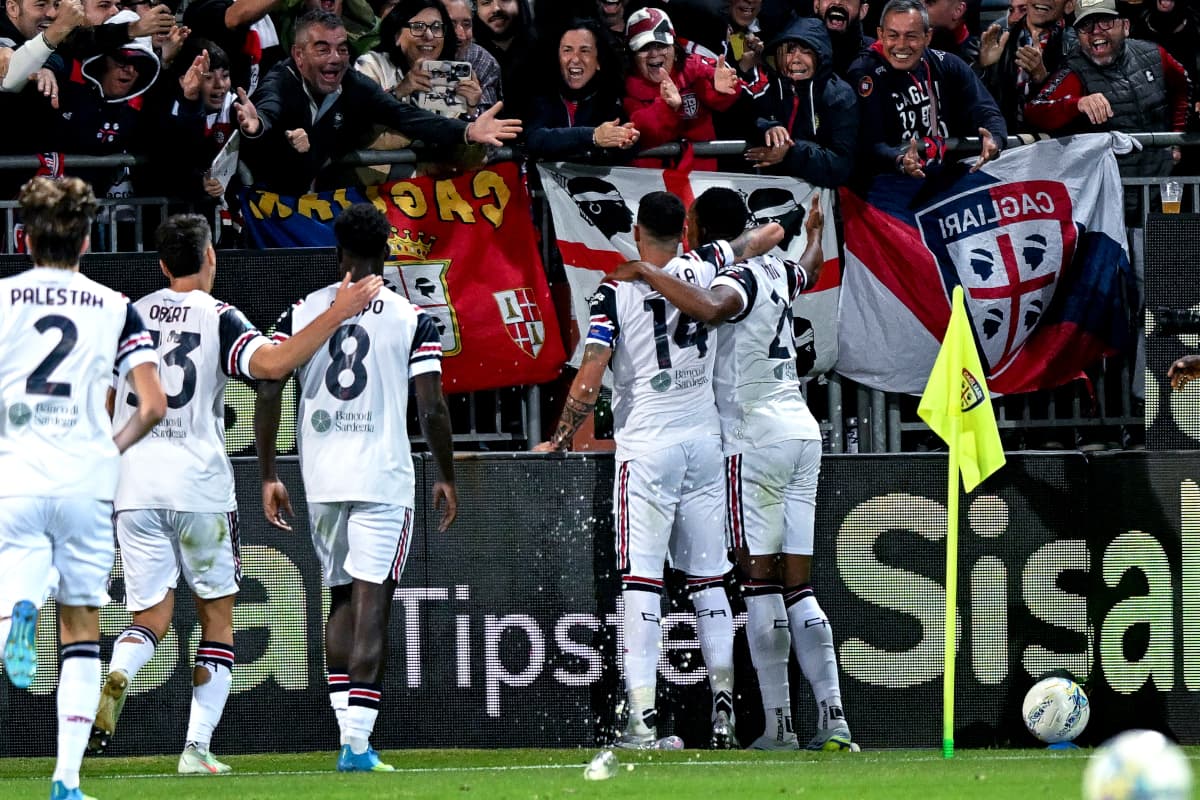
Under the evening lights of the Unipol Domus, Cagliari closed their home campaign with a statement win, edging Torino 2–1 in a tight Serie A contest that felt far more charged than a routine “Regular Season - 37” fixture. Following this result, the table tells a clear story: Cagliari sit 16th on 40 points with a goal difference of -14 (38 scored, 52 conceded), Torino 12th on 44 points with a goal difference of -19 (42 scored, 61 conceded). But the 90 minutes in Sardinia revealed as much about each side’s tactical identity as an entire season of numbers.
I. The Big Picture – Structures and Season DNA
Fabio Pisacane rolled the dice with a 4-3-2-1, a shape Cagliari have only used 3 times this Serie A season, after leaning primarily on a 3-5-2 (17 matches). It was a deliberate shift: four at the back to protect the box, three central midfielders to clog Torino’s half-spaces, and a narrow band of two creators behind a lone striker to attack transitions.
Torino, under Leonardo Colucci, answered with their familiar 3-4-2-1, one of the club’s core structures this season (4 matches in that exact shape, but always within a three-centre-back family: 3-5-2 used 16 times, 3-4-1-2 eight times). It was a set-up designed to lean on wing-backs and the vertical power of Duvan Zapata, with Giovanni Simeone and Nikola Vlasic floating in support.
Seasonally, Cagliari’s profile has been that of a survival specialist: in total this campaign they have played 37 matches, winning 10, drawing 10, losing 17. They score 1.0 goals per game overall (38 in 37) and concede 1.4 (52 in 37). At home, they average 1.2 goals for and 1.2 against, a marginally positive attacking return that makes the Unipol Domus their lifeline.
Torino, by contrast, are more volatile. In total they have 12 wins, 8 draws, 17 defeats from 37 games, scoring 1.1 goals per match (42 in 37) and conceding 1.6 (61 in 37). On their travels, they average 0.9 goals for and 1.8 against, a fragile away profile that once again surfaced here.
II. Tactical Voids – Absences and Discipline
Both squads arrived with notable absentees. Cagliari were stripped of attacking and creative depth: M. Felici, R. Idrissi and J. Liteta (all with injuries), L. Mazzitelli (calf injury), L. Pavoletti (knee injury) and J. Pedro (suspended for yellow cards). That forced Pisacane to trust youth and versatility: M. Palestra and S. Esposito as advanced midfielders, P. Mendy as the lone forward.
Torino were also patched together. Z. Aboukhlal and A. Ismajli (muscle injuries) and F. Anjorin (hip injury) removed both a wide threat and defensive rotation, while G. Gineitis was out through suspension. Colucci’s bench was long but not perfectly balanced, with a heavy tilt toward defenders and young midfielders.
Disciplinary trends framed the tone. Heading into this game, Cagliari’s yellow-card curve showed a pronounced late spike: 27.85% of their yellows come between 76–90 minutes, and their only reds in Serie A this season (2 in total) have all arrived in that same 76–90 window. Torino, meanwhile, are slow burners in terms of cautions, with a combined 41.43% of their yellows arriving from 76–90 and into stoppage time (91–105). The match duly followed the script: a tense, combative second half where both sides walked a fine line in duels and tactical fouls.
III. Key Matchups – Hunter vs Shield, and the Engine Room
The headline duel was always going to be “Hunter vs Shield”: Giovanni Simeone against a Cagliari defence anchored by Adam Obert and Yerry Mina. Simeone has been Torino’s cutting edge in Serie A 2025: 11 goals in total from 31 appearances, supported by 58 shots (28 on target). His work rate is ferocious – 283 duels contested, 110 won – and he presses as much as he finishes.
Obert, though, is Cagliari’s disciplinary and defensive bellwether. With 9 yellow cards and 1 yellow-red in 34 league appearances, he plays on the edge, but he backs it up with substance: 65 tackles, 18 blocked shots and 40 interceptions, plus 230 duels contested and 123 won. Against Torino’s front three, Obert and Mina formed a compact axis, squeezing the spaces where Simeone likes to receive on the half-turn. The 4-3-2-1 gave them extra protection from full-backs G. Zappa and A. Dossena, who could step into wide duels without leaving the centre exposed.
In midfield, the “Engine Room” belonged to S. Esposito versus Torino’s double pivot of E. Ilkhan and M. Prati. Esposito is Cagliari’s creative metronome: in total this campaign he has produced 7 goals and 5 assists, with 954 passes completed and 67 key passes, plus 41 dribble attempts (17 successful). He also brings bite: 52 tackles, 4 blocks and 16 interceptions, and he draws more fouls (52) than he commits (44). Against Torino, his role between the lines was decisive, receiving behind Ilkhan and Prati, then threading passes into P. Mendy and combining with G. Gaetano.
Torino’s midfielders, more functional than flamboyant, struggled to pin him down without conceding dangerous free-kicks. With Cagliari’s penalty record at 100.00% in total this season (2 scored from 2, no misses), any foul around the box carried extra risk.
IV. Statistical Prognosis – What This Game Says About Both Sides
From a statistical lens, the 2–1 scoreline fits the underlying patterns. Cagliari at home average 1.2 goals scored and 1.2 conceded; Torino away average 0.9 scored and 1.8 conceded. A narrow home win with both teams scoring sits neatly within those bands.
Defensively, Cagliari remain a side that bends but doesn’t always break at the Unipol Domus. Eight clean sheets in total this campaign (6 at home) show that when their structure is right, they can suffocate opponents. The shift to a back four, with Obert’s aggression and Mina’s aerial command, reduced Torino’s threat to isolated moments rather than sustained waves.
Torino’s away fragility persists. Conceding 34 goals on their travels across 19 matches – an average of 1.8 per game – reflects a side that often leaves its back three exposed when wing-backs push on. Here, Cagliari’s narrow attacking band exploited the channels between centre-backs and wide midfielders, drawing them into awkward zones.
In xG terms, while no explicit values are provided, the profiles are clear: Cagliari’s modest overall scoring rate but improved home numbers suggest they tend to create enough to edge games like this, especially when their key creator, Esposito, is on the pitch for long stretches. Torino, by contrast, rely heavily on individual finishing from Simeone and Zapata rather than a steady stream of high-quality chances.
Following this result, the prognosis is nuanced. Cagliari look like a side whose tactical flexibility – shifting from back three to back four, trusting Esposito as a central reference – can keep them just ahead of danger, particularly at home. Torino, meanwhile, remain an unpredictable mid-table side: capable of bursts of attacking power, but undermined by a porous away defence and an overreliance on their front line to bail them out.
On this night, structure, discipline and a sharper exploitation of space made the difference. The numbers merely confirm what the Unipol Domus could feel: Cagliari’s 4-3-2-1 was the more coherent, more balanced system – and it carried them over the line.