.svg&w=384&q=75 "Pitchgist logo")
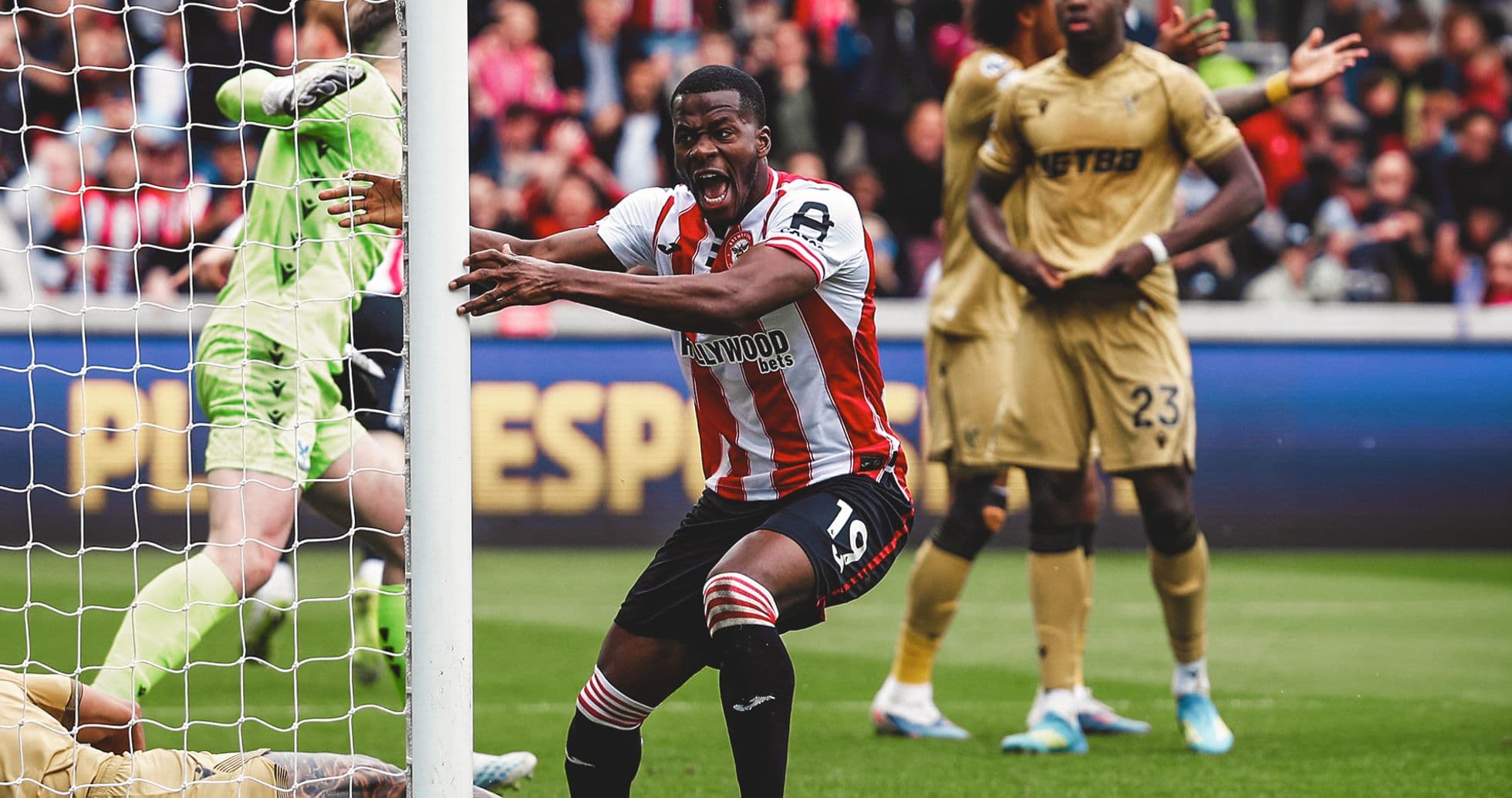
Brentford and Crystal Palace Share Spoils in 2-2 Draw
The late-season light at Brentford Community Stadium caught a game that never quite settled on a winner. Brentford and Crystal Palace shared a 2-2 draw, a result that felt perfectly in tune with their broader Premier League identities heading into this game: the home side a controlled, often front-foot outfit in London, the visitors a counter-punching, structurally disciplined team more dangerous on their travels than their league position suggests.
For Brentford, this was the 37th step of a campaign defined by balance more than brilliance. They sit 8th with 52 points, their overall goal difference of 3 the product of 54 goals scored and 51 conceded in total. At home, the numbers underline why Keith Andrews leaned into a proactive 4-2-3-1: 33 goals for and 21 against at Brentford Community Stadium, an average of 1.7 goals for and 1.1 against at home. This is a side built to use the ball, pin opponents back, and trust their structure.
Crystal Palace arrived from a different angle. In total this campaign they have 45 points and a goal difference of -9, with 40 goals scored and 49 conceded overall. Yet that negativity is softened by an away profile that has quietly been their strength: on their travels they have 7 wins, 3 draws and 9 defeats, with 22 goals for and 28 against, averaging 1.2 goals scored and 1.5 conceded away. Oliver Glasner’s 3-4-2-1 is calibrated for away days: compact, spring-loaded, and reliant on the front three’s ability to exploit space.
The lineups told their own story. Andrews’ 4-2-3-1 was textbook Brentford 2025-26. Caoimhín Kelleher behind a back four of M. Kayode, K. Ajer, N. Collins and K. Lewis-Potter gave them a blend of aerial strength and ball progression from deep. Ahead of them, the double pivot of Y. Yarmolyuk and V. Janelt formed the metronome, with D. Ouattara, M. Jensen and M. Damsgaard supporting lone forward I. Thiago.
Across from them, Palace’s 3-4-2-1 was equally familiar. D. Henderson in goal, shielded by a back three of J. Canvot, M. Lacroix and C. Riad, with D. Munoz and T. Mitchell as wing-backs. In the middle, A. Wharton and D. Kamada provided the blend of control and verticality, while I. Sarr and Y. Pino buzzed around central striker J. S. Larsen.
The tactical voids were clear before a ball was kicked. Brentford were without F. Carvalho and A. Milambo through knee injuries and R. Henry with a muscle problem. The absence of Henry in particular nudged Andrews toward Lewis-Potter at full-back, subtly shifting the left flank’s profile from pure defensive solidity to a more adventurous, winger-turned-defender dynamic. It made Brentford more dangerous going forward, but also more vulnerable to quick transitions into the space behind.
Palace had their own holes. C. Doucoure’s knee injury removed a natural defensive screener from midfield, forcing Wharton and Kamada to shoulder both build-up and protection duties. E. Nketiah’s thigh injury and the absence of B. Sosa further thinned Glasner’s rotation, particularly in terms of direct running in behind and left-sided balance. It meant more responsibility on I. Sarr and Y. Pino to carry the counter-attacking threat and more minutes for J. Mateta as an impact option from the bench if Glasner chose to change the game state.
Discipline and card profiles framed how aggressive each side could be. Heading into this game, Brentford’s yellow card distribution showed a clear late-game spike: 27.27% of their yellows arriving between 76-90 minutes, with another 22.73% between 61-75. This is a side that often defends leads or chases games with edge in the final quarter, walking a line between intensity and recklessness. Their only red card of the league campaign came between 31-45 minutes, a reminder that the emotional temperature can rise before half-time too.
Palace, by contrast, spread their cautions more evenly, but with notable peaks of 18.42% in the 31-45, 46-60 and 76-90 minute ranges. Their two reds in the league have come after the interval – one between 46-60 minutes and one between 61-75 – underlining the risk in their aggressive mid-block and transitional fouling once fatigue sets in. For both sides, the second half is where tactical plans meet disciplinary jeopardy.
Within that frame, the key matchups had a clear headline: Hunter vs Shield. Igor Thiago arrived as one of the Premier League’s most productive strikers this season. In total he has 22 league goals and 1 assist in 37 appearances, built on 66 shots with 43 on target. He is not just a finisher but a constant duel magnet – 513 duels contested and 199 won – and a penalty taker with a human edge: he has scored 8 spot-kicks but missed 1, so Brentford cannot claim perfection from 12 yards.
His duel was with a Palace defence anchored by Maxence Lacroix, who has quietly been one of the league’s most reliable centre-backs. In total this season he has 60 tackles, 18 blocked shots and 45 interceptions, underpinned by 1,656 passes at an 88% accuracy rate. Lacroix is not just a stopper; he is the first passer in Palace’s build-up. His timing in stepping out to meet Thiago between the lines and his ability to win aerials and second balls were central to Glasner’s plan to suffocate Brentford’s main scoring outlet.
Behind Thiago, Brentford’s “engine room” battle pitted Janelt and Yarmolyuk against Wharton and Kamada. Janelt’s role as the stabiliser – screening transitions, recycling possession – allowed Jensen and Damsgaard to find pockets between Palace’s lines. Wharton, still young but already central to Palace’s identity, had to juggle shielding his back three and progressing the ball through Brentford’s first press. Kamada, meanwhile, offered the forward thrust, looking to connect quickly with Sarr and Pino once Palace broke.
On the Palace side, the secondary “Hunter” was J. Mateta, sitting on 11 goals in total this campaign. Even from the bench, his profile as a penalty-box focal point – 55 shots, 31 on target – gave Glasner a different dimension if Larsen’s movement-heavy role needed complementing by a more direct target.
From a statistical prognosis standpoint, both sides came into this fixture with mid-table xG and defensive profiles that matched the eventual 2-2 scoreline more than a cagey stalemate. Brentford’s overall scoring rate of 1.5 goals per game and concession rate of 1.4 in total pointed toward a team that tends to trade chances rather than lock games down. Palace’s 1.1 goals for and 1.3 against in total, combined with their stronger away record, suggested they would not be overawed by the venue.
Following this result, the draw feels like a fair crystallisation of their seasons: Brentford’s controlled aggression at home, Palace’s capacity to travel well and punch above their 15th place. The Hunter vs Shield duel between Thiago and Lacroix remains a microcosm of the contest – a top-tier striker against a high-volume, high-precision defender – and a reminder that, in this corner of the Premier League, margins are thin, and balance is everything.