.svg&w=384&q=75 "Pitchgist logo")
Pisa vs Napoli: A Serie A Reckoning at Arena Garibaldi
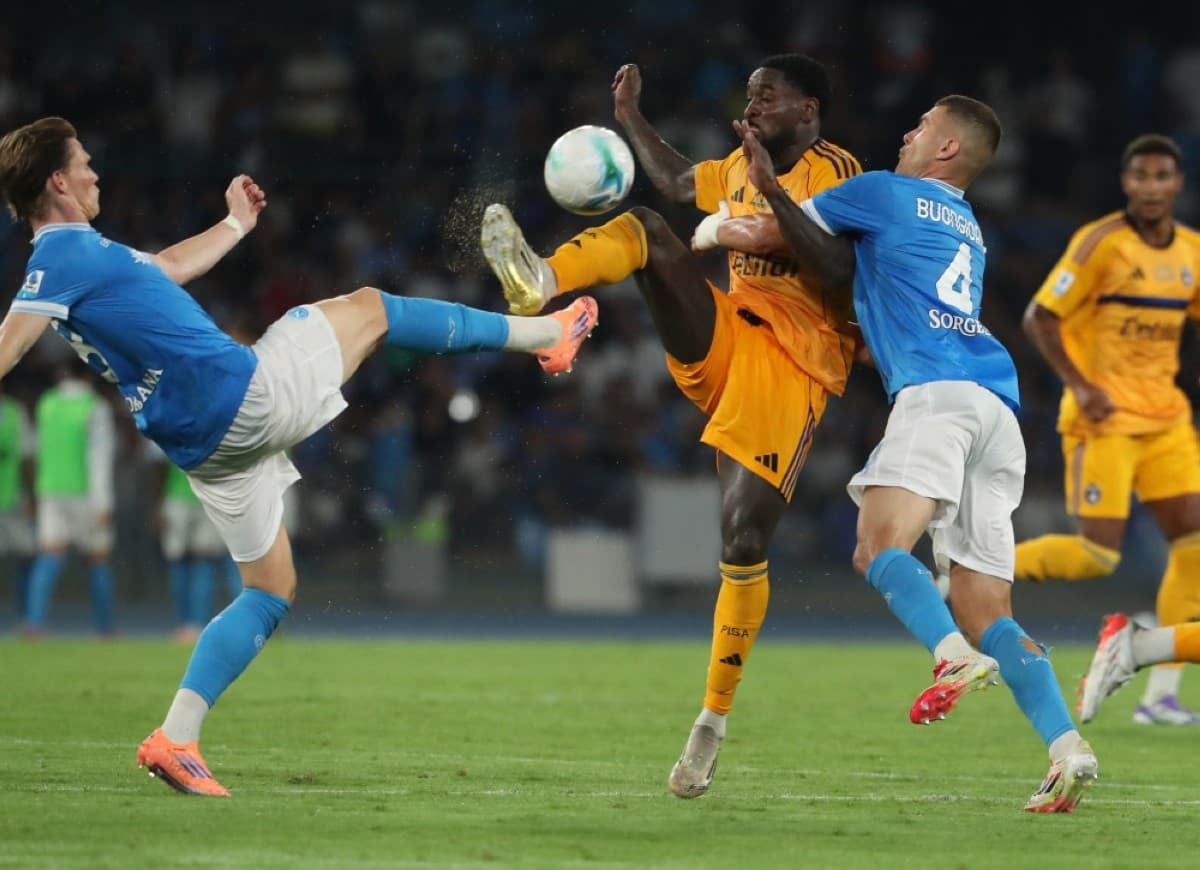
The Arena Garibaldi – Stadio Romeo Anconetani had the feel of a farewell and a reckoning. In a Serie A season that has dragged Pisa inexorably toward relegation, the visit of title-chasing Napoli in Round 37 always looked like a mismatch. The table told the story even before kick-off: Pisa rooted in 20th with 18 points and a goal difference of -44, Napoli in 2nd on 73 points with a GD of 21, their Champions League ticket already stamped. Following this result, the 3-0 scoreline to the visitors simply underlined the gulf in class and conviction.
I. The Big Picture – Systems, Context, and the Shape of the Contest
Pisa set up in a 3-5-2, Oscar Hiljemark clinging to the structure that has defined their campaign. It is the formation they have used most often, deployed in 20 league matches, and one that attempts to crowd the middle while offering width from hard-running wing-backs. At home this season, however, the numbers have been brutal: across 19 matches at the Arena Garibaldi, Pisa have scored just 9 goals (an average of 0.5 at home) and conceded 26 (1.4 at home). The three centre-backs and five-man midfield are supposed to create a defensive shell, but the broader picture – 69 goals conceded in total and only 25 scored – shows a side that has been outgunned and outthought all year.
Napoli, by contrast, arrived as a finished product. Antonio Conte opted for a 3-4-3, one of the shapes in a season-long toolkit that has also featured 3-4-2-1 (their most-used formation, 21 times) and 4-1-4-1. On their travels, Napoli have been controlled and efficient: 25 away goals scored at an average of 1.3, only 18 conceded away at 0.9 per game, and 8 away clean sheets. Overall, they have 57 goals for and 36 against, an all-round profile of a side that can dominate territory without losing defensive balance.
The narrative of the match followed those season-long patterns. Napoli’s 2-0 half-time lead and eventual 3-0 victory felt like the logical extension of a campaign in which they have consistently imposed their structure, while Pisa have struggled to turn formation into function.
II. Tactical Voids – Absences and Discipline
If Pisa’s season has been one long scrape against the bottom, their absences here only deepened the void. R. Bozhinov and F. Loyola were both missing through red-card suspensions, stripping Hiljemark of defensive and structural options in a squad already short on top-level quality. Injuries to F. Coppola, D. Denoon and M. Tramoni, plus the “Inactive” status of Lorran, further narrowed the coach’s ability to adjust either his back line or his attacking rotations.
This matters because Pisa’s season-long disciplinary profile hints at a side that spends long stretches under pressure and defending reactively. Their yellow-card distribution spikes late: 25.97% of their yellows arrive between 76-90 minutes, a late-game surge that speaks of tired legs and desperate challenges. Red cards are scattered across phases, with a notable 40.00% in the 31-45 window and another 20.00% between 16-30, showing how often their structure has cracked even before half-time.
Napoli had their own notable absentees – David Neres and R. Lukaku through injury, M. Politano suspended for yellow cards – yet Conte’s squad depth softened the blow. Politano’s absence removed one of Serie A’s most reliable wide creators (5 assists in total), but the system simply re-centered around other conduits. Napoli’s own disciplinary profile is more controlled: yellows peak between 61-75 minutes at 30.61%, often in game-management phases, while all of their red cards this season have come between 76-90 minutes, usually when closing out high-intensity contests rather than chasing them.
III. Key Matchups – Hunter vs Shield, Engine Room Battles
The “Hunter vs Shield” duel was written across the front line and Pisa’s back three. R. Højlund, with 11 league goals and 5 assists overall, led Napoli’s attack. His season numbers – 44 shots total, 23 on target – speak to a striker who constantly threatens the box. Behind him, the creative weight is shared, but his role as both finisher and link-man is clear: 31 key passes and a 74% pass accuracy underline how he drops to knit moves before surging into the area.
Facing him was the heart of Pisa’s defence, anchored by A. Caracciolo. One of Serie A’s most heavily booked players with 10 yellows, Caracciolo has been both shield and warning sign for Pisa’s season. His defensive metrics – 71 tackles, 24 successful blocked shots, 51 interceptions and 139 duels won – show a centre-back constantly in the line of fire. Yet the sheer volume of defensive actions is a symptom of a team defending too deep and too often. Against Napoli’s structured front three, Caracciolo and his partners A. Calabresi and S. Canestrelli were always likely to be dragged into wide spaces and one-on-one duels they could ill afford.
In midfield, the “Engine Room” duel pitched Napoli’s control triangle of S. Lobotka and S. McTominay against Pisa’s central trio of M. Aebischer, M. Hojholt and E. Akinsanmiro. McTominay’s season has been quietly devastating: 10 goals and 3 assists from midfield, 71 shots (34 on target), 28 tackles, 13 blocked shots and 21 interceptions. He is both breaker and late-arriving finisher, a hybrid who can crash the box or anchor the press. Lobotka’s metronomic passing and positional discipline allow him to step forward with impunity.
Pisa’s answer lay in industry rather than incision. Aebischer, with 1 goal and 1 assist in total, has been their main organiser: 1,490 passes at 85% accuracy, 33 key passes, 64 tackles and 35 interceptions. He is the closest thing Hiljemark has to a two-way midfielder, but he has been asked to do too much – progress the ball, protect the back line, and knit transitions. Around him, Hojholt and Akinsanmiro offered legs and energy, yet Napoli’s superior structure and technical level meant that Pisa’s five-man midfield often looked like a line of chasers rather than controllers.
Wide, M. Leris and S. Angori were tasked with stretching Napoli’s back three and pinning wing-backs G. Di Lorenzo and L. Spinazzola. In reality, the pattern inverted: Di Lorenzo and Spinazzola advanced aggressively, hemming Pisa in and forcing the home wing-backs to defend deep. That robbed Pisa’s front two, S. Moreo and F. Stojilkovic, of the early service they needed to exploit transitions.
IV. Statistical Prognosis – xG Shape and Defensive Solidity
Even without explicit xG figures, the season-long metrics frame the expected shot quality and control. Napoli’s overall scoring average of 1.5 goals per game, combined with Pisa’s concession rate of 1.9 in total, pointed toward a match in which the visitors would generate multiple high-value chances. On their travels, Napoli’s 1.3 goals per game and 8 away clean sheets suggested a team adept at creating efficient opportunities while limiting the opponent’s volume and quality of shots.
Pisa’s attack has been anaemic all season. Overall they average 0.7 goals per game, and at home just 0.5. They have failed to score in 21 matches in total, including 12 at home. Against a Napoli side that concedes only 1.0 goals per game overall and 0.9 away – and that has kept 14 clean sheets in total – the probability of Pisa carving out enough clear chances to change the story was always slim.
Defensively, Pisa’s -44 goal difference (25 scored, 69 conceded) is the statistical expression of a side that breaks under sustained pressure. Napoli’s GD of 21 (57 for, 36 against) reflects balance: they score enough to win, but more importantly, they concede few enough to control. Overlaying those profiles, the likely xG map was always tilted: Napoli with territorial dominance, repeated entries into the box, and a steady accumulation of chances; Pisa relying on rare counters and set-pieces.
Following this result, the 3-0 scoreline felt less like a single match and more like a compressed version of the entire season. Napoli’s structure, depth and star quality – from Højlund’s penalty-box menace to McTominay’s box-to-box authority and Lobotka’s calm – imposed a familiar pattern. Pisa’s 3-5-2, for all its theoretical solidity, again morphed into a low block that could not protect its own area nor launch enough counters to threaten.
In the end, the tactical preview writes itself in hindsight: a relegated side with a brittle defence and blunted attack, stripped by suspensions and injuries, up against an elite, well-drilled contender. The numbers, the shapes, and the narrative converged on the same outcome – a comfortable Napoli victory, and another harsh lesson for Pisa at the close of a punishing Serie A campaign.