.svg&w=384&q=75 "Pitchgist logo")
Inter Held by Verona in Serie A Stalemate
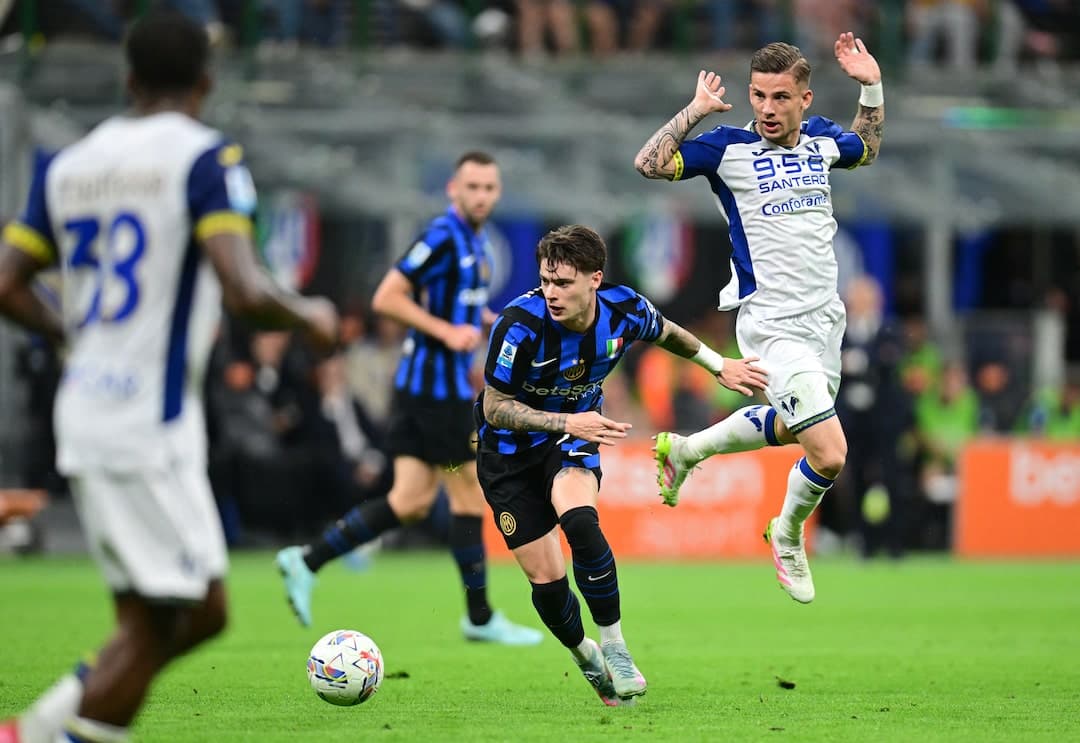
The afternoon at Stadio Giuseppe Meazza ended in a stalemate on the scoreboard, but not in the story. Inter, already the defining force of this Serie A season, were held 1-1 by relegation-threatened Hellas Verona in Round 37, a result that underlined both the champions’ human side and the visitors’ stubborn refusal to accept their fate quietly.
Following this result, the table still speaks of two different worlds. Inter sit top with 86 points from 37 matches, their overall goal difference a commanding +54, built from 86 goals scored and 32 conceded. Verona remain 19th on 21 points, their overall goal difference a stark -34, with only 25 goals scored and 59 allowed. Yet for 90 minutes in Milan, those numbers compressed into something far more even.
I. The Big Picture: Structures and Intent
Cristian Chivu stayed faithful to Inter’s season-long blueprint: a 3-5-2 that has become the league’s most ruthless machine. At home this campaign, Inter have played 19 matches, winning 14, drawing 3 and losing just 2, scoring 50 and conceding 16. An average of 2.6 home goals per game against only 0.8 conceded set the backdrop: the Meazza is usually a place of inevitability.
The starting XI reflected that identity. Yann Sommer behind a back three of Matteo Darmian, Stefan de Vrij and Francesco Acerbi formed the usual secure base. Across midfield, Luis Henrique and Carlos Augusto provided width, with A. Diouf, P. Sucic and Henrikh Mkhitaryan forming a technical interior triangle. Up front, A. Bonny partnered L. Martinez, the league’s leading marksman for Inter with 17 total Serie A goals and 6 assists.
Verona, by contrast, arrived as survivors rather than stylists. Paolo Sammarco set them up in a 5-3-2, a low, compact block designed to absorb Inter’s pressure. Lorenzo Montipò was shielded by a back five of M. Frese, N. Valentini, A. Edmundsson, V. Nelsson and R. Belghali. In midfield, S. Lovric, R. Gagliardini and A. Bernede were tasked with narrowing central spaces, while T. Suslov and K. Bowie led the counterattacking line.
Heading into this game, Verona’s season numbers told a grim story: overall just 3 wins in 37 matches, with 22 defeats. On their travels they had played 19 times, winning 2, drawing 7 and losing 10, scoring 13 and conceding 33 – an away average of only 0.7 goals for and 1.7 against. The plan was clear: survive first, hope later.
II. Tactical Voids and Absences
Verona’s bench was shaped as much by who was missing as who was present. D. Mosquera and S. Serdar were both ruled out with knee injuries, while D. Oyegoke was also unavailable through injury and G. Orban listed as inactive. That stripped Sammarco of rotation options in both defence and attack, especially the kind of vertical outlet Orban might have offered.
Inter, by contrast, had a lavish bench: Hakan Çalhanoğlu, Nicolò Barella, Federico Dimarco and Marcus Thuram all available to change the game. Çalhanoğlu has 9 total league goals and 4 assists, Dimarco 6 goals and 16 assists, Barella 3 goals and 8 assists, Thuram 13 goals and 6 assists. Few sides can introduce that level of technical and creative upgrade mid-match.
Disciplinary tendencies also framed the contest. Inter’s season-long yellow card profile peaks late: 30.65% of their yellows arrive between 76-90 minutes, a sign of aggressive game management and pressing into the closing stages. Verona’s bookings spike earlier, with 23.26% between 46-60 minutes and 20.93% between 31-45, suggesting that their intensity often crests around the mid-game phase. Red cards have haunted Verona more: they have seen dismissals in the 0-15, 46-60 and especially 76-90 ranges (50% of their reds in that final quarter), underlining the risk of desperation fouls under pressure.
III. Key Matchups: Hunter vs Shield, Engine Room vs Enforcer
The headline duel was always going to be L. Martinez against Verona’s defence. Martinez’s 17 total league goals, supported by 69 total shots and 39 on target, mark him as the division’s most consistent finisher. He thrives on quick combinations and early deliveries, usually from the likes of Dimarco and Barella. Against a Verona side that, overall, concedes 1.6 goals per game and 1.7 on their travels, the expectation was that Inter’s captain-in-all-but-name would find space.
Yet Verona’s back five, anchored by V. Nelsson and A. Edmundsson, compressed the central lane and forced Inter’s front two to receive with their back to goal. M. Frese, who has 79 total tackles and 10 blocked shots this season, again showed why he is one of Verona’s most combative defenders, stepping out aggressively to disrupt Inter’s wide combinations.
In midfield, the “Engine Room” battle pitted Inter’s technical carousel against Verona’s physical screen. Even when starting from the bench, the shadow of Çalhanoğlu and Barella loomed over the match. Çalhanoğlu’s 1393 total passes with 41 key passes and 90% accuracy, plus 34 tackles and 6 blocked shots, make him both a regista and a defensive pivot. Barella adds 1725 total passes, 72 key passes and 52 tackles, a perpetual motion machine between the lines.
Verona’s answer was Gagliardini, their disciplinary heartbeat and defensive metronome. With 73 tackles, 13 blocked shots and 54 interceptions this season, he is the one who steps into passing lanes and crashes into duels – 285 total, winning 169. His 10 yellow cards underline the cost of that role, but also its necessity. Alongside him, J. Akpa Akpro – another serial card collector with 9 yellows – waited on the bench as a second-wave enforcer if the game tilted too far Inter’s way.
IV. Statistical Prognosis and What the Draw Tells Us
On paper, Inter’s attacking profile should overwhelm a side like Verona. Overall, Inter average 2.3 goals per game, with 2.6 at home, while conceding only 0.9 overall. Verona, by contrast, average 0.7 goals for and 1.6 against. In any Expected Goals model, this fixture would project a clear Inter win, perhaps in the region of double the xG of their visitors.
Yet the 1-1 scoreline reflects how structure and desperation can bend probabilities. Verona’s use of a deep 5-3-2, combined with their willingness to absorb pressure and foul when necessary, compressed Inter’s usual xG advantage. Montipò’s presence behind a crowded box, plus the aerial work of Nelsson and Edmundsson, helped Verona survive the most dangerous zones where Inter typically generate their best chances.
For Inter, the draw is a reminder that even the most dominant systems need freshness. The 3-5-2 has served them flawlessly – they have used it in all 37 league matches – but when the tempo drops and the opposition sits deep, the onus falls on creative sparks like Dimarco and Çalhanoğlu to raise the passing speed and shot quality. Inter’s perfect penalty record this season – 5 taken, 5 scored overall – did not come into play here, removing one of their most reliable high-xG weapons.
For Verona, the point at the Meazza is both a tactical vindication and a statistical anomaly. A team that has failed to score in 19 total league matches managed to find a goal and a result in the most hostile of venues. Their defensive frailty – 59 goals conceded overall, 33 on their travels – was, for one afternoon, contained by discipline, structure and sheer volume of bodies behind the ball.
Following this result, the story of the season remains unchanged: Inter are champions in all but mathematics, Verona still cling to hope in the relegation fight. But this 1-1 at the Meazza will be remembered as the day the league’s most fragile side went toe-to-toe with its most ruthless, and proved that for 90 minutes, numbers can be bent by belief, organisation and a perfectly executed plan.