.svg&w=384&q=75 "Pitchgist logo")
Everton vs Sunderland: Tactical Analysis of a 1-3 Defeat
Everton’s 1-3 home defeat to Sunderland at Hill Dickinson Stadium unfolded as a tactical swing rather than a statistical mismatch. Both sides posted near-identical possession (Everton 49%, Sunderland 51%) and passing accuracy (both 85%), but Sunderland’s structural adjustments and timing of substitutions transformed an even contest into a controlled away win in the second half. Leighton Baines and Regis Le Bris both set up in a 4-2-3-1, yet the visitors’ superior game management, especially after the hour, flipped a match Everton had led 1-0 at half-time.
Everton’s 4-2-3-1 was built on a stable back four and a double pivot, but the balance between protection and progression proved fragile. Jordan Pickford, with 0 goalkeeper saves recorded, spent most of the game as a distributor behind a high defensive line rather than an active shot-stopper. James Tarkowski and Michael Keane formed the central pairing, with Vitalii Mykolenko and Jake O’Brien as full-backs. In front, Tim Iroegbunam and James Garner were tasked with screening and circulation, while the advanced line of Mads Rohl, Kiernan Dewsbury-Hall and Iliman Ndiaye supported Beto.
Everton’s early plan was clear: build methodically through the double pivot, then use Rohl and Dewsbury-Hall between Sunderland’s lines. Their 406 passes, 346 accurate (85%), show a side comfortable in possession but not especially incisive. Of their 10 total shots, only 6 came inside the box, and 4 were on target. The breakthrough on 43 minutes came from structured play rather than chaos: Mads Rohl ghosted into a central pocket to finish, assisted by Michael Keane. That centre-back involvement underlined Everton’s desire to step their defenders into midfield when Sunderland’s first line was passive.
Defensively, however, the Toffees’ structure frayed as the game stretched. Fourteen fouls and three yellow cards – all for “Foul” – point to a midfield increasingly reacting late. Tim Iroegbunam’s booking at 25 minutes was an early warning that Everton’s press was arriving a step behind. As Sunderland raised their tempo after the interval, that issue worsened. Jake O’Brien’s yellow at 47 minutes, again for “Foul”, highlighted how exposed the full-backs became once Sunderland began targeting wide channels and half-spaces.
Baines’ in-game management was aggressive but ultimately destabilising. On 73 minutes, he made a double attacking change: T. George (IN) came on for Tim Iroegbunam (OUT), and T. Barry (IN) came on for Beto (OUT). Removing Iroegbunam from the double pivot weakened central protection just as Sunderland were committing more bodies forward. The late switches at 88 minutes – Seamus Coleman (IN) for Jake O’Brien (OUT) and D. McNeil (IN) for Mads Rohl (OUT) – felt reactive, coming after Sunderland had already seized control of the scoreline. By then, Everton’s shape was stretched and their transitions disjointed.
Sunderland mirrored Everton’s 4-2-3-1 but used it more dynamically as the match progressed. R. Roefs, with 3 goalkeeper saves and 0.02 goals prevented, provided a calm base and justified a slightly higher defensive line, knowing he could manage the modest xG Everton generated (1.07). The back four of Lutsharel Geertruida, Nordi Mukiele, Omar Alderete and Reinildo Mandava initially stayed compact, but the key was the double pivot: Granit Xhaka and N. Sadiki (later supplemented by others) provided the platform for Sunderland’s attacking midfield trio.
In the first half, Sunderland’s 51% possession and 430 passes (365 accurate, 85%) did not translate into volume of shots – only 7 total by full-time, 3 on target – but they were patient. Their xG of 0.73 suggests they did not rely on a barrage of chances; instead, they maximised the quality of moments they created. The turning point came with a series of substitutions that re-energised the attacking structure and improved occupation of the half-spaces.
At 23 minutes, L. O’Nien (IN) came on for O. Alderete (OUT), an early backline adjustment that hinted at Le Bris’ willingness to tweak his defensive profile. The real shift arrived around the hour: on 60 minutes, C. Talbi (IN) came on for T. Hume (OUT), adding fresh legs and more direct threat on the flank. Then, in a triple change on 77 minutes, C. Rigg (IN) replaced N. Angulo (OUT), H. Diarra (IN) replaced N. Sadiki (OUT), and W. Isidor (IN) replaced B. Brobbey (OUT). This wave of substitutions injected verticality and creativity.
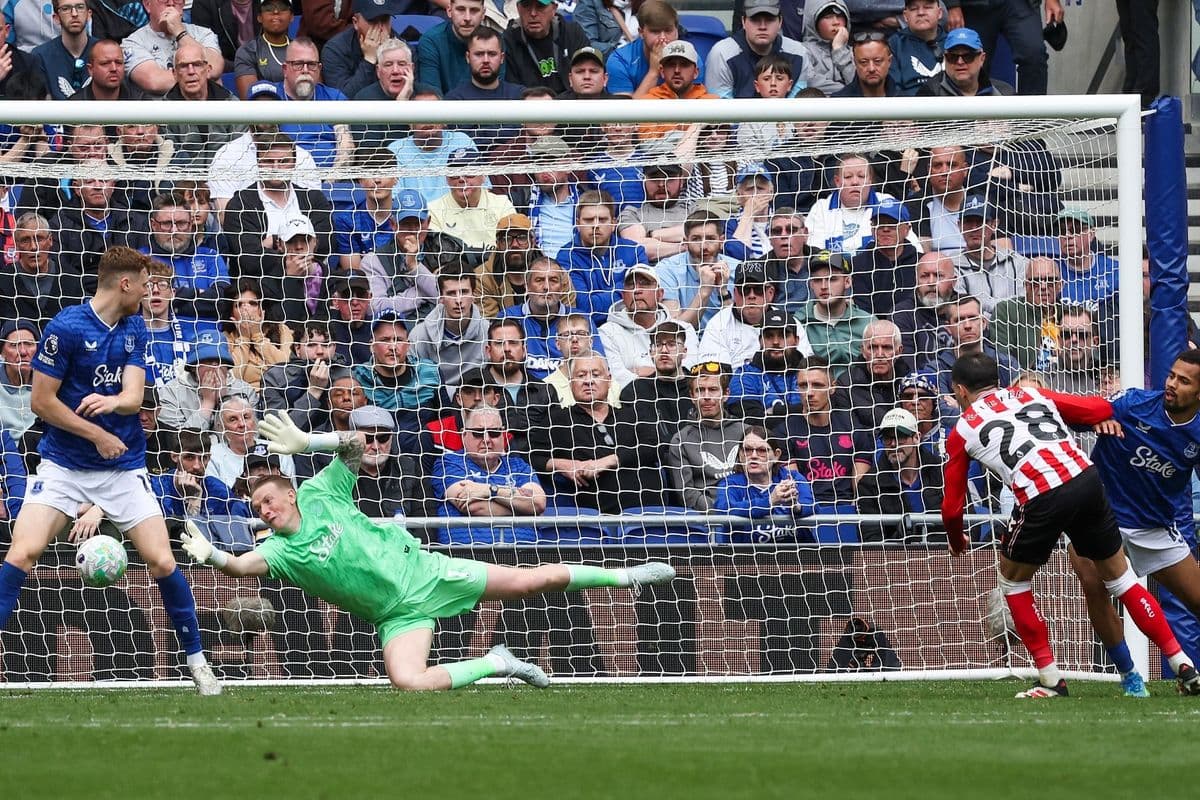
Tactically, Sunderland’s first goal on 59 minutes – B. Brobbey finishing from an E. Le Fee assist – encapsulated their adjustment. With Everton’s double pivot stretched, Le Fee found space to thread a pass into the channel, exploiting the gap between centre-back and full-back. The second goal at 81 minutes, scored by E. Le Fee and assisted by C. Rigg, underlined the impact of the bench: Rigg’s introduction gave Sunderland an extra line-breaking presence, and Le Fee’s advanced positioning punished Everton’s disorganised rest defence.
The third goal at 90 minutes, from W. Isidor assisted by H. Diarra, was the product of a Sunderland side managing transitions better than their hosts. With Everton chasing, Sunderland’s structure in midfield – now with Diarra as an energetic presence – allowed them to spring forward quickly against a broken press. That they scored three times from only 7 shots (5 inside the box) speaks to the clarity of their attacking patterns once the game opened up.
Discipline further illustrates the tactical divergence. Sunderland committed only 9 fouls and received no cards, maintaining structural control and avoiding risky duels. Everton, by contrast, saw James Garner booked at 90+6 minutes for “Foul”, capping a night where their midfield repeatedly arrived late into challenges. Those three yellows, all for “Foul”, are not just numbers; they are markers of a team increasingly out of sync with the tempo and movement of their opponent.
Statistically, Everton’s narrow edge in total shots (10 vs 7) and similar xG (1.07 vs 0.73) suggest the game was not a rout in chance creation. But Sunderland’s superior game management, substitution strategy, and exploitation of Everton’s loosened midfield structure after 73 minutes turned parity on paper into a 1-3 away win. Everton’s overall form indicators – solid possession, good passing percentage – contrasted with a weaker defensive index, exposed by three conceded goals from relatively few shots. Sunderland, by contrast, paired a compact defensive index with ruthless attacking efficiency, embodying a side whose tactical clarity outweighed raw volume of chances.