.svg&w=384&q=75 "Pitchgist logo")

Brentford and Crystal Palace Draw 2-2: A Tactical Analysis
Brentford and Crystal Palace shared a 2-2 draw at Brentford Community Stadium, but the tactical story was of contrasting structures gradually converging towards stalemate. Brentford’s 4-2-3-1 under Keith Andrews aimed to dominate territory and possession; Oliver Glasner’s 3-4-2-1 for Crystal Palace prioritised vertical threat and penalty-box efficiency. The statistical profile reflects that balance: Brentford had 58% of the ball, more passes and corners, and a marginal xG edge (2.05 to 1.67), while Palace generated more shots on target and forced Caoimhín Kelleher into three saves to Dean Henderson’s one.
Scoring Sequence
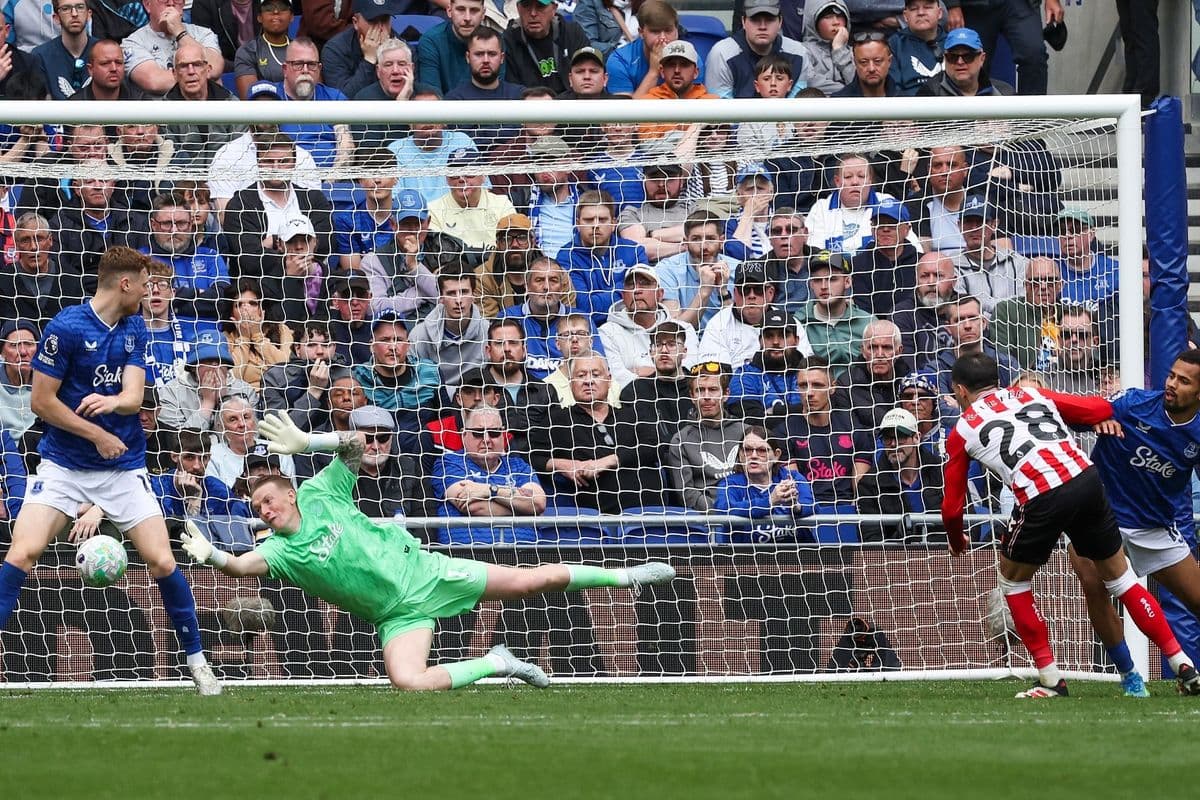
In terms of scoring sequence, Palace struck first through structure and set pattern. A VAR intervention at 4' confirmed a Crystal Palace penalty, and Ismaïla Sarr converted from the spot at 6' for 0-1. Brentford’s response built slowly from their wide overloads, and Dango Ouattara levelled at 40' with a Normal Goal, punishing Palace’s back three when forced to defend deeper and narrower than intended. After the break, Palace’s midfield box functioned better: at 52' Adam Wharton arrived from his central role to score a Normal Goal, assisted by Daniel Munoz, restoring a 1-2 lead. The final twist came late; at 88' Ouattara struck again, this time from a Normal Goal assisted by Sepp van den Berg, capping Brentford’s sustained pressure into a 2-2 final score.
Disciplinary and Control Dynamics
The disciplinary and control dynamics are also revealing. Palace collected three yellow cards, Brentford one, for a total of four cautions. Chronologically: 83' Chris Richards (Crystal Palace) — Foul; 89' Jefferson Lerma (Crystal Palace) — Foul; 90+5' Michael Kayode (Brentford) — Argument; 90+5' Dean Henderson (Crystal Palace) — Time wasting. The timing of the cautions shows Palace increasingly reactive as Brentford pushed for parity, with Henderson’s late booking underlining Palace’s desire to protect the 2-1 lead that ultimately slipped.
Structural Approach
Structurally, Brentford’s 4-2-3-1 was built to pin Palace’s wing-backs and stretch the back three horizontally. Mads Roerslev-like functions were taken by Michael Kayode on the right and Keane Lewis-Potter on the left, both nominally defenders but used aggressively to form a five-man attacking line in settled possession. The double pivot of Yehor Yarmolyuk and Vitaly Janelt provided the platform: one holding to screen transitions, the other stepping into the half-spaces to connect with Mathias Jensen and Mikkel Damsgaard between the lines.
The numbers support that approach. Brentford completed 365 of 454 passes (80%), significantly more volume and accuracy than Palace’s 228 of 339 (67%). That passing edge translated into territory: 9 corners to 4, 11 shots inside the box out of 14 total, and 3 shots on target. Yet the finishing pattern shows why they needed Ouattara’s late intervention. Despite an xG of 2.05, Brentford produced only three shots on goal, suggesting long spells of circulation that did not always break Palace’s final line. When they did, it was usually via quick switches to isolate Ouattara and the advanced full-backs against the outer centre-backs of Palace’s three.
Palace's Approach
Palace’s 3-4-2-1 was more direct and punchy. With Marc-Oliver Lacroix, Chris Riad and J. Canvot as the back three, the visitors were happy to defend in a mid-block, then spring forward through Sarr, Yeremy Pino and J. S. Larsen. The wing-backs, Munoz and Tyrick Mitchell, were crucial: Munoz in particular provided the assist for Wharton’s goal by attacking the right channel and cutting back into the central lane, exploiting the space behind Brentford’s advanced left side.
Palace’s attacking profile was sharper despite less of the ball. They produced 16 total shots to Brentford’s 14, with 5 on target and 6 blocked efforts — evidence of a team consistently getting into shooting positions even against a set defence. Their 10 shots inside the box from 42% possession reflect a clear plan: bypass midfield quickly, occupy central lanes with Wharton and Daichi Kamada, and let Sarr attack the gaps behind Brentford’s full-backs. The early penalty, confirmed by VAR, came from exactly that verticality, as Sarr’s movement and Palace’s willingness to play forward early stressed Brentford’s back four before it could settle.
Substitution Patterns
The substitution pattern subtly altered both teams’ tactical shapes. Glasner’s first change at 46' saw B. Johnson (IN) come on for Y. Pino (OUT), adding a more direct runner to stretch Brentford’s left side. At 61', J. Mateta (IN) came on for J. S. Larsen (OUT), adding a penalty-box reference point, while C. Richards (IN) replaced M. Lacroix (OUT) in the same minute, refreshing the back line without changing the base structure. J. Lerma (IN) for C. Riad (OUT) at 74' shifted Palace towards a more conservative, midfield-heavy setup to protect their 1-2 lead.
Andrews responded on 63' with J. Henderson (IN) for Janelt (OUT) and K. Schade (IN) for Jensen (OUT), moves that injected fresh legs and more vertical passing from deep. At 82', van den Berg (IN) for Kristoffer Ajer (OUT) gave Brentford a more aggressive ball-playing defender, a change that proved decisive when van den Berg later assisted Ouattara’s 88' equaliser. Finally, J. Dasilva (IN) for Yarmolyuk (OUT) at 89' was a last push for creativity from midfield.
Goalkeeping Performance
In goal, Kelleher’s three saves and goals prevented figure of 0.12 align with Palace’s 1.67 xG: he performed to expectation, neither overperforming nor capitulating, with the penalty and Wharton’s strike both high-quality chances. At the other end, Dean Henderson faced only one shot on target but also posted 0.12 goals prevented, underlining that Brentford’s 2.05 xG was driven heavily by volume and blocked efforts rather than clear one-on-ones. Palace’s defensive index was defined by compactness and last-ditch blocks (6 blocked shots), while Brentford’s was more about controlling space and limiting Palace’s passing rhythm, reflected in the visitors’ lower pass accuracy.
Conclusion
Statistically, the draw feels justified. Brentford’s overall form in this match was of a possession-dominant side that created slightly better chances on aggregate but struggled to translate pressure into frequent shots on target. Palace’s profile was that of an efficient counter-puncher: fewer passes, more direct threat, and a willingness to defend deep late on, even at the cost of discipline. The 2-2 scoreline, mirrored by xG (2.05 vs 1.67) and the shot map, encapsulates a tactical contest where Brentford’s structural control and Palace’s vertical clarity cancelled each other out.