.svg&w=384&q=75 "Pitchgist logo")
Wolves vs Fulham: Tactical Analysis of 1-1 Draw
Wolves’ 1-1 draw with Fulham at Molineux Stadium unfolded as a clash of contrasting game models: Wolves’ compact, vertical 4-2-3-1 against Fulham’s ball-dominant, structure-heavy 4-2-3-1. Despite Fulham controlling 69% possession and outshooting Wolves 13-11, the underlying xG — 1.4 for Wolves versus 1.53 for Fulham — underlined how balanced the chance quality actually was, and how much this game was about territory and control rather than pure volume.
Executive Summary
Rob Edwards set Wolves up to suffer without the ball but strike quickly, while Marco Silva’s Fulham aimed to suffocate the game with circulation and overloads between the lines. Wolves led through M. Mane on 25 minutes, but Fulham’s pressure, and a key VAR intervention, swung the momentum. A penalty confirmed by VAR for Timothy Castagne’s involvement at 45+1’ allowed A. Robinson to equalise from the spot on 45’. From there, Wolves increasingly retreated into a low block, relying on J. Sa and a rugged defensive line to preserve the point against a Fulham side that moved the ball with control but struggled to dismantle Wolves’ final-third density consistently.
Scoring Sequence & Disciplinary Log
The scoring opened in the 25th minute: M. Mane (Wolves) — assisted by Hwang Hee-Chan — finished a classic Wolves transition. The move epitomised Edwards’ plan: quick progression from a compact base, with Mane attacking the half-space and Hwang providing the final ball.
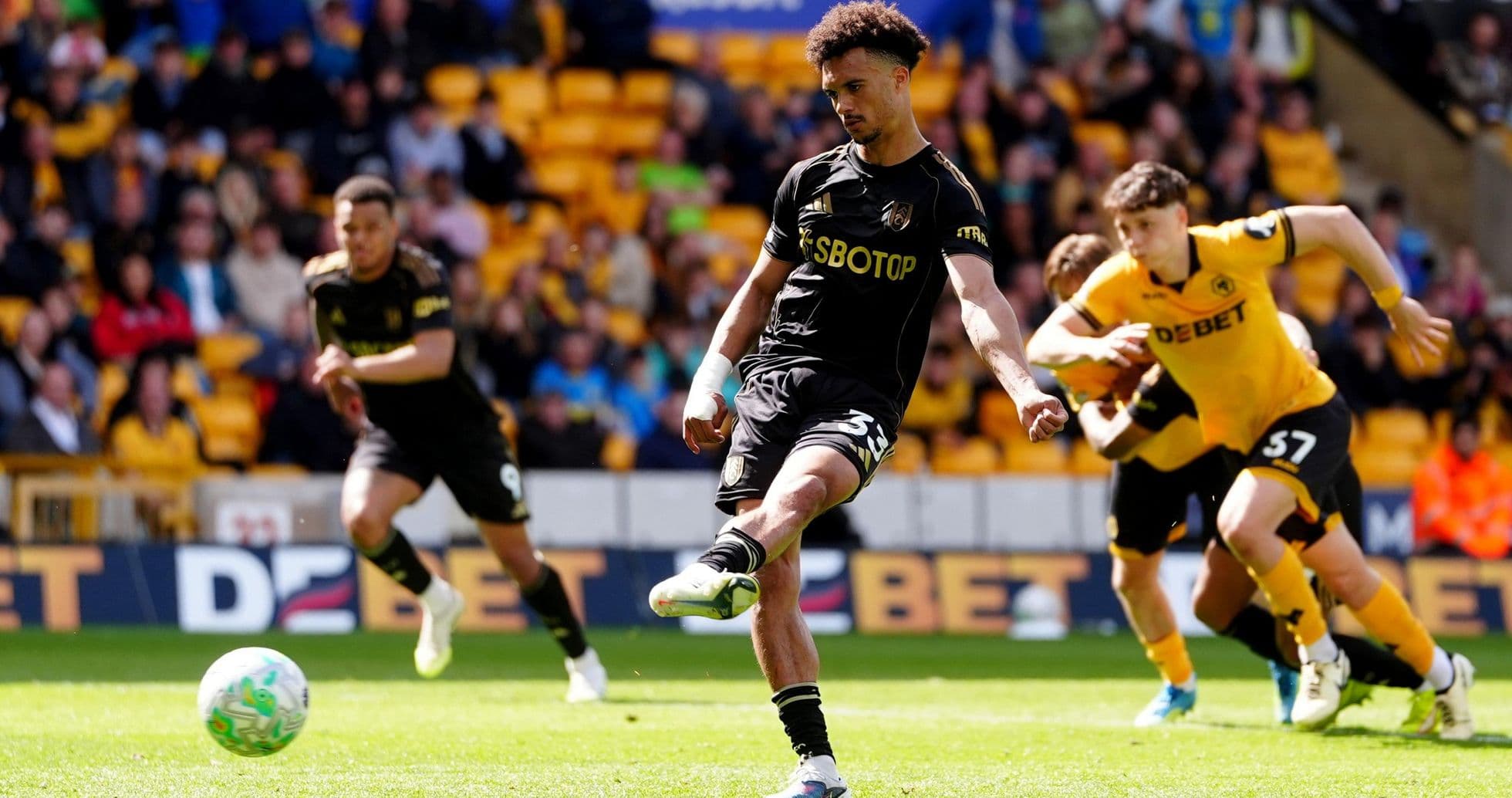
The pivotal equaliser arrived around half-time, driven by Fulham’s territorial dominance. At 45+1’, a VAR check resulted in “Penalty confirmed” for Fulham, with Timothy Castagne central to the incident. One minute earlier in real time (recorded at 45’), A. Robinson had already been awarded the penalty and converted it, striking from the spot for 1-1. The VAR confirmation at 45+1’ thus locked in the decision rather than overturning it, and Fulham went into the break level after sustained pressure.
Discipline was sparse but precise. The only card of the game came deep into added time: at 90+4’, André (Wolves) received a Yellow Card — Foul. That left the final card count as: Wolves 1, Fulham 0, Total 1. There were no reds and no additional disciplinary incidents, which matched the statistical picture of Wolves committing far more Fouls (20) than Fulham (8), but largely staying just inside the referee’s threshold.
Tactical Breakdown & Personnel
Both sides lined up in a 4-2-3-1, but the systems behaved very differently. Wolves’ back four of D. M. Wolfe, L. Krejci, S. Bueno and Y. Mosquera sat relatively narrow, with Joao Gomes and André as a double pivot screening the central zones. Ahead of them, R. Gomes, M. Mane and Hwang Hee-Chan supported A. Armstrong, forming a vertically-oriented attacking band designed to spring forward once possession was recovered.
Fulham’s 4-2-3-1, with B. Leno behind a back line of A. Robinson, C. Bassey, I. Diop and T. Castagne, was built for patient construction. S. Berge and S. Lukic operated as a double pivot, with O. Bobb, E. Smith Rowe and A. Iwobi rotating behind Rodrigo Muniz. Their 580 passes, 501 accurate (86%), contrasted sharply with Wolves’ 250 passes, 173 accurate (69%), underlining Fulham’s desire to dominate the ball and use positional play to stretch Wolves horizontally.
Wolves’ attacking plan was clear: accept long defensive phases, then break quickly through the 10 and wide channels. The goal from Mane came from precisely this pattern, with Wolves exploiting the space behind Fulham’s advanced full-backs. The fact that seven of Wolves’ 11 Total Shots came from inside the box reflected that, when they did progress, they managed to reach dangerous central areas rather than settling for speculative long-range efforts.
Defensively, Wolves’ 20 Fouls and only three Corner Kicks conceded highlighted a strategy of disrupting Fulham’s rhythm before they could create clean shooting lanes. J. Sa’s workload — four Goalkeeper Saves — aligned with Fulham’s five Shots on Goal, suggesting that Wolves generally forced Fulham into either blocked efforts (three) or less threatening shots outside the box (five).
Fulham, by contrast, built patiently, often through Berge and Lukic dropping to assist the centre-backs and create a 2-4 base against Wolves’ first line. With 69% Ball Possession, they repeatedly forced Wolves into their own third, but the xG of 1.53 showed that, while they generated a steady stream of looks, truly clear-cut chances were limited. The penalty for Robinson was their most high-value moment.
The substitutions reflected tactical fine-tuning rather than systemic overhaul. For Fulham, Kevin (IN) came on for S. Berge (OUT) at 46’, adding a more forward-minded presence from deep. At 67’, R. Jimenez (IN) replaced Rodrigo Muniz (OUT), and J. King (IN) came on for A. Iwobi (OUT), freshening the front line and adding different movement profiles against a tiring Wolves block. Later, H. Wilson (IN) for E. Smith Rowe (OUT) and S. Chukwueze (IN) for O. Bobb (OUT) at 79’ sharpened Fulham’s wide threat and directness.
For Wolves, T. Arokodare (IN) replaced A. Armstrong (OUT) on 72’, providing a more physical reference point to hold up rare clearances. J. Bellegarde (IN) for Hwang Hee-Chan (OUT) at 79’ tilted Wolves slightly more towards ball-carrying in transition rather than pure depth runs. Finally, H. Bueno (IN) for D. M. Wolfe (OUT) and Pedro Lima (IN) for R. Gomes (OUT) at 85’ were late-game stabilising changes, adding fresh legs to protect the flanks and help see out pressure.
In goal, J. Sa’s goals_prevented figure of -0.64, combined with Fulham’s 1.53 xG, indicates that he conceded slightly more than the model might expect, particularly given the penalty, but his four saves were still critical in preserving the draw. At the other end, B. Leno recorded two Goalkeeper Saves against Wolves’ 1.4 xG and also carried a goals_prevented of -0.64, suggesting he, too, conceded roughly in line with chance quality.
The Statistical Verdict
The numbers crystallise the story: Fulham’s control versus Wolves’ punch. Fulham’s 69% Ball Possession, 580 passes (501 accurate, 86%), and 13 Total Shots (five on target) show a side that dictated tempo and territory. Yet their xG of 1.53, only marginally above Wolves’ 1.4, underlines that their dominance did not translate into overwhelming chance quality, with Wolves’ compact 4-2-3-1 and 20 Fouls effectively clogging central spaces.
Wolves, with 31% Ball Possession and 250 passes (173 accurate, 69%), leaned into a low-volume, high-impact approach. Eleven Total Shots, seven inside the box, and three Shots on Goal reflect a team that picked its moments carefully. The single Yellow Card — André for Foul at 90+4’ — and Fulham’s clean disciplinary sheet confirm that this was more about structural tension than chaos. In the end, the 1-1 scoreline at Molineux Stadium aligned closely with the xG balance and told of a tactical stalemate: Fulham’s methodical control blunted by Wolves’ organised resistance and incisive transitions.