.svg&w=384&q=75 "Pitchgist logo")
Ivory Coast Edges Ecuador 1-0 in Tactical Showdown
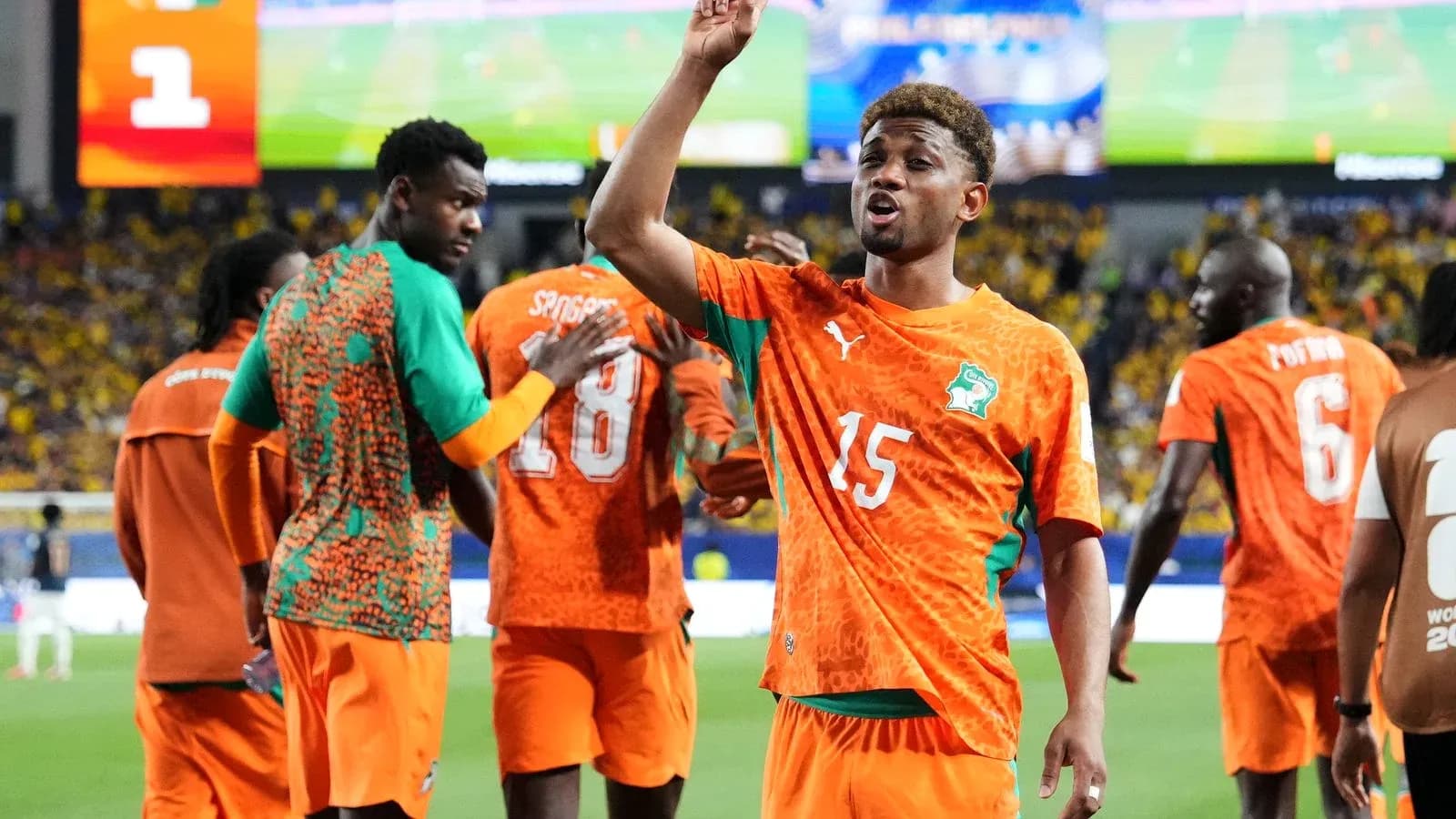
Ivory Coast’s 1-0 win over Ecuador at Lincoln Financial Field was a controlled, structurally coherent performance built on a clear 4-4-2 identity and superior chance quality. Despite trailing slightly in possession (48% to Ecuador’s 52%), Emerse Fae’s side produced more shots (15–12), more efforts on target (4–1) and the higher xG (1.52 to 1.01), ultimately finding the decisive breakthrough in the 90th minute through substitute Amad Diallo.
Both teams lined up in 4-4-2, but their interpretations diverged. Ivory Coast’s shape was a classic double-pivot plus two narrow wide midfielders, while Ecuador’s front four behaved more fluidly, often resembling a 4-2-3-1 in possession with Pedro Vite stepping into the half-spaces and Gonzalo Plata drifting inside from the right.
In the Ivorian back line, Guéla Doué and Ghislain Konan played relatively conservative full-back roles, advancing in staged fashion rather than simultaneously. That decision underpinned Ivory Coast’s defensive stability: despite conceding 12 shots, they allowed only one on target. The centre-back pairing of Wilfried Singo and Emmanuel Agbadou defended aggressively on the front foot, stepping into midfield to contest first balls into Enner Valencia and limit Ecuador’s ability to set attacks centrally. Ecuador’s xG of 1.01 suggests they did manage some promising shooting positions, but the final actions were often rushed or poorly executed, reflected in the low on-target count.
In midfield, the game’s tactical hinge was the duel between Franck Kessié and Seko Fofana on one side, and Moisés Caicedo with Vite on the other. Ivory Coast’s central pair sought to impose verticality: Fofana frequently broke lines with forward carries and early passes, while Kessié balanced the structure with more positional discipline. Their aggression without the ball was notable, but it came at a disciplinary cost. The yellow card to Seko Fofana for “Roughing” at 28' and to Kessié for “Tripping” at 38' highlighted how Ivory Coast were willing to accept tactical fouls to disrupt Ecuador’s counters, especially when Plata or John Yeboah tried to transition quickly.
Bazoumana Touré and Yan Diomande, nominally wide midfielders, often tucked inside, creating central overloads and freeing full-backs to provide width selectively. This narrowness helped Ivory Coast dominate second balls and sustain pressure: they produced 8 shots inside the box from 15 total, underlining the territorial advantage they built through their structure and pressing triggers.
Ecuador’s 4-4-2 had more of a counter-attacking slant. The back four, with Willian Pacho and Joel Ordóñez at its heart, defended relatively deep, inviting Ivory Coast to play in front of them. Caicedo’s role was critical: he screened passing lanes into the Ivorian forwards and tried to launch transitions once possession was regained. However, Ecuador’s inability to consistently connect their first and second passes in transition meant many promising situations fizzled out. Their 492 passes at 85% accuracy suggest competence in circulation, but much of this came in safer zones rather than in decisive progression.
The substitution pattern around the 56th minute was tactically decisive. For Ecuador, Alan Minda (OUT) and Nilson Angulo (IN) hinted at a desire for more direct running in wide areas, but it was Ivory Coast’s double change that truly shifted the attacking dynamic. Elye Wahi (OUT) with Ange-Yoan Bonny (IN), and Bazoumana Touré (OUT) with Amad Diallo (IN), re-energised the front line. Bonny offered more physical presence and back-to-goal play, allowing Ivory Coast to hold the ball higher up the pitch, while Diallo introduced a sharper, more unpredictable threat between the lines and in wide pockets.
Later, at 77', Christopher Inao Oulaï (IN) for Nicolas Pépé (OUT) and Ibrahim Sangaré (IN) for Seko Fofana (OUT) completed the rebalancing. Sangaré provided fresh legs and defensive security in midfield, allowing Kessié to push a little higher at times without exposing the back four. For Ecuador, Jackson Porozo (IN) for Alan Franco (OUT) at 62' and Kevin Rodriguez (IN) for Enner Valencia (OUT) at 77' signalled a shift towards more aerial and physical presence in the back line and front line respectively, but they did not significantly alter the expected goals trend.
Defensively, Ivory Coast’s plan was validated by the numbers. They committed 10 fouls to Ecuador’s 13, but their fouling profile was more controlled, mostly in midfield zones to stop transitions. The third Ivorian booking, Guéla Doué for “Tripping” at 40', came from a wide defensive duel, again underlining the intensity of their man-oriented defending on the flanks. Ecuador’s only yellow card, to Jackson Porozo for “Holding” at 73', reflected the mounting pressure they faced as Ivory Coast chased the winner and forced more desperate defending.
In goal, Yahia Fofana (Ivory Coast) was largely protected by the structure in front of him, needing to make just 1 save. His role was more about high starting positions and sweeping behind the high defensive line than about shot-stopping volume. Hernán Galíndez (Ecuador), by contrast, made 3 saves, and the goals prevented value of 0.22 for both sides indicates that neither goalkeeper was forced into extreme, xG-defying heroics; rather, the match was decided by cumulative territorial and qualitative superiority.
The decisive moment at 90' encapsulated Ivory Coast’s tactical evolution across the 90 minutes. With the structure still in a nominal 4-4-2, the personnel and positioning looked more like a 4-2-3-1 in the final phase, with Diallo operating as an advanced wide playmaker. The winning goal, scored by Amad Diallo and assisted by Wilfried Singo, reflected the full-back’s license to advance once Sangaré had entered to stabilise midfield. Singo’s involvement high up the pitch was not accidental but the product of a calculated late-game shift: with Ecuador tiring and pinned deeper, Ivory Coast pushed their right-back forward to create an extra man in the final third. Diallo’s finish converted Ivory Coast’s xG edge into a tangible lead right at the end of regular time.
Statistically, Ivory Coast’s 470 passes with 397 accurate (84%) show a side comfortable in structured possession, but not obsessed with sterile circulation. Their 3 corner kicks to Ecuador’s 5 confirm that Ecuador had spells of pressure, yet the sharper shot profile and higher xG underline that Ivory Coast’s attacks were better constructed. Ecuador’s 12 shots, 5 inside the box, and xG of 1.01 point to a team that reached decent positions but lacked the final pass or composure to truly test Fofana.
Overall, this was a tactically mature group-stage performance from Ivory Coast: disciplined without the ball, increasingly assertive with it, and decisive in the timing and nature of their substitutions. Ecuador’s structure was sound and their passing metrics respectable, but their inability to turn possession and field position into high-quality shots left them vulnerable to exactly the kind of late, well-crafted strike that settled the match 1-0.