.svg&w=384&q=75 "Pitchgist logo")
Germany's Tactical Masterclass Against Curaçao
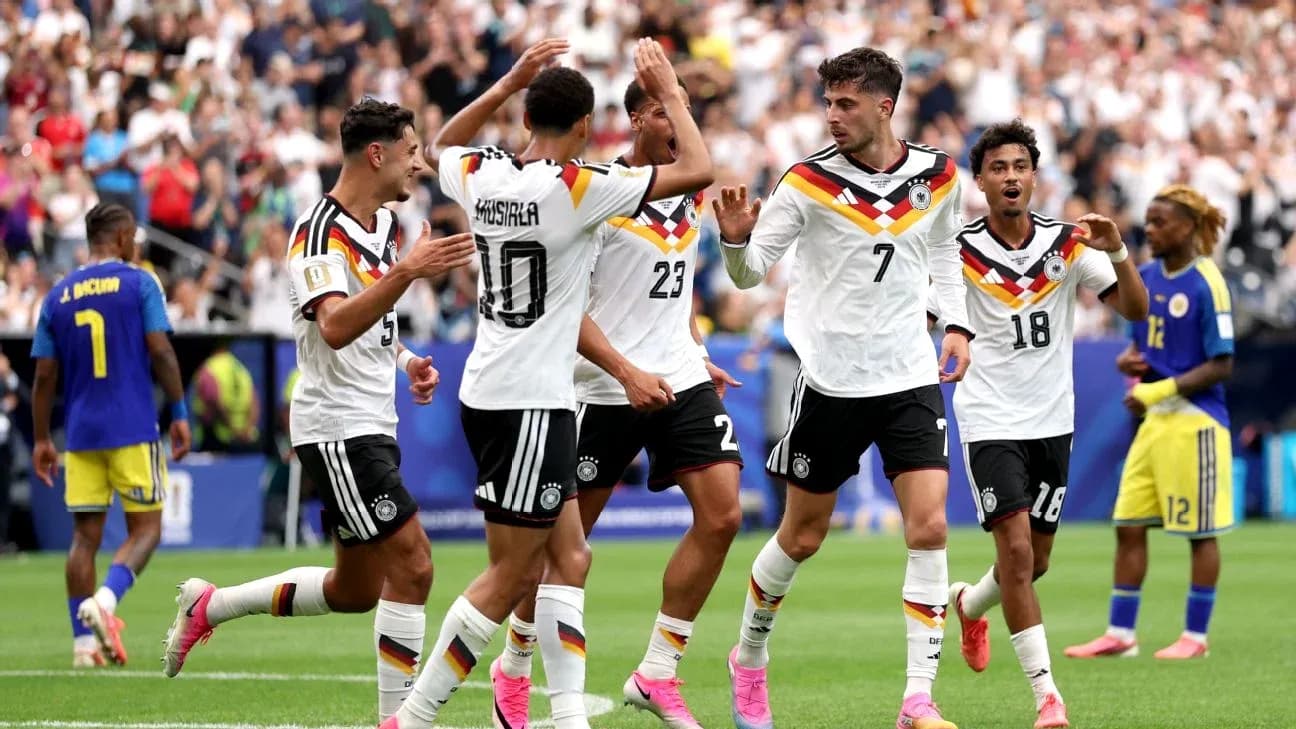
Germany’s 7-1 dismantling of Curaçao at NRG Stadium was a tactical rout built on structure, intensity, and ruthless exploitation of space. Julian Nagelsmann’s 4-2-3-1 dominated both territory and tempo, pinning Dick Advocaat’s 4-3-1-2 deep and stretching its narrow spine until it broke. With 65% possession, 27 total shots and 22 efforts from inside the box, Germany imposed a positional-play blueprint that Curaçao’s compact but passive block could not withstand.
The opening pattern was clear within minutes. Germany’s back four of Joshua Kimmich, Jonathan Tah, Nico Schlotterbeck and Nathaniel Brown fanned wide, with Aleksandar Pavlović and Felix Nmecha forming a double pivot that constantly offered inside connections. Jamal Musiala operated as the central 10, with Florian Wirtz and Leroy Sané between the lines and Kai Havertz as a roaming 9. The first goal on 6 minutes crystallised the plan: Germany created an overload in the right half-space, Wirtz found Nmecha’s late run, and Nmecha finished to cap a classic third-man pattern.
Curaçao’s 4-3-1-2 was designed to crowd central lanes. Livano Comenencia, Leandro Bacuna and Juninho Bacuna formed a narrow midfield trio, with Tahith Chong nominally ahead as a connector to the front pair Jürgen Locadia and Sontje Hansen. In theory, this should have clogged Musiala’s and Wirtz’s zones. In practice, Germany’s full-backs and wingers stretched the last line, forcing Curaçao’s midfield to constantly shuffle laterally, opening seams for vertical passes and cut-backs.
The visitors’ lone goal on 21 minutes, finished by Comenencia, actually came from one of their rare successful transitions. With Germany’s full-backs high, Curaçao finally accessed space behind the German midfield, combining quickly enough to isolate Comenencia arriving from deep. It was one of only eight shots Curaçao managed all match, underlining how little sustained threat they produced despite the occasional counter window.
Germany’s dominance in chance creation was reflected in the metrics: 12 shots on goal from 27 attempts, with 22 inside the box, against Curaçao’s 2 shots on goal from 8 total. The 3.91 xG figure for Germany matches the eye test of repeated high-value opportunities; Curaçao’s 0.4 xG confirms that Comenencia’s goal was an outlier in an otherwise stifled attack.
The second and third German goals before the break showed the breadth of their attacking repertoire. Schlotterbeck’s 38th-minute strike, assisted by Brown, came from a set-phase-style occupation of the box, with a defender stepping into a finishing role as the front line dragged markers away. Havertz’s penalty at 45+5’ reflected Germany’s constant presence in the area; repeated entries forced defensive errors and panicked decisions from Curaçao’s back line.
Second Half
At half-time, the 3-1 scoreline already mirrored a structural mismatch, but Nagelsmann’s side accelerated further after the break. The 4-2-3-1 morphed in possession into a 2-3-5, with Kimmich stepping inside to form a midfield three alongside Pavlović and Nmecha, while Wirtz and Sané held width and Musiala and Havertz attacked the half-spaces. Musiala’s 47’ goal, assisted by Kimmich, was a direct consequence of this: Kimmich underlapped from his nominal right-back zone into central midfield, threading a vertical pass into Musiala arriving between Curaçao’s centre-backs and midfield.
Substitutions sharpened, rather than disrupted, Germany’s structure. At 64’, Deniz Undav (IN) came on for Jamal Musiala (OUT), adding a more direct penalty-box presence while Havertz could drift and combine. On 73’, David Raum (IN) replaced Brown (OUT), Antonio Rüdiger (IN) came on for Tah (OUT), and Leon Goretzka (IN) replaced Nmecha (OUT). Each change maintained the 4-2-3-1 shell but refreshed intensity: Raum offered overlapping width on the left, Rüdiger added vertical passing from the back, and Goretzka injected late runs from midfield.
Undav’s influence was immediate. Brown’s 68’ goal, assisted by Undav, came from Germany attacking the left channel, with Undav linking play and Brown exploiting the vacated lane. Undav then scored himself on 78’, again fed by Kimmich, who repeatedly found space to deliver from the right. By this stage, Curaçao’s 4-3-1-2 had collapsed into a low 4-5-1, the second striker dropping just to help absorb waves of pressure, but without any coordinated pressing triggers to launch counters.
The final blow came on 88 minutes: Havertz’s second of the night, assisted by Undav, symbolised Germany’s ability to keep layering combinations even with the result beyond doubt. The front line interchanged freely, with Havertz arriving as a finisher after Undav again linked play in the final third.
Defensively, Germany’s structure was almost untested but still disciplined. With 65% possession and only 8 shots conceded, the 4-2-3-1 out of possession resembled a 4-4-2, with Musiala stepping up alongside Havertz to screen Curaçao’s first line. The double pivot tracked Comenencia and the Bacuna brothers, preventing them from turning and driving. Germany committed 18 fouls to Curaçao’s 11, a by-product of aggressive counter-pressing rather than being out of control; they simply refused to allow transitions to develop.
In goal, Manuel Neuer (Germany) faced only 2 shots on target and made 1 save, a reflection of the defensive shield in front of him more than any extended examination. At the other end, Eloy Room (Curaçao) was overwhelmed: he made 4 saves but conceded 7, with his goals prevented figure at -2.47 underlining that he underperformed the xG he faced. Germany’s own goals prevented metric, also at -2.47, suggests that Comenencia’s finish and perhaps another chance exceeded what the model expected, but Curaçao never had the volume to exploit that.
On the ball, Germany’s passing network was dominant and clean: 633 total passes, 550 accurate at 87%. The ball circulated quickly through Pavlović and Nmecha, then later Goretzka, constantly shifting Curaçao’s block. Curaçao completed 276 of 336 passes (82%), which is respectable but misleading: most of their passing was in deeper zones under little pressure once Germany had retreated into rest defence.
Set pieces and territorial control told the same story. Germany won 8 corner kicks to Curaçao’s 1 and registered 8 blocked shots, indicating sustained pressure and repeated efforts from dangerous areas. Curaçao had 0 blocked shots, a marker of how infrequently they even reached shooting positions against a settled defence.
Overall, this was a comprehensive tactical exhibition from Germany: a fluid 4-2-3-1 that controlled every phase, generated a high volume of quality chances, and suffocated Curaçao’s 4-3-1-2 both centrally and in transition. The 7-1 scoreline, 3.91 xG and lopsided shot profile accurately reflect the gulf in structure, intensity, and execution.