.svg&w=384&q=75 "Pitchgist logo")
Everton vs Sunderland Match Preview: Key Stats and Predictions
On 17 May 2026, the Hill Dickinson Stadium in Liverpool stages a tense late‑spring meeting between Everton and Sunderland, with mid‑table comfort masking a fierce battle for pride, prize money and momentum. Everton, at home and a point ahead, are pushing to cement a top‑half finish, while Sunderland arrive on Merseyside knowing that a win could flip the positions and cap their return to the Premier League with a statement result.
Season Context
Everton sit 10th with 49 points from 36 matches, having scored 46 goals and conceded 46. A perfectly balanced goal difference (46 scored, 46 conceded) underlines a campaign of fine margins, where 13 wins, 10 draws and 13 defeats have kept them clear of trouble but short of the European conversation.
Sunderland are 12th with 48 points from 36 games, built on 37 goals scored and 46 conceded. The negative goal difference (-9) reflects a side that has often been competitive but occasionally overpowered, yet 12 wins and 12 draws show enough resilience to secure a solid mid‑table return to the top flight.
Form & Momentum
Everton’s recent league form string reads “DDLLD”, a sequence that captures a stuttering spell (two defeats in five) where they have struggled to turn performances into victories. Over the full campaign they average roughly 1.28 goals scored and 1.28 goals conceded per game (46 goals for and 46 against in 36 matches), suggesting a team that lives on the edge of tight contests and rarely runs away with matches.
Sunderland arrive with the form string “DDLLW”, another uneven run that includes two defeats but also a morale‑boosting win (one victory in the last five). Their season averages of about 1.03 goals scored and 1.28 conceded per match (37 for, 46 against over 36 games) point to a side that often keeps games close but can be punished when stretched.
Head-to-Head Patterns
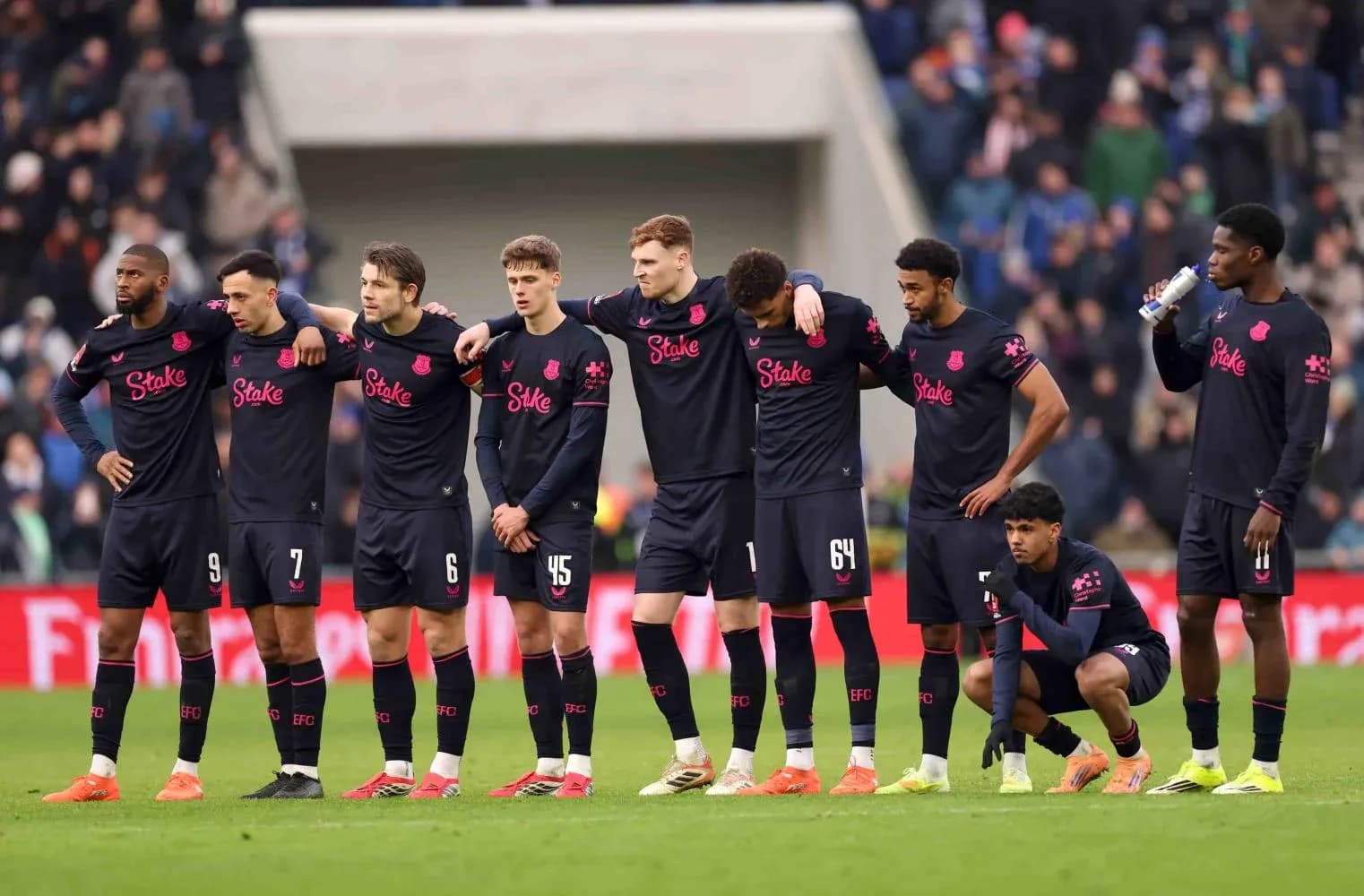
Recent history between these clubs has swung sharply. On 10 January 2026, Sunderland knocked Everton out on penalties after a 1-1 draw at the Hill Dickinson Stadium (FA Cup, season 2025, January 2026), a result that still stings on the blue half of Liverpool. Earlier in the league calendar, on 3 November 2025, the sides shared the points in a 1-1 draw at the Stadium of Light (Premier League, season 2025, November 2025), underlining how tight this matchup has become. Going back further, Everton enjoyed a commanding 3-0 home victory over Sunderland on 20 September 2017 at Goodison Park (League Cup, season 2017, September 2017), a reminder of how dominant they once were in this fixture.
Tactical Preview
At home, Everton’s statistical profile and lineups data point strongly towards a 4-2-3-1 as their base system (21 uses), with the option of a 4-3-3 as a secondary shape. With 46 goals from 36 league matches, Everton lean on a fluid attacking midfield band to supply their central striker, while the double pivot offers protection for a back line that has conceded at the same rate it scores (46 goals conceded in 36 games). J. Garner is a key figure in this structure; listed as a midfielder for Everton, J. Garner has produced 7 assists and 2 goals while attempting 1665 passes at 86% accuracy and making 115 tackles, 9 blocks and 54 interceptions, combining progression and ball‑winning from deeper areas. On the left, J. Grealish adds craft and incision, with 6 assists and 2 goals from 20 appearances, plus 40 key passes and 57 dribble attempts, making him a primary creative outlet in the final third.
Defensively, Everton can be combative but ill‑disciplined at times: J. Garner has collected 11 yellow cards, while J. O’Brien, a defender, has one red card and 4 yellows, indicating an aggressive back‑line approach that can both disrupt and endanger them. Their season‑long balance of 46 goals conceded in 36 matches mirrors their attacking output, reinforcing the sense of a team that accepts defensive risk to push numbers forward.
Sunderland’s tactical identity is more flexible. Their most used shape is also a 4-2-3-1 (19 matches), but they have regularly switched to 4-3-3 and 5-4-1 (5 matches each), with further appearances in 4-4-2 and 4-1-4-1. That variety hints at a coach willing to tailor the game plan, especially away from home where Sunderland have 14 goals scored and 27 conceded in 18 league matches (0.78 scored and 1.5 conceded per away game based on team statistics, consistent with their standings totals over the full sample). In midfield, G. Xhaka is the metronome, with 6 assists, 1684 passes at 83% accuracy and 49 tackles, while E. Le Fée adds a more dynamic edge with 4 goals, 5 assists and 83 tackles, offering both ball progression and counter‑pressing threat.
At the back, Sunderland rely on a cluster of committed defenders. T. Hume, listed as a midfielder in the squad but deployed with defensive responsibilities, has 64 tackles, 12 blocks and 25 interceptions along with 9 yellow cards, reflecting his role as an aggressive ball‑winner on the flank. Reinildo and D. Ballard bring further bite; both have one red card each and solid tackling numbers (34 and 33 tackles respectively), underlining a back line that will not shy away from physical duels but can flirt with disciplinary trouble.
Given Everton’s stronger attacking metrics (46 league goals, with their predictive model giving them 64% in attack comparison) and Sunderland’s more modest scoring record (37 league goals, 36% in attack comparison), the hosts are expected to dictate territory and possession. Sunderland’s tactical flexibility and ball‑playing midfielders give them a clear counter‑attacking route, but their higher goals conceded column (46, matching Everton’s) suggests they may struggle to contain sustained pressure at the Hill Dickinson Stadium.
Statistical Snapshot
- Competition: Premier League, season 2025 — 17 May 2026.
- Venue: Hill Dickinson Stadium, Liverpool.
- Prediction: Win or draw — Double chance : Everton or draw.
- Win Probabilities: Home 45% / Draw 45% / Away 10%.
- Model: Everton 60.0% — Sunderland 40.2%.
Betting Verdict
The data and context both lean towards Everton avoiding defeat, which aligns with the model’s “Win or draw” call and the advice of “Double chance : Everton or draw.” With home win odds clustered around 1.80–1.90 and the draw roughly in the 3.60–3.80 range, backing Everton on the double‑chance market looks a pragmatic way to side with the stronger attacking team (46 league goals) while respecting Sunderland’s capacity to grind out results. The recent 1-1 league draw at the Stadium of Light and Sunderland’s FA Cup penalty triumph at the Hill Dickinson Stadium warn against assuming a straightforward home victory, but Everton’s superior attacking numbers and the model edge (60.0% to 40.2%) justify a cautious pro‑Everton stance.