.svg&w=384&q=75 "Pitchgist logo")
West Ham's 3-0 Victory Over Leeds in Premier League Finale
The London Stadium’s final act of the 2025–26 Premier League season ended with a twist of irony. West Ham produced one of their most complete home performances of the campaign, beating Leeds 3–0, yet following this result they still slipped through the trapdoor, finishing 18th with 39 points and a goal difference of -19 (46 scored, 65 conceded). Leeds, beaten comprehensively on the day, nonetheless closed out the season in 14th on 47 points, their -7 goal difference (49 for, 56 against) a more forgiving reflection of a side that had learned to survive.
This was Round 38, not a cup tie, but it carried the tension of a knockout. The stakes shaped the tactical choices. West Ham, whose seasonal DNA has been streaky and fragile—10 wins, 9 draws, 19 defeats overall—returned to their most-used structure: a 4-2-3-1 that tried to blend solidity with direct threat. Nuno Espirito Santo trusted a back four of K. Walker-Peters, K. Mavropanos, A. Disasi and M. Diouf in front of M. Hermansen, with T. Soucek and M. Fernandes as a double pivot. Ahead of them, a creative trio of J. Bowen, Pablo and C. Summerville supported lone forward T. Castellanos.
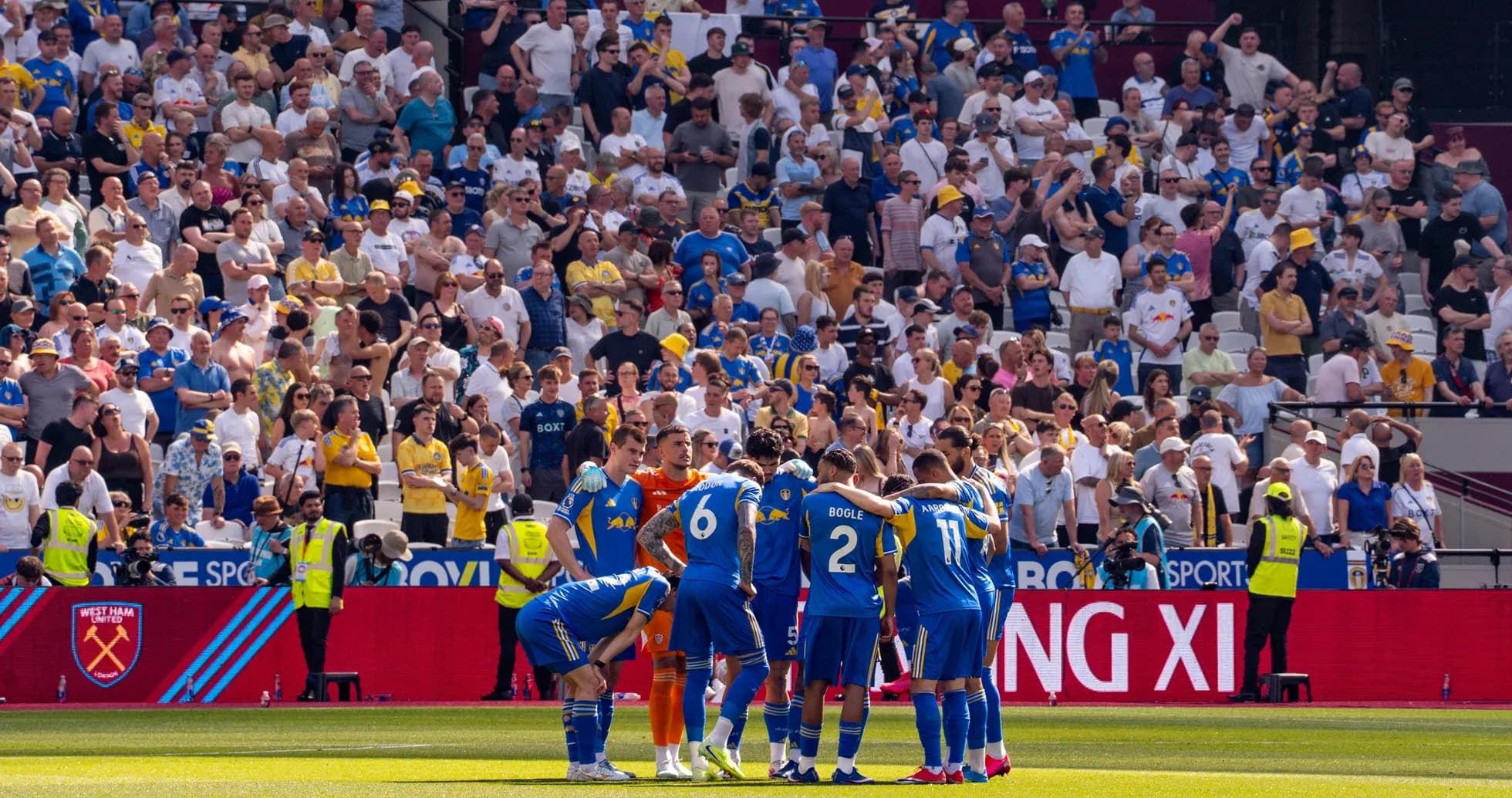
Leeds arrived in London with a different identity: Daniel Farke’s 3-5-2, a shape he had leaned on heavily this season. J. Rodon, J. Bijol and P. Struijk formed the back three in front of K. Darlow, with J. Bogle and J. Justin as wing-backs. The midfield core of E. Ampadu, B. Aaronson and A. Tanaka sat behind a front pairing of D. Calvert-Lewin and L. Nmecha. On their travels this season, Leeds had been stubborn rather than spectacular—only 2 away wins but 9 draws, scoring 20 and conceding 35—so the shape was designed more to absorb and counter than to dominate.
The absences on both sides subtly re-drew the tactical map. For West Ham, L. Fabianski’s back injury kept a veteran voice off the pitch, placing full trust in Hermansen’s distribution and command of the box. A. Traore’s muscle injury removed a vertical, one-v-one outlet from the bench, nudging Nuno towards a more possession-linked wide threat through Bowen and Summerville rather than pure power and pace.
Leeds were hit harder numerically. I. Gruev (knee), G. Gudmundsson (hamstring), S. Longstaff (hernia), N. Okafor (calf) and A. Stach (ankle) all missed out. The cumulative effect was a thinning of Farke’s midfield options and a loss of rotation between ball-winners and progressive passers. Without Stach’s presence as an additional screening midfielder and Okafor’s movement as a flexible forward option, Leeds’ 3-5-2 felt more rigid. Ampadu, already the side’s enforcer and metronome, was asked to do even more.
Discipline has been a season-long subplot for both clubs, and it hovered over this match as an invisible pressure. West Ham’s yellow-card profile shows a spiky side that often boils over around half-time and late on: 23.19% of their yellows came between 31–45 minutes and 21.74% between 91–105 minutes, with a noticeable 20.29% spike from 61–75. Red cards have also been a theme; three in total, split evenly across the second half in 46–60, 76–90 and 91–105. That temperament is embodied by players like T. Soucek and J. Todibo (even though Todibo did not feature here): Soucek’s season includes 1 red card and a combative profile of 262 duels and 37 fouls committed, while Todibo’s 1 red and 5 yellows underscore the edge in West Ham’s back line.
Leeds, by contrast, have been more controlled but still combative. E. Ampadu stands out as the league’s yellow-card magnet with 10 bookings. His 81 tackles, 18 successful blocks and 50 interceptions tell the story of a midfielder who lives on the fault line between control and chaos. Overall, Leeds’ yellows cluster most heavily between 61–75 minutes (21.88%), with a secondary swell in the 31–45 and 76–90 windows. Heading into this game, that pattern suggested that if the match became stretched in the second half, Ampadu’s interventions would be decisive—either as match-saving tackles or costly fouls.
The “Hunter vs Shield” duel was clearest in Leeds’ attack against West Ham’s leaky defence. D. Calvert-Lewin came into the day as one of the league’s more productive strikers: 14 goals and 1 assist in 35 appearances, with 66 shots and 34 on target. He is not just a finisher but a constant aerial and physical presence, engaging in 465 duels and drawing 38 fouls. Yet Leeds’ away scoring average of 1.1 goals per game on their travels met a West Ham defence that, at home, conceded 1.6 per game—porous, but on this day finally compact and aggressive.
On the other side, the “Engine Room” battle pitted West Ham’s creators against Leeds’ screen. J. Bowen, one of the league’s premier chance-makers with 11 assists and 9 goals across 38 appearances, operated nominally from the right but drifted into half-spaces, using his 45 key passes and 119 dribble attempts to destabilise the Leeds block. His duel with Ampadu was the tactical hinge: Bowen trying to receive between the lines and turn; Ampadu stepping out from the central trio to close space, backed by Bijol and Struijk.
Nuno’s 4-2-3-1 gave West Ham natural width and a clear pressing trigger. With Pablo and Summerville tucking inside at times, Walker-Peters and Diouf could push high, pinning Bogle and Justin back and isolating Leeds’ forwards. Behind them, Soucek’s late runs into the box and aerial threat added a second wave that Leeds’ back three struggled to track whenever Bowen or Pablo delivered from wide.
Farke’s 3-5-2, in theory, could overload midfield and exploit transitions, especially with Aaronson’s mobility between the lines. But with so many midfielders missing, the bench lacked like-for-like options to adjust the structure mid-game. When Leeds fell behind, shifting the 3-5-2 into a more aggressive 3-4-3 would have meant sacrificing central stability, something Farke seemed reluctant or unable to do decisively.
In statistical terms, the season-long numbers had hinted at a tight contest. West Ham, at home, averaged 1.4 goals scored and 1.6 conceded; Leeds, away, averaged 1.1 scored and 1.8 conceded. That pointed towards a marginal edge for West Ham in attacking productivity at the London Stadium, offset by their defensive frailty. Yet the 3–0 scoreline suggests they finally married their attacking threat with rare defensive control.
Any xG-based reading of these squads before kick-off would likely have shaded Leeds as the more balanced team over 38 games—slightly better defensive record overall (56 against versus West Ham’s 65) and a steadier form line of draws and narrow defeats. But football is situational, and on this afternoon the context belonged to West Ham: desperation, home crowd, and a structure built around Bowen’s creativity and Soucek’s industry.
Following this result, the paradox is stark. West Ham exit the Premier League having shown what their 4-2-3-1 can look like when it clicks: aggressive full-backs, a hard-running double pivot, and a playmaker-winger in Bowen capable of unpicking even a five-man midfield. Leeds, beaten but safe, leave London reminded that while Calvert-Lewin can lead the line and Ampadu can anchor the middle, the next step in their evolution will demand more depth and flexibility behind those pillars—especially away from home, where their 2 wins and 8 defeats underline just how fragile their shield can be when the hunter is asked to roam too far from support.