.svg&w=384&q=75 "Pitchgist logo")
Manchester City vs Aston Villa: Tactical Analysis of a Shocking 2-1 Upset
Under grey Manchester skies at the Etihad Stadium, a season’s worth of narratives converged into a jarring twist. Manchester City, heading into this game as the division’s most polished home machine, fell 2-1 to Aston Villa in a result that underlined why both sides finished inside the top four, but with very different identities.
Following this result, City close their Premier League campaign in 2nd place on 78 points, their overall goal difference of 42 a product of 77 goals scored and 35 conceded. At home this season they have been ruthless: 14 wins from 19, with 45 goals for and only 14 against, averaging 2.4 goals scored and 0.7 conceded at the Etihad. Villa, meanwhile, end in 4th on 65 points, with a leaner goal difference of 7 (56 for, 49 against). On their travels they have been far more volatile: 7 wins, 6 draws, 6 defeats, scoring 24 and conceding 27, an away average of 1.3 goals for and 1.4 against.
This was not a cup tie, but the stakes felt knockout‑like: the final day of the Premier League season, “Regular Season - 38”, with Champions League places already secured yet reputations still on the line. Pep Guardiola rolled out an aggressive 4-2-2-2, while Unai Emery stayed loyal to the 4-2-3-1 that has defined Aston Villa’s year.
Tactical Voids and Absences
The team sheets told their own story of compromise and adaptation. City, despite their depth, were without their most devastating finisher: Erling Haaland, the league’s top scorer with 27 goals and 8 assists in total this campaign, was not in the matchday squad. His absence forced Guardiola to reimagine the front line, with P. Foden and T. Reijnders starting as a fluid forward pair, supported by A. Semenyo and Savinho from the half-spaces.
At the other end, Villa were stripped of spine and security. E. Martinez, usually a commanding presence in goal, missed out with a finger injury, handing the gloves to M. Bizot. In midfield, B. Kamara’s knee injury removed a key screen in front of the defence, while Alysson’s muscle issue further thinned Emery’s options. For a side that has conceded 49 goals overall, losing two defensive pillars on the final day might have signalled vulnerability.
Yet Emery’s solution was structural rather than reactive. L. Bogarde and Douglas Luiz formed the double pivot, with L. Bailey, R. Barkley and E. Buendia operating behind O. Watkins. It was a configuration that prioritised compactness and transition over control.
Disciplinary profiles also framed the contest’s edge. City have accumulated a notable late-game yellow-card spike this season, with 20.90% of their cautions arriving between 76-90 minutes. Villa, by contrast, are most combustible just after the restart, with 29.31% of their yellows in the 46-60 window and their only red card in the 61-75 period. The risk zones were clear: City’s frustration late, Villa’s aggression early in second halves.
Key Matchups
Hunter vs Shield
Without Haaland on the pitch, the “hunter” mantle for City passed to Foden. Across the season he has contributed 7 goals and 5 assists in total, operating as a hybrid creator-finisher. In this 4-2-2-2, he started nominally as a forward but repeatedly dropped to knit play with B. Silva and Nico.
Their collective task was to unpick a Villa back four that, on their travels, has conceded 27 goals in 19 games. That away figure – 1.4 goals against on average – paints Villa as resilient but penetrable. The absence of Martinez and Kamara should, in theory, have widened those cracks.
Yet the true “hunter vs shield” duel was at the other end. O. Watkins, with 16 goals and 3 assists overall, led the line against a City defence that has been one of the league’s stingiest, conceding only 35 goals in total and just 14 at home. Watkins’ profile – 60 shots total, 38 on target, and 283 duels contested with 116 won – speaks to a striker who thrives in attritional battles. Against R. Dias and J. Stones, he had to turn half-chances into full punishment.
Engine Room
The midfield battle was nuanced and layered. For City, B. Silva was the metronome and agitator. Over the season he has completed 2,196 passes with 47 key passes and a 90% accuracy rate, while also making 53 tackles and blocking 6 shots. He is not just a creator but a pressing trigger and defensive organiser. Alongside him, Nico offered energy and verticality, while Semenyo and Savinho stretched Villa laterally from the half-spaces.
Villa’s response came through Douglas Luiz and Bogarde as the double pivot, with Barkley and Buendia adding technical security between the lines. The missing reference point was M. Rogers, one of Villa’s creative leaders this season with 10 goals and 6 assists in total, but not in this particular XI. His usual presence as a ball-carrying outlet and pressing resistor was instead approximated by Buendia’s movement and Barkley’s surges.
On the flanks, I. Maatsen’s raids from left-back and L. Bailey’s direct running tested City’s full-backs. R. Lewis, starting on the right, had to juggle overlapping duties with the defensive responsibility of tracking Bailey’s pace.
Statistical Prognosis and Tactical Reading
Heading into this game, the numbers heavily leaned City’s way. At home they averaged 2.4 goals scored and only 0.7 conceded, with 9 clean sheets in 19 at the Etihad. Overall, they failed to score at home just once all season. Villa, on their travels, had kept only 3 clean sheets and failed to score 6 times, a profile that suggested City’s dominance would translate into territory, chances and, typically, goals.
City’s season-long penalty record – 3 penalties taken, 3 scored, 0 missed – underlined their clinical edge in high-leverage moments, even if no spot-kick arrived here. Haaland’s own penalty ledger, with 3 scored and 1 missed, reminded how much of their xG ceiling is tied to his presence, but structurally City still generate high-quality chances through their positional play.
Villa’s defensive numbers away from home pointed to a side that bends but does not always break. Conceding 27 on their travels, with an average of 1.4 per game, they are used to absorbing pressure and surviving long spells without the ball. Emery’s reliance on a 4-2-3-1 in 34 league matches this season has ingrained automatisms in their block: narrow midfield lines, aggressive full-backs, and quick vertical passes into Watkins and the three behind him.
The late-game disciplinary profiles hinted at how the narrative might swing. City’s tendency to collect 20.90% of their yellow cards in the 76-90 period suggested frustration if the scoreline remained tight. Villa’s peak of 29.31% yellows in the 46-60 window pointed to an intense, possibly reckless, start to the second half as they tried to disrupt City’s rhythm.
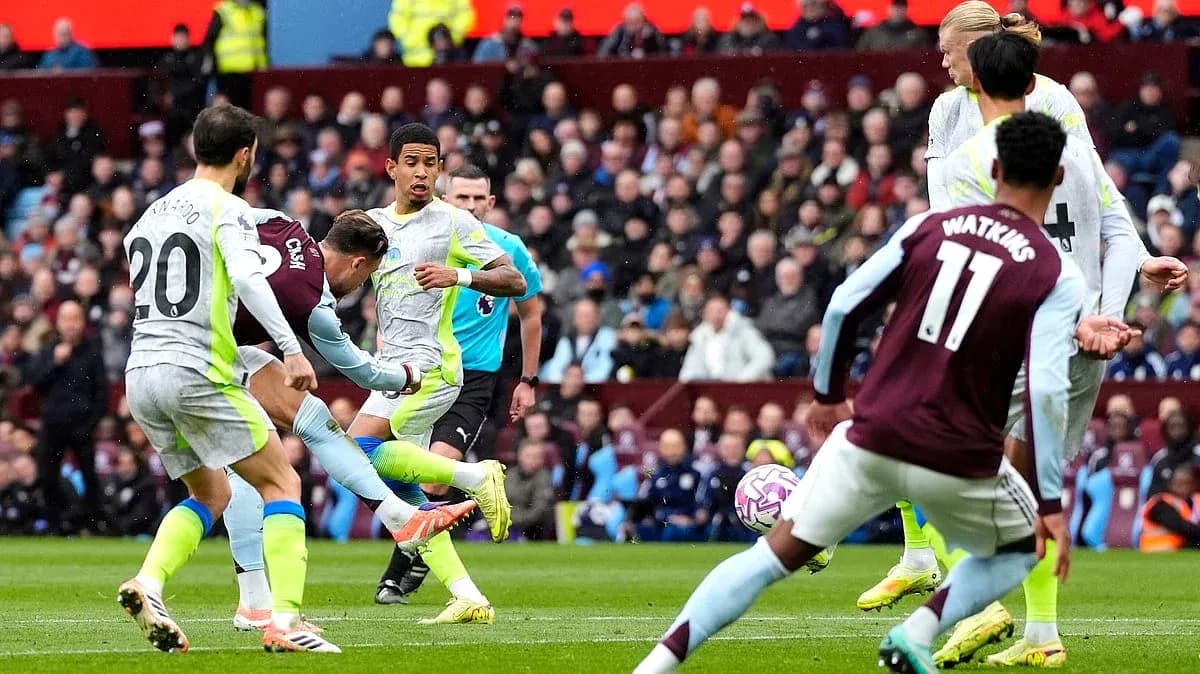
In the end, the 2-1 scoreline in Villa’s favour felt like a statistical upset but a tactical triumph. Emery’s side weaponised their transition threat and structural discipline to overturn a half-time deficit of 1-0, leaning on Watkins’ relentless movement and the creative lines of Buendia and Bailey. City, even with their 4-2-2-2 and a front quartet rich in technical quality, could not convert territorial dominance into a second goal.
Following this result, the data leaves a clear coda: City remain the league’s most complete territorial and chance-creating side, but their ceiling without Haaland on the pitch is perceptibly lower. Villa, meanwhile, close the campaign as a dangerous Champions League qualifier – a team whose away fragility on paper can be overridden by tactical clarity, resilience, and a striker in Watkins who consistently punches above the xG script.