.svg&w=384&q=75 "Pitchgist logo")
Brighton vs Manchester United: Tactical Insights and Season Overview
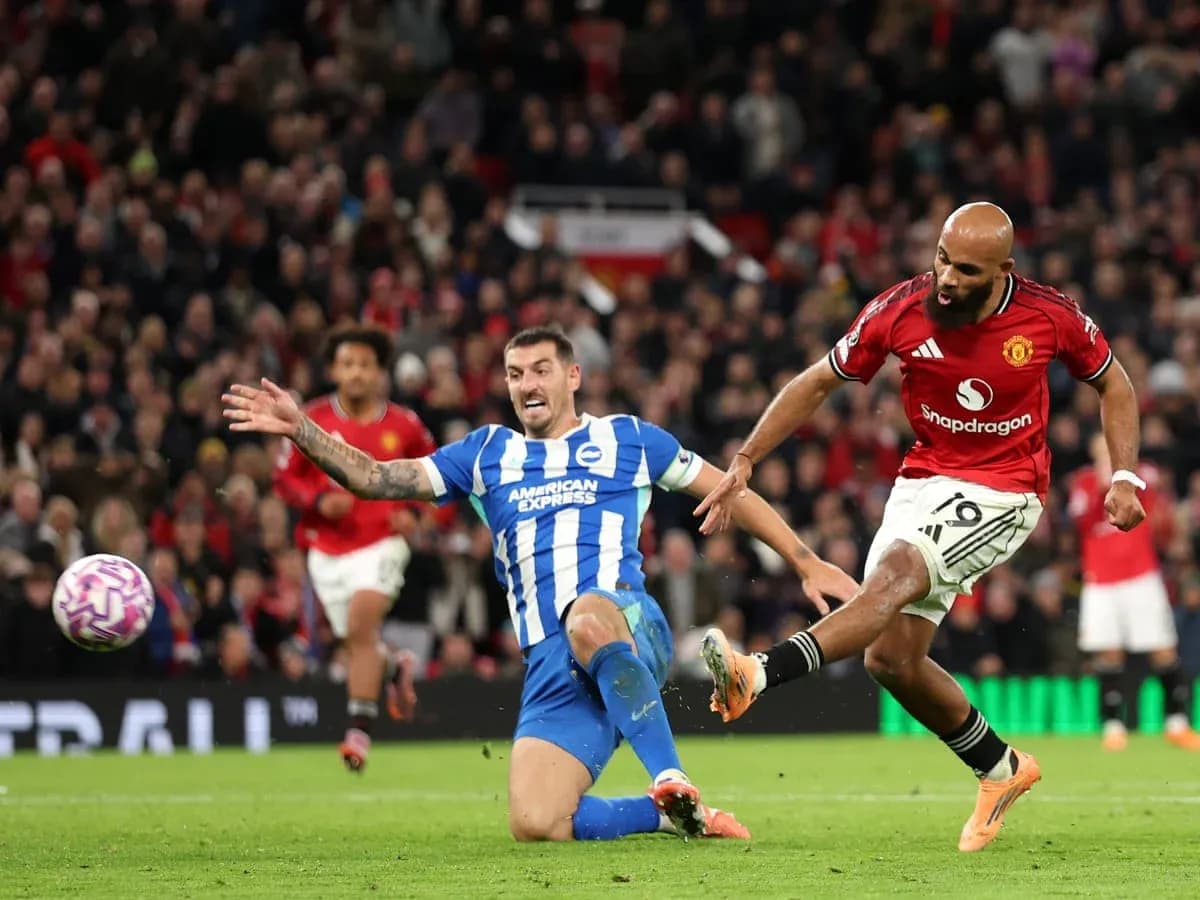
Amex Stadium felt like a crossroads more than a curtain call. Regular Season - 38, Brighton already assured of 8th and a Conference League qualification spot, Manchester United locked into 3rd and Champions League football. Yet the way this 3-0 away win unfolded said plenty about the squads, their tactical identities, and the fault lines each will carry into next season.
I. The Big Picture – Structure, Rank, and Seasonal DNA
Following this result, Brighton finish 8th with 53 points and a goal difference of 6, built on 52 goals for and 46 against in total. At home they have been quietly efficient: 9 wins from 19, with 30 goals for and 20 against, an attacking average of 1.6 at home and 1.1 conceded. Their season-long reliance on a 4-2-3-1 (33 league games in that shape) was reaffirmed here by Fabian Hurzeler’s selection.
Manchester United, by contrast, complete the campaign in 3rd with 71 points and a goal difference of 19, scoring 69 and conceding 50 in total. On their travels they have been sturdy if not spectacular: 7 away wins, 8 draws, 4 defeats, with 30 goals for and 26 against, averaging 1.6 away goals and 1.4 conceded. Michael Carrick has alternated between 4-2-3-1 and 3-4-2-1 this season, but went with the former here, matching Brighton’s structure and trusting superior quality between the lines.
The symmetry of the formations only heightened the contrast in execution: Brighton’s possession-first, risk-tolerant build-up against a United side that has grown into a ruthless transition machine with enough control in midfield to manage games once ahead.
II. Tactical Voids – Absences and Discipline
Both managers had to navigate notable absences. For Brighton, K. Mitoma’s hamstring injury removed their most natural one-v-one outlet on the flank, forcing Hurzeler to lean on M. De Cuyper and J. Hinshelwood as more structured, combination-based options in the second line. The double loss of S. Tzimas and A. Webster to knee injuries further thinned defensive depth, pushing Lewis Dunk into another heavy-responsibility afternoon at the heart of the back four.
United’s absences were equally telling. Casemiro, one of the league’s leading yellow card collectors with 10 yellows and a yellow-red this season, was inactive. Without his destructive presence, Carrick doubled down on technical control: Kobbie Mainoo and Mason Mount as a mobile double pivot rather than a pure holding midfielder. The injuries to B. Šeško (leg) and M. de Ligt (back) removed a direct, penalty-box striker and a dominant aerial centre-back, but United’s squad depth allowed them to reconfigure rather than compromise.
Across the season, Brighton’s disciplinary profile hints at a side that often chases games late. Their yellow cards spike between 46-60 minutes (27.91%) and then again in the final quarter-hour of regulation and early added time, with 15.12% of yellows in 76-90 and another 15.12% from 91-105. United show a similar pattern of intensity after the break: 21.88% of their yellows come between 46-60, and 20.31% from 76-90, with 17.19% from 91-105. Both teams, then, are prone to second-half edge rather than first-half recklessness, which matched the narrative of a game that tightened in duels as the scoreline grew more lopsided.
III. Key Matchups – Hunter vs Shield, Engine Room
The headline duel was always going to be D. Welbeck against United’s back line. Welbeck, Brighton’s leading scorer with 13 league goals in total, has fashioned that tally from 46 shots, 28 on target. His profile is that of a striker who works across the line, linking play (487 passes, 20 key) and attacking space rather than simply waiting in the box. Against Harry Maguire and Lisandro Martinez, the challenge was to disrupt United’s build-up and exploit any high line.
But United’s defensive record on their travels – 26 away goals conceded in 19 matches – underlines a unit that, while not elite, is resilient when they can protect the box. Luke Shaw’s season has been emblematic: 38 appearances, 3231 minutes, and 9 yellow cards, a full-back who plays on the edge, aggressive in duels (301 total, 166 won) and willing to absorb pressure. With Martinez alongside Maguire, United had enough physicality and anticipation to keep Welbeck’s threat largely peripheral.
At the other end, Bryan Mbeumo embodied the “Hunter” role. With 11 goals and 3 assists in total, 59 shots and 32 on target, he arrived at the Amex as a forward who thrives in channels and transition. Brighton’s total defensive numbers – 46 goals against, an average of 1.2 per game overall – are respectable, but they have often struggled when their full-backs are pinned high. Here, F. Kadioglu and M. Wieffer were tasked with providing width and progression from the back, leaving J. P. van Hecke and Dunk exposed to Mbeumo’s diagonal runs and A. Diallo’s surges from the right half-space.
The true axis of control, though, lay in the “Engine Room”: Pascal Gross and James Milner against Bruno Fernandes and Mainoo. Gross, Brighton’s metronome, was asked to knit play between the lines, but United’s structure was designed to funnel him into traffic. Fernandes, the league’s top creator with 21 assists and 9 goals, has been a relentless source of final-third incision: 137 key passes, 1994 total passes at 82% accuracy, and 55 shots in total. Even when he drifts high, his work without the ball – 54 tackles, 5 blocks, 20 interceptions – helps United compress space around opposition playmakers.
Mainoo’s calm distribution and Mount’s vertical running allowed Fernandes to hover between Brighton’s midfield and defence, constantly probing the pockets around Hinshelwood and Gomez. Once United established a two-goal cushion by half-time, the game tilted decisively in their favour, with Brighton’s double pivot stretched between protecting the centre and covering the wide overloads.
IV. Statistical Prognosis – xG Shape and Defensive Solidity
While explicit xG values are not provided, the season-long shot and goal profiles offer a clear lens. United’s attack, averaging 1.8 goals per game in total and 1.6 on their travels, is underpinned by multiple high-volume shooters: Mbeumo (59 shots), Matheus Cunha (58 shots, 10 goals, 2 assists), and Fernandes (55 shots, 9 goals). That diversity of threat typically inflates their xG baseline in any given match, especially against sides like Brighton who commit numbers forward.
Brighton’s attack, by contrast, leans heavily on Welbeck’s 13 goals and a collective structure that spreads chances rather than concentrating them. Their total average of 1.4 goals per game – 1.6 at home – suggests a side capable of crafting opportunities but not always of turning pressure into high-quality chances. Against a United team that has kept 8 clean sheets overall, 4 of them away, the margin for inefficiency was always slim.
Defensively, Brighton’s total concession rate of 1.2 per game and United’s 1.3 in total (1.4 away) point to mid-table solidity rather than elite rearguards. But United’s ability to surge into leads and then manage tempo has masked some of that fragility. Their longest winning streak of 4 and draw streak of 3 show a side that rarely collapses, even when not at their best.
Following this result, the narrative is coherent: United’s multi-pronged attack, orchestrated by Fernandes and supported by Mbeumo and Cunha, simply carried a higher expected goal ceiling than Brighton’s more singular reliance on Welbeck and structured build-up. Brighton’s bravery with the ball, a defining feature of their season, met a United side whose pressing triggers and transition speed were perfectly calibrated to punish any technical error.
For Hurzeler, the off-season question is how to diversify the threat beyond Welbeck and protect the back line when both full-backs advance. For Carrick, the task is to add further defensive steel without blunting the creativity of Fernandes and the dynamism of Mainoo and Mount. On this evidence, United’s 3rd-place finish and 19-goal positive difference feel like a platform; Brighton’s 8th and +6 reflect a project that is ahead of schedule, but still searching for the extra edge that separates brave football from brutally efficient winning.