.svg&w=384&q=75 "Pitchgist logo")
Chelsea's Tactical Mastery Secures 2-1 Victory Over Tottenham
Chelsea’s 2-1 win over Tottenham at Stamford Bridge was a classic case of a team winning the tactical battle in key zones despite losing the territorial and statistical war. Both sides lined up in a 4-2-3-1, but the way they interpreted the shape – and the way Chelsea managed game states after each goal – defined the contest.
Out of possession, Chelsea’s 4-2-3-1 behaved more like a compact 4-4-1-1. Liam Delap stayed high to pin the centre-backs, while Cole Palmer and Pedro Neto narrowed aggressively off the flanks, helping Andrey Santos and Moises Caicedo screen central access into João Palhinha and Rodrigo Bentancur. With only 44% possession and 425 passes (355 accurate, 84%), Chelsea were content to defend medium and then spring quickly rather than press Tottenham’s first line constantly.
Tottenham, by contrast, leaned into a more expansive 4-2-3-1 with long settled spells: 56% possession, 538 passes (473 accurate, 88%). Micky van de Ven and Kevin Danso held a high line, full-backs Pedro Porro and Destiny Udogie pushed on, and the double pivot tried to draw Chelsea’s first line out before finding pockets for Randal Kolo Muani, Mathys Tel and Conor Gallagher between the lines. The structure produced volume in dangerous zones – eight shots inside the box out of nine total – but lacked enough dynamism and final-third clarity until late.
Chelsea's First Goal
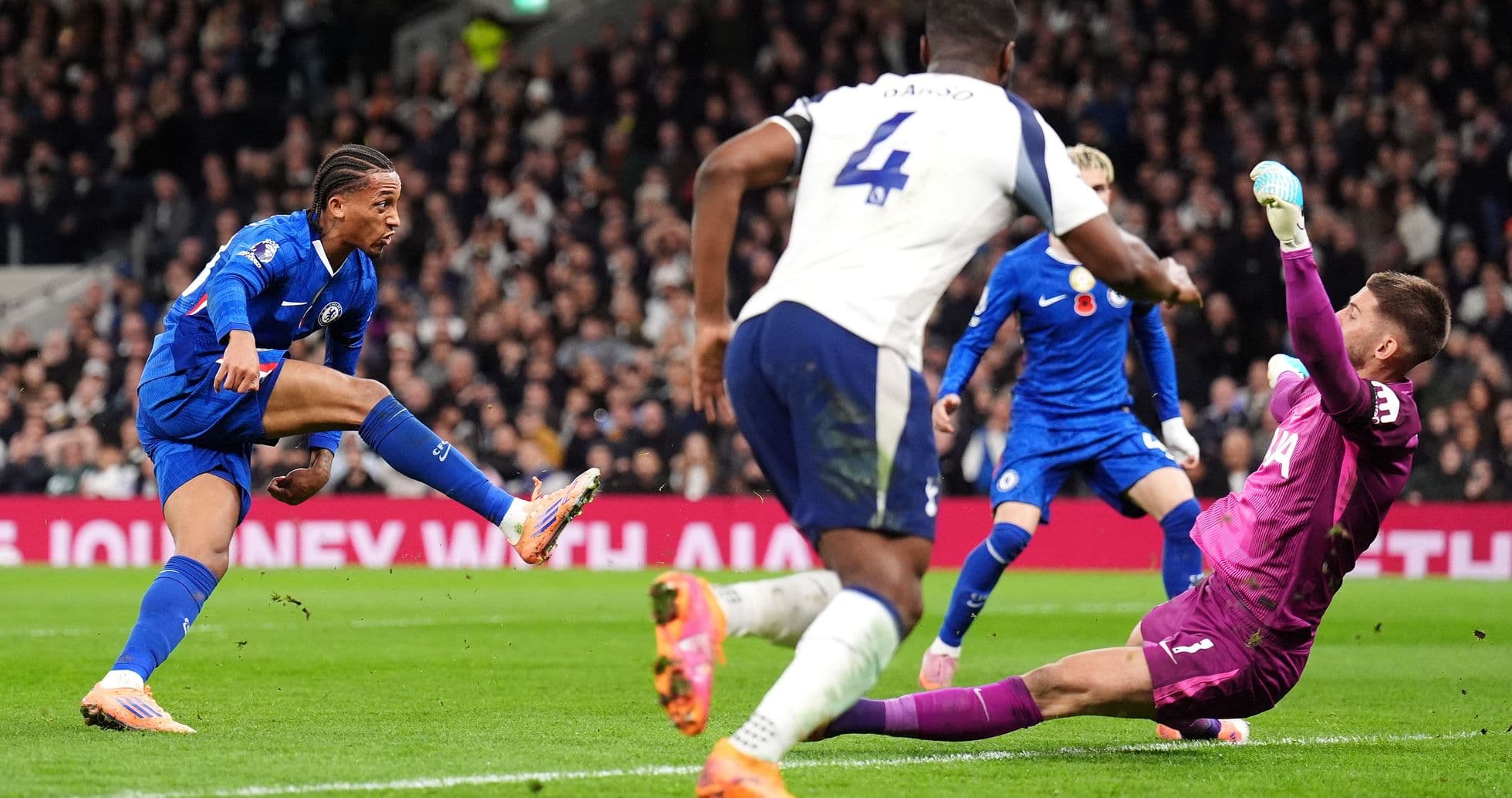
Chelsea’s first goal on 18 minutes distilled their offensive plan. Winning the ball in midfield, they broke quickly into the half-spaces, with Neto receiving wide and driving at an exposed back line. His assist into Enzo Fernandez came after Tottenham’s midfield line had been bypassed, leaving Palhinha and Bentancur chasing. Fernandez arrived from a deeper starting position, timing his run to exploit the gap between full-back and centre-back. It was a textbook vertical transition from a side that knew it would not dominate the ball but trusted its quality in the first and second passes after regains.
Defensive Strategy
Defensively, Chelsea accepted that they would concede territory but focused on protecting the central lane. Wesley Fofana and Jorrel Hato stayed relatively narrow, with Marc Cucurella rarely venturing too high at the same time as Neto. The hosts allowed crosses and wide circulation, backing their centre-backs to deal with first balls and Moises Caicedo to mop up seconds. The fact Tottenham produced nine shots but only three on target underlines Chelsea’s success in forcing suboptimal body shapes or rushed finishes, even if the visitors’ xG of 1.72 suggested they did engineer some high-quality looks that were not fully punished.
Second Goal
The second Chelsea goal at 67 minutes again exposed Tottenham’s rest defence. With Spurs chasing the game, both full-backs were advanced and the double pivot stretched. Fernandez, now enjoying more freedom between the lines, combined centrally before slipping Andrey Santos into a seam vacated by an overcommitted midfield. Santos’ finish reflected Chelsea’s willingness to commit a midfielder beyond the ball on transition, turning what looked like a controlled Tottenham phase into a direct punishment of their high-risk structure.
Tottenham's Response
Tottenham’s response came via structural aggression from the bench. The triple substitution on 69 minutes – James Maddison, Djed Spence and Pape Matar Sarr entering for Kolo Muani, Udogie and Palhinha – tilted the shape towards a more attacking 4-1-4-1/4-3-3 hybrid. Sarr’s more progressive passing from deep and Maddison’s occupation of the right half-space increased the tempo and variety of final-third entries. The payoff was immediate: at 74 minutes, Sarr assisted Richarlison, who finally exploited the space between Chelsea’s centre-backs with a more direct, penalty-box run. It was the clearest expression of Spurs’ box-focused approach, aligning with their eight shots inside the area.
Game Management
From that point, the game became a contest of control versus chaos. Chelsea’s substitutions at 74 and then a flurry at 89 minutes were clearly about shoring up defensive energy and managing tempo. Trevoh Chalobah replacing Joseph Acheampong and Malang Sarr coming on for Fofana both nudged the team towards a more conservative posture, while Alejandro Garnacho, Dário Essugo and Shaun Wade Mheuka offered fresh legs to press and run channels rather than refine possession. The yellow card for Hato on 79 minutes for “Time wasting” underlined Chelsea’s shift into game-management mode.
Discipline Data
Discipline data supports the narrative of a physically stretched Tottenham trying to recover the game and a Chelsea side increasingly focused on disruption. Spurs committed 18 fouls to Chelsea’s 11 and collected three yellows – Pedro Porro, van de Ven and Udogie all for “Foul” – symptomatic of repeated emergency defending in wide and transitional situations. Chelsea’s four yellows were more varied: Hato for “Time wasting”, Cucurella for “Argument”, and both Delap and Essugo for “Foul”. That spread reflects a mix of tactical fouls, emotional flashpoints and clock management as they protected the lead.
Goalkeeping Performance
In goal, Robert Sanchez (Chelsea) and Andreas Kinsky (Tottenham) each recorded two saves. The raw saves count suggests neither was under siege, but the underlying numbers add nuance. Chelsea’s xG of 0.63 from nine shots (four on target, two blocked) shows they were ruthlessly efficient, scoring twice from relatively modest chance quality. Tottenham’s 1.72 xG from nine shots (three on target, one blocked) and identical goals prevented figures of -1.08 for both keepers point to underperformance in finishing and less-than-exceptional shot-stopping at key moments.
Statistical Analysis
Statistically, Tottenham’s superior possession, passing accuracy, and box entries normally map to at least a draw. But Chelsea’s structure – compact without the ball, vertical and incisive with it – meant their attacks carried a clarity Spurs lacked until the late reshuffle. The hosts used their 4-2-3-1 as a counterpunching platform, maximising the creative influence of Neto and Fernandez and the box-running of Santos and Delap. Spurs’ version of the same shape was more about circulation and territory, but without enough early penalty-area presence to convert control into goals.
Ultimately, the match was decided in transition and in the half-spaces. Chelsea’s ability to turn limited possession into two well-constructed goals, combined with disciplined – if sometimes cynical – game management once ahead, allowed them to bend Tottenham’s more expansive plan to their will and secure a tactically mature 2-1 victory.