.svg&w=384&q=75 "Pitchgist logo")
Bournemouth vs Manchester City: A Tactical Stalemate in the Premier League
Following this result at the Vitality Stadium, the 1-1 draw between Bournemouth and Manchester City felt less like a routine end-of-season fixture and more like a statement about where both clubs stand in the Premier League’s hierarchy.
I. The Big Picture – Two Identities, One Stalemate
Heading into this game, the table already framed the narrative. Bournemouth, remarkably up in 6th with 56 points and a goal difference of 4 (57 scored, 53 conceded), have built a season on stubborn resilience: only 7 losses in 37 league matches, and at home just 2 defeats in 19. Manchester City arrived as the established powerhouse, 2nd on 78 points with a formidable goal difference of 43 (76 for, 33 against overall), boasting the division’s most reliable attack and one of its stingiest defences.
The clash of seasonal DNA was clear. Bournemouth’s 4-2-3-1 under Andoni Iraola has been a constant – it is the formation they have used in 35 of their 37 league matches – a structure designed for compactness out of possession and quick vertical transitions. City, listed in their familiar 4-1-4-1, mirrored the shape but not the intent: a single pivot, high full-backs, and a five-man attacking wave built around possession and positional play.
The first half reflected Bournemouth’s belief in their home fortress. With 29 goals scored at home (an average of 1.5) and only 20 conceded (1.1), they are used to dictating the emotional tempo on their own turf. The early goal – and the 1-0 half-time lead – grew naturally from that confidence: aggressive pressing from the second line of Rayan, E. J. Kroupi and M. Tavernier, with Evanilson the reference point to pin City’s centre-backs.
City, though, are rarely flustered for long. On their travels they average 1.7 goals for and only 1.1 against, and their eventual equaliser in the second half restored a familiar pattern: territory, control, and a sense that they can always manufacture at least one moment of clarity, even when the game feels clogged.
II. Tactical Voids – Suspensions and Discipline
Bournemouth’s bench told one story; the missing list told another. R. Christie, carrying a red card, and Álex Jiménez, suspended, both sat out this fixture. Christie’s absence stripped Iraola of a flexible, high-energy midfielder who can connect phases and press intelligently between the lines. Jiménez, a defender who has accumulated 10 yellow cards this season, is a combative presence who thrives in duels (277 contested, 141 won) and has blocked 11 shots; his suspension removed a natural defensive aggressor from Bournemouth’s right side.
Without Jiménez, A. Smith and J. Hill had to be more conservative, especially against J. Doku’s direct running and the overlapping threat from N. O’Reilly. Bournemouth’s season-long disciplinary profile also loomed over proceedings: 26.44% of their yellow cards arrive in the 76-90 minute window, and another 21.84% between 91-105. That late-game spike often reflects fatigue in a high-energy system, and it subtly shaped how deep Bournemouth dropped in the closing stages, wary of mistimed challenges and costly bookings.
City, by contrast, came in with a cleaner disciplinary slate in terms of reds, but with a clear pattern of yellow-card accumulation in the middle and late phases of games: 19.70% between 46-60 minutes and another 19.70% from 76-90. Bernardo Silva, who has collected 10 yellow cards this season, embodies that edge. His relentless pressing and tactical fouling from midfield are both a weapon and a risk – vital in slowing transitions, yet always flirting with the referee’s patience.
III. Key Matchups – Hunter vs Shield, Engine Room vs Enforcer
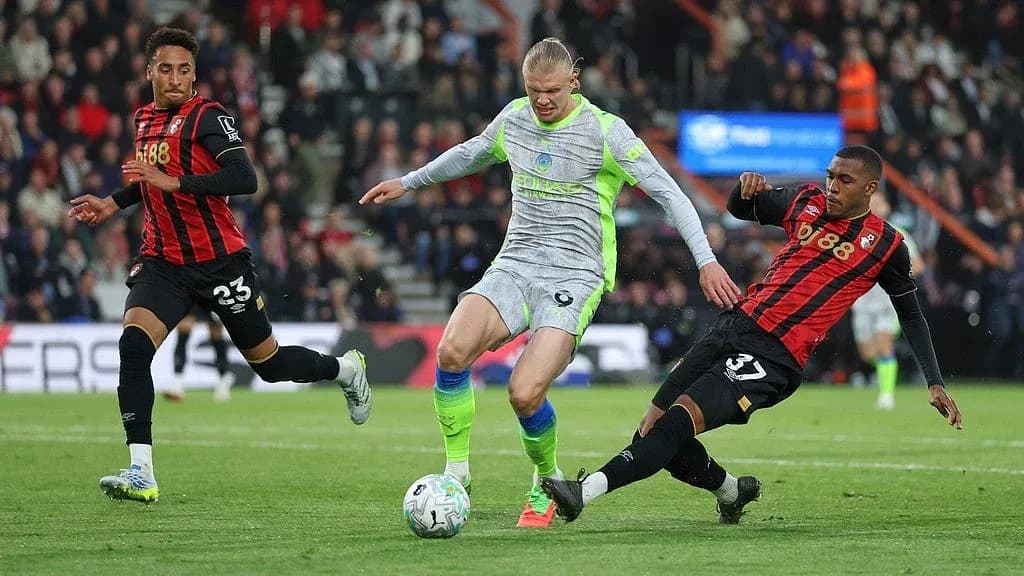
The marquee duel was inevitable: Erling Haaland against Bournemouth’s defensive structure. Haaland came into the fixture as the league’s top scorer, with 27 goals and 8 assists in 35 appearances, firing 102 shots with 59 on target. He is more than just a finisher; 25 key passes and 8 assists underline his capacity to combine as well as conclude. Yet his penalty record this season is human rather than robotic: 3 scored, 1 missed. Against a Bournemouth side with 11 clean sheets overall (6 at home), the “Hunter vs Shield” battle was about denying him service as much as marking him in the box.
Iraola’s solution was collective. M. Senesi and J. Hill narrowed the channels, while T. Adams and A. Scott screened central spaces in front of them. With Bournemouth conceding 1.4 goals per game overall but only 1.1 at home, their plan was to compress the central corridor and force City’s attacks wide, trusting Petrovic’s command of his area and the back four’s ability to defend crosses.
At the other end, Bournemouth’s own “Hunter” was E. J. Kroupi. With 13 goals from 32 league appearances and 21 shots on target from 31 attempts, he is ruthlessly efficient when he finds space between the lines. Deployed as one of the three behind Evanilson, he drifted into pockets around Rodri, trying to pull City’s midfield shape apart. His duel with M. Guehi and A. Khusanov was as much about timing as physicality: could he receive on the half-turn before City’s centre-backs stepped in?
In the “Engine Room” matchup, Rodri was the metronome and shield for City, sitting behind a line of M. Kovacic, Bernardo Silva, A. Semenyo and J. Doku. Rodri’s positioning allowed City to sustain pressure, recycling second balls and hemming Bournemouth into their own third after the equaliser. For Bournemouth, Adams was the closest thing to an enforcer, tasked with both breaking up play and launching the first pass into transition. His duel with Rodri determined whether Bournemouth could escape City’s press with any regularity.
City’s bench added another layer of latent threat. Players like P. Foden, R. Cherki and Savinho offered Pep Guardiola the option to inject creativity and one‑v‑one dynamism from the sidelines. Cherki, with 12 assists and 61 key passes this season, is one of the league’s most incisive creators; even starting on the bench, his mere presence in reserve forced Bournemouth to consider how they would cope with fresh technical quality late on.
IV. Statistical Prognosis – A Draw That Fits the Numbers
Following this result, the numbers still paint City as the more potent side overall: 2.1 goals scored per match and only 0.9 conceded across the season, compared with Bournemouth’s 1.5 for and 1.4 against. Yet the context of venue and game state matters. At home, Bournemouth’s scoring rate of 1.5 and their defensive record of 1.1 conceded align almost perfectly with the 1-1 outcome. City’s away profile – 1.7 scored, 1.1 conceded – also nudges toward a narrow, low‑margin contest rather than a rout.
In xG terms, this was the archetype of a balanced draw: City’s territorial dominance and volume of possession likely pushed their expected goals slightly higher, but Bournemouth’s high-quality transition moments and their early breakthrough would have kept the gap narrow. Bournemouth’s defensive solidity at home, combined with City’s slight drop-off in attacking output away from the Etihad, always suggested a tighter contest than the league positions alone might imply.
So the 1-1 feels less like an upset and more like a logical convergence of two well-defined profiles. Bournemouth, with their disciplined 4-2-3-1 and resilient home metrics, showed why they sit in the European conversation. City, even when held, underlined the depth and structure that keep them in the title picture. The story of the night was not about one side failing, but about two distinct tactical identities colliding and, for once, cancelling each other out.