.svg&w=384&q=75 "Pitchgist logo")
Bournemouth and Manchester City Battle to 1-1 Draw
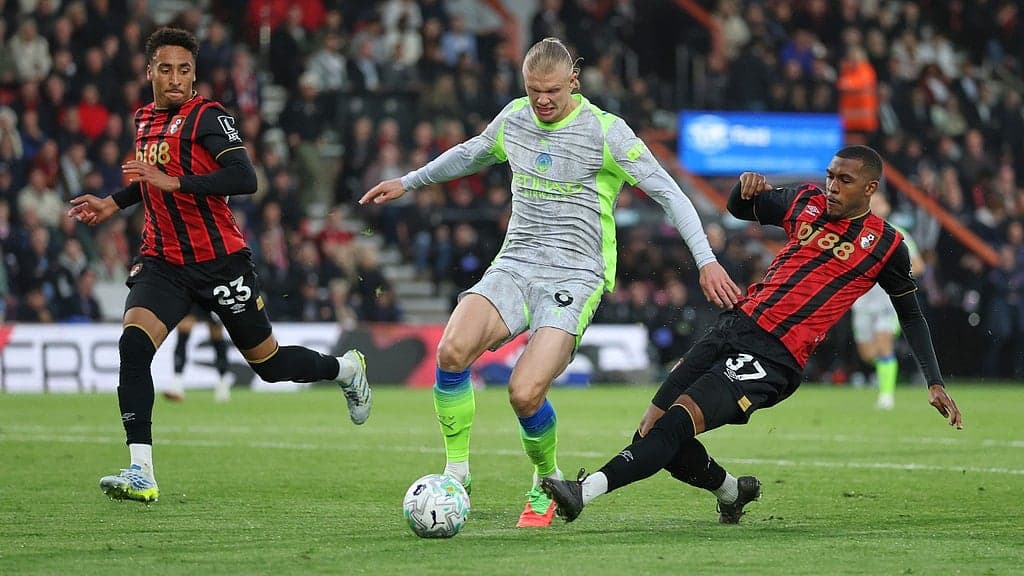
Bournemouth’s 1-1 draw with Manchester City at Vitality Stadium was a high-discipline, high-concentration performance built on clear structural ideas from both coaches. In a match where City held 55% of the ball and outshot Bournemouth 14-10, Andoni Iraola’s side leaned on compact spacing, aggressive duels, and quick vertical transitions, while Pep Guardiola’s team had to chase the game and eventually salvaged a point through late penalty-box presence.
Executive Summary
In a Premier League Round 37 fixture, Bournemouth set up in a 4-2-3-1 and Manchester City in a 4-1-4-1. Bournemouth led 1-0 at half-time and were seconds away from a statement win before City’s late equaliser secured a 1-1 final score. The balance of xG (1.99 for Bournemouth, 1.68 for Manchester City) underlined a contest where the hosts matched City’s chance quality despite conceding more territory and shots.
Scoring Sequence & Disciplinary Log
Goal verification list:
- 39' E. J. Kroupi (Bournemouth) — assisted by A. Truffert
- 90' E. Haaland (Manchester City) — (no assist)
The goals align with the final 1-1 score (Bournemouth 1-1 Manchester City).
Card verification list (chronological, with reasons):
- 37' Tyler Adams (Bournemouth) — Argument
- 59' James Hill (Bournemouth) — Foul
- 90+3' Justin Kluivert (Bournemouth) — Argument
- 90+3' Rodri (Manchester City) — Argument
- 90+6' Adrien Truffert (Bournemouth) — Foul
Totals: Bournemouth 4 yellow cards, Manchester City 1 yellow card, Total: 5.
Match flow and discipline: Bournemouth’s aggressive edge appeared early when Tyler Adams was booked on 37' for Argument, reflecting the emotional intensity in central midfield as he tried to disrupt City’s rhythm. Two minutes later, Bournemouth capitalised: on 39', E. J. Kroupi finished a move created by A. Truffert down the left, giving the hosts a 1-0 lead that they carried into half-time.
Guardiola reacted on 56', reshaping his midfield and wide structure with a triple substitution vector:
- P. Foden (IN) came on for M. Kovacic (OUT)
- R. Cherki (IN) came on for B. Silva (OUT)
- Savinho (IN) came on for A. Semenyo (OUT)
Bournemouth’s back line absorbed increasing pressure but James Hill’s yellow card on 59' for Foul highlighted the cost of maintaining such intensity.
Iraola turned to his bench late to refresh his front line and defensive work:
- J. Kluivert (IN) came on for E. J. Kroupi (OUT) at 76'
- O. Marmoush (IN) came on for J. Doku (OUT) at 76'
- D. Brooks (IN) came on for Rayan (OUT) at 84'
- E. Unal (IN) came on for Evanilson (OUT) at 89'
- L. Cook (IN) came on for A. Smith (OUT) at 90'
The closing stages were fractious. At 90+3', Justin Kluivert received a yellow card for Argument, quickly followed in the same minute by Rodri’s yellow, also for Argument, as tempers flared around duels and decisions. Six minutes into added time, Adrien Truffert was booked for Foul, encapsulating Bournemouth’s last-ditch defending.
Crucially, before those late cards, City finally broke through: on 90', E. Haaland struck from close range with no assist credited, levelling the match at 1-1 and denying Bournemouth a landmark win.
Tactical Breakdown & Personnel
Bournemouth’s 4-2-3-1 was built on a disciplined double pivot of Tyler Adams and A. Scott screening a back four of A. Smith, James Hill, M. Senesi, and A. Truffert. Out of possession, this often flattened into a 4-4-1-1, with Rayan and M. Tavernier tucking in alongside the pivots, and E. J. Kroupi working between the lines behind Evanilson.
The hosts accepted a 45% share of possession and focused on compressing central zones. City’s 4-1-4-1, with Rodri anchoring behind an advanced line of A. Semenyo, B. Silva, M. Kovacic, and J. Doku supporting E. Haaland, sought to create overloads between Bournemouth’s midfield and defensive lines. Bournemouth countered by narrowing their full-backs and asking the wingers to track City’s wide midfielders, leaving less space for cut-backs.
Bournemouth’s attacking plan was clear: use quick vertical passes and the creativity of Kroupi and Tavernier to attack the spaces behind City’s full-backs. Their 10 total shots, with 6 inside the box and an xG of 1.99, indicate they generated high-quality situations when they broke through the press. The 7 corner kicks underline sustained moments of pressure, not just isolated counters.
A. Truffert was central to this approach, both defensively and offensively. His assist for Kroupi’s opener came from advanced positioning on the left, overlapping into space created by inside movements ahead of him. Defensively, his late yellow for Foul at 90+6' reflected the strain of repeated one-on-ones as City chased the game.
In midfield, Adams’ early yellow for Argument did not blunt his aggression; Bournemouth committed 16 fouls overall, doubling City’s 7, a sign of a deliberate choice to disrupt City’s rhythm rather than sit passively. James Hill’s booking for Foul at 59' further illustrated the defenders’ willingness to step out and contest first contacts with Haaland and the arriving midfield runners.
City’s in-possession structure evolved after the triple change on 56'. With P. Foden and R. Cherki introduced, the visitors shifted towards a more fluid, positional-play shape, with Rodri as the single pivot and multiple players rotating between half-spaces. Savinho’s entrance added directness on the flank, stretching Bournemouth’s back line and creating more crossing opportunities into Haaland.
Despite City’s 14 shots (10 inside the box) and 55% possession, Bournemouth’s defensive compactness limited truly clear openings. G. Donnarumma in the City goal faced 2 shots on target, while D. Petrovic for Bournemouth dealt with 5 shots on target, making 3 goalkeeper saves. The goals prevented metric at 0.29 for each goalkeeper suggests both made interventions that slightly exceeded the baseline expectation of the chances they faced.
The Statistical Verdict
The underlying numbers confirm a finely balanced tactical contest. City’s 55% possession and 527 total passes (458 accurate, 87%) show their territorial control and technical superiority in circulation. Bournemouth, with 431 total passes and 346 accurate (80%), were more direct and less focused on sterile possession, using the ball purposefully when they had it.
Shot volume favoured City (14-10), but Bournemouth’s xG edge (1.99 vs 1.68) indicates that Iraola’s plan produced chances of at least equal, if not slightly higher, quality. City’s 6 blocked shots highlight Bournemouth’s commitment to last-line defending, while the home side’s 7 corners to City’s 6 reflect that Bournemouth had meaningful attacking phases, not merely isolated counters.
Discipline was a clear differentiator: Bournemouth’s 4 yellow cards, all with explicit reasons (Argument for Adams and Kluivert, Foul for Hill and Truffert), contrasted with City’s single yellow for Rodri (Argument). This imbalance underscores how much physical and emotional energy Bournemouth expended to contain City’s structure.
Both goalkeepers posting 0.29 goals prevented, combined with the 1-1 scoreline and near-par xG, frames this as a match where tactical plans were largely effective on both sides. Bournemouth’s structure and intensity earned them a point and nearly more; City’s depth and late penalty-box pressure, culminating in Haaland’s 90' equaliser, ensured their territorial dominance eventually translated into the minimum result their performance merited.