.svg&w=384&q=75 "Pitchgist logo")
Tottenham Edges Everton 1-0: A Season of Struggles
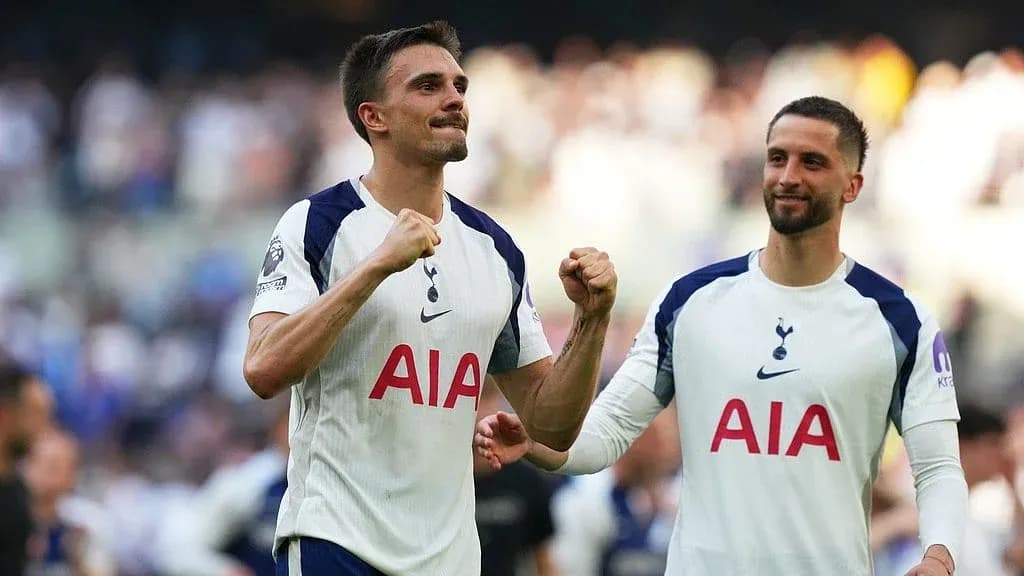
Under a grey May sky at the Tottenham Hotspur Stadium, a season of toil and turbulence finally exhaled. Tottenham, clinging to Premier League status, edged Everton 1–0 in a tight, tactical contest that mirrored the campaigns both clubs have just completed: attritional, nervy, and decided in the details.
Following this result, Tottenham close the season 17th with 41 points and a goal difference of -9, the numbers of a side that has lived on the edge. Everton, 13th with 49 points and a goal difference of -3, finish as a mid-table paradox: structurally solid in spells, but never fully convincing.
I. The Big Picture – Two 4-2-3-1s, Two Different Stories
Both managers leaned into the familiar. Roberto De Zerbi kept faith with the 4-2-3-1 that has been Tottenham’s default this campaign, a shape they have used in 19 league matches. Jordan Pickford stared down a mirror image, with Leighton Baines also rolling out a 4-2-3-1 – a system Everton have used 37 times in the league.
For Spurs, the season’s identity is stark in the numbers. Heading into this game, they had played 38 matches, winning 10, drawing 11 and losing 17. They scored 48 goals overall (22 at home, 26 on their travels) and conceded 57 overall (31 at home, 26 away). That overall goal difference of -9 is not an accident; it is the statistical imprint of a side that has bled control, particularly at home, where they had only 3 wins from 19.
Everton’s profile is more balanced. Across 38 matches they recorded 13 wins, 10 draws and 15 defeats, with 47 goals for and 50 against overall. Their away record – 7 wins, 5 draws, 7 defeats, 21 goals scored and 23 conceded – hints at a team comfortable in the role they played here: compact, reactive, willing to suffer.
II. Tactical Voids – The Missing Pillars
The team sheets told a story of absence as much as presence. Tottenham’s spine has been gnawed away by injury. B. Davies (ankle), M. Kudus (muscle), D. Kulusevski (knee), W. Odobert (knee), C. Romero (knee) and X. Simons (knee) were all listed as missing for this fixture. That is a full defensive leader (Romero), a creative winger (Kulusevski), a dynamic playmaker (Simons), plus depth and rotation options stripped away.
Without Romero, De Zerbi leaned on K. Danso and M. van de Ven at the heart of defence. Van de Ven, who across the season has made 35 league appearances with 22 successful blocks and 23 interceptions, brings recovery pace and calm distribution. But he is also a magnet for disciplinary risk, having collected 9 yellow cards and 1 red in the league. The absence of Romero, another aggressive enforcer, forced van de Ven to balance his front-foot instincts with restraint.
Higher up, the creative burden that might have been shared by Kudus, Kulusevski or Simons fell on a more workmanlike trio: D. Spence, C. Gallagher and M. Tel behind Richarlison. It made Tottenham less flamboyant but more functional.
Everton were not spared. J. Branthwaite (hamstring), J. Grealish (foot) and I. Gueye (injury) were all unavailable. Branthwaite’s absence removed a key left-sided organiser from the back line, pushing M. Keane into a starting role alongside J. Tarkowski. The loss of Grealish, who had contributed 6 assists in 20 league appearances, stripped Baines of his most incisive ball-carrier between the lines.
III. Key Matchups – Hunter vs Shield, Engine vs Engine
Hunter vs Shield: Richarlison vs Everton’s Back Four
Richarlison arrived at this finale as Tottenham’s leading scorer in the league, with 11 goals and 4 assists from 32 appearances. His profile this season has been that of a bruising, relentless forward: 47 shots, 26 on target, 325 duels contested and 137 won. He thrives in chaos, in second balls and broken phases.
Everton’s task was to smother him through structure. Tarkowski and Keane, screened by T. Iroegbunam and J. Garner, formed a narrow box around the Brazilian. Garner’s season numbers underline his dual role: 120 tackles, 10 blocked shots and 57 interceptions, married to 7 assists and 56 key passes. He is both destroyer and distributor, and here his job was to step into the half-space when Richarlison drifted off the front, cutting off the bounce passes from Gallagher and Tel.
In the end, Tottenham’s lone goal – forged from persistence rather than sustained dominance – owed as much to the home side’s willingness to flood the box as to any systemic flaw in Everton’s away defence, which had conceded only 23 goals on their travels heading into this game.
Engine Room: Bentancur & Palhinha vs Garner & Iroegbunam
The midfield battle was the game’s truest theatre. De Zerbi’s double pivot of R. Bentancur and J. Palhinha is built for control and collisions. Palhinha, in particular, is a magnet for duels and tackles, the shield in front of a back four that has often been over-exposed at home, where Spurs have conceded 31 goals this season.
Against them, Everton’s pairing of Garner and Iroegbunam offered a different dynamic: Garner as the metronome and deep-lying playmaker, Iroegbunam as the legs and cover. Garner’s 1792 passes at an 87% accuracy rate this season speak to his importance in Everton’s build-up. Here, though, he found himself pressed aggressively by Gallagher stepping out of the No. 10 slot, forcing Everton to go longer into T. Barry more often than they would have liked.
Without Grealish dropping into pockets to relieve pressure, Everton’s 4-2-3-1 frequently flattened into a 4-4-1-1, with I. Ndiaye working off Barry but unable to consistently turn Tottenham’s centre-backs. Van de Ven’s reading of the game – underlined by those 22 blocked shots across the season – allowed Spurs to hold a higher line than their fragile home record might suggest.
IV. Statistical Prognosis – Margins, Discipline and a Narrow Verdict
Across the season, Tottenham’s defensive numbers have painted a worrying picture: 57 goals conceded overall at an average of 1.5 per game, with 1.6 conceded at home. Everton, by contrast, have been slightly more secure, allowing 50 overall at 1.3 per game, and only 1.2 per match on their travels.
In a notional xG frame, you would expect Everton’s compact 4-2-3-1 and their 11 clean sheets overall (5 away) to drag this game towards a low-scoring equilibrium. Tottenham’s attack, averaging 1.2 goals at home and 1.3 overall, tends to create enough to threaten but not overwhelm.
Discipline was always likely to be a subplot. Tottenham’s yellow-card distribution peaks late, with 24.75% of their bookings arriving between 61–75 minutes – a classic sign of a team that tires and fouls under pressure. Everton, meanwhile, show a late-game surge of their own, with 21.62% of yellow cards between 76–90 minutes and a notable red-card presence across the 0–15, 61–75 and 76–90 ranges. This fixture, though, stayed just the right side of chaos, perhaps because so many of the usual flashpoints – Romero for Spurs, Branthwaite and Grealish for Everton – were missing.
The 1–0 scoreline feels like the logical meeting point of these profiles. Tottenham, fragile but desperate, found just enough incision through Richarlison and the supporting trio to edge a side whose away defensive record is ordinarily reliable. Everton, solid in structure but shorn of their most creative individual, could not quite tilt the shot quality in their favour.
Following this result, the numbers on the table and the patterns in the performance align: Spurs survive by the skin of their teeth, their season defined by narrow margins and defensive frailty; Everton settle into mid-table with the sense that, with a fitter, fuller squad, this same tactical template could have delivered something more.