.svg&w=384&q=75 "Pitchgist logo")
Nottingham Forest vs Bournemouth: Tactical Analysis of 1-1 Draw
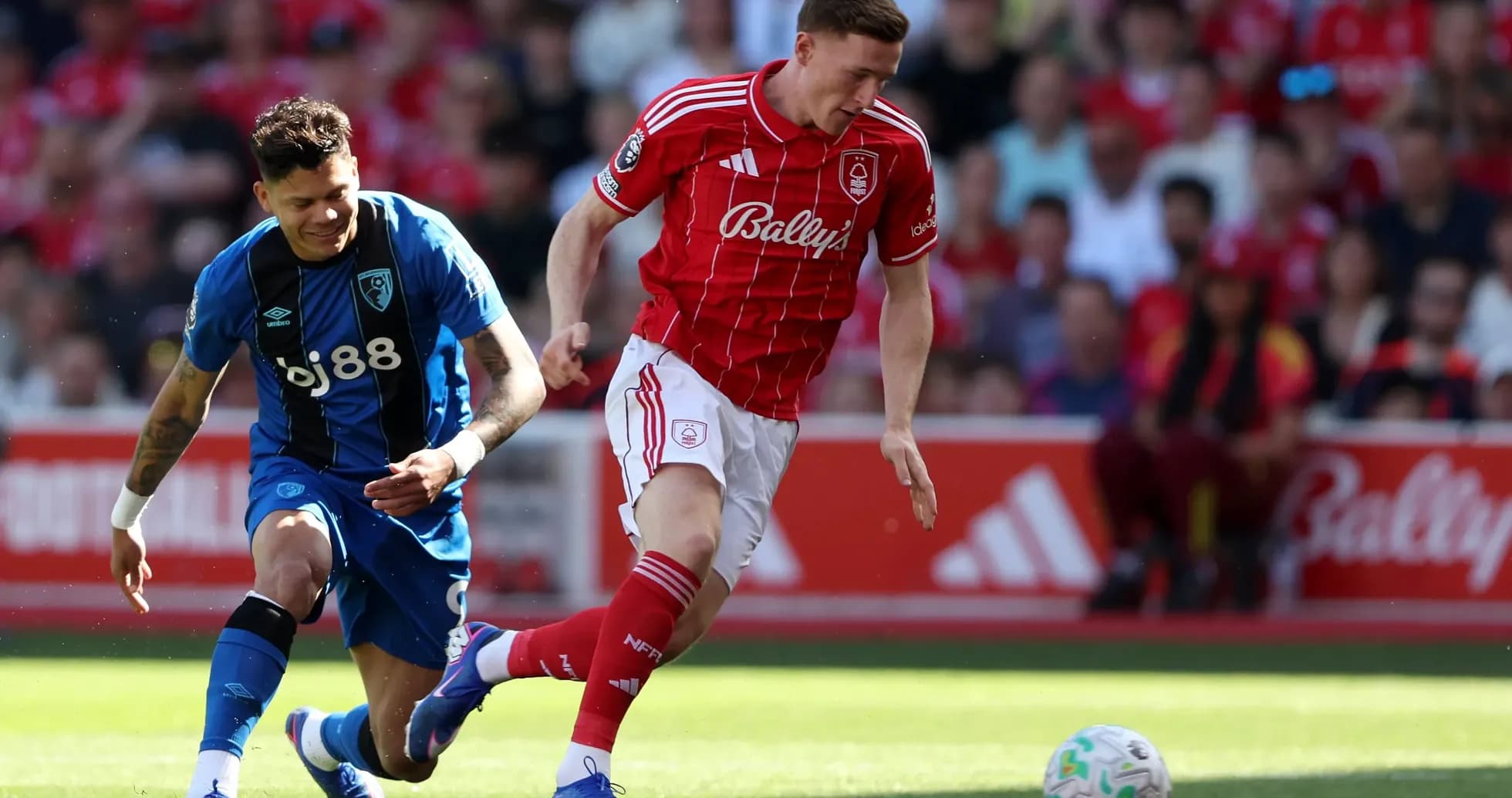
Nottingham Forest and Bournemouth produced a tactically balanced 1-1 draw at the City Ground, a match defined by contrasting structures and a subtle territorial shift after half-time. Forest, in a 4-4-2 under Vitor Pereira, leaned on verticality and direct occupation of the last line, while Andoni Iraola’s Bournemouth, in a 4-2-3-1, gradually asserted control through a more patient, possession-oriented approach.
Forest’s 4-4-2 was clearly designed to compress central zones and spring quickly once the ball was recovered. The front pairing of Igor Jesus and C. Wood gave Forest two distinct reference points: Jesus more mobile between the lines, Wood a classic target to contest first balls and pin centre-backs. Behind them, the midfield four of O. Hutchinson, I. Sangare, E. Anderson and M. Gibbs-White provided a hybrid between a flat band and an asymmetrical 4-2-3-1, with Gibbs-White frequently stepping into the right half-space as the main creative outlet.
This structure translated into Forest’s shot profile. They generated 15 total shots, with 10 from inside the box, a clear indication that the 4-4-2 was effective at reaching advanced zones once the initial press was broken. The wide midfielders and full-backs – N. Williams on the right and Cunha on the left – pushed high enough to create crossing opportunities and second-ball situations, reflected in 6 corner kicks and 5 blocked shots. The team’s xG of 1.87 underscores that the chance quality matched the territorial intent.
Bournemouth, by contrast, built through a 4-2-3-1 that prioritised control. The double pivot of T. Adams and A. Toth provided a stable base in front of the back four, allowing full-backs A. Smith and A. Truffert to advance and stretch Forest’s compact 4-4-2 horizontally. With 55% ball possession and 483 total passes (405 accurate, 84%), Bournemouth’s game was about circulating around Forest’s first line, drawing out one of the strikers and then playing through the vacated channel.
Higher up, M. Tavernier, E. J. Kroupi and Rayan (before and after substitutions) operated between the lines, trying to exploit the natural spaces that appear between a flat midfield four and the back line. Bournemouth ended with 17 total shots, but only 6 from inside the box; they were often forced to shoot from distance or from less favourable angles, which is consistent with Forest’s low block protecting the central corridor.
The pressing dynamics followed this structural contrast. Forest’s 11 fouls and a single yellow card for Taiwo Awoniyi, who came on for C. Wood, show a team willing to break play with tactical interventions when Bournemouth threatened to progress centrally. Bournemouth, with just 7 fouls and one yellow card for James Hill, were more about containment and body positioning than repeated contact, trusting their structure and rest defence rather than aggressive counter-pressing.
Substitutions subtly altered the tactical picture. For Forest, bringing on T. Awoniyi (IN) for C. Wood (OUT) at 62 minutes shifted the profile of the front line towards greater depth running and transition threat. Awoniyi’s presence asked Bournemouth’s centre-backs to defend more space in behind, even as Bournemouth tried to dominate the ball. Shortly after, L. Netz (IN) for Cunha (OUT) and R. Yates (IN) for E. Anderson (OUT), plus N. Dominguez (IN) for I. Sangare (OUT), suggested Pereira’s intent to refresh both the left flank and central energy: more legs to sustain Forest’s mid-block and protect the lead before Bournemouth’s equaliser and then to chase a winner.
On Bournemouth’s side, the triple change at 73 minutes – E. Unal (IN) for Evanilson (OUT), J. Kluivert (IN) for E. J. Kroupi (OUT), and A. Adli (IN) for Rayan (OUT) – represented a clear attacking recalibration. Iraola injected fresh forwards with more direct threat and 1v1 ability, aiming to destabilise a Forest defence that had already absorbed a lot of work. L. Cook (IN) for A. Smith (OUT) at 90 minutes was a late attempt to strengthen central control and protect against counters while still keeping enough technical security to build one last wave of pressure.
In possession, Forest’s 396 total passes with 307 accurate (78%) reflect a more vertical, risk-tolerant approach. They were prepared to lose the ball if it meant playing quickly into the front two or attacking the channels. Bournemouth’s higher pass volume and accuracy underpinned their territorial dominance after the break, but their xG of 1.0 shows that Forest’s block forced them into lower-quality looks despite the ball control.
Defensively, both goalkeepers were asked to manage a moderate but meaningful workload. M. Sels (Nottingham Forest) made 3 saves, aligning with Bournemouth’s 4 shots on goal and illustrating that Forest’s back line succeeded in limiting truly clean looks. D. Petrovic (Bournemouth) also made 3 saves against Forest’s 5 shots on goal, with the numbers indicating that Bournemouth’s defensive line did allow Forest into dangerous zones but generally kept shooting angles manageable.
The goals themselves mirror the broader tactical story. Forest’s opener came in a phase where their 4-4-2 pressing and direct play were at their sharpest, with M. Gibbs-White capitalising on a move that typified his role as the advanced creative midfielder. Bournemouth’s equaliser, scored by M. Tavernier, reflected their improved territorial control and their ability to finally turn possession into penetration down the left, where Truffert’s support and combinations in the half-space eventually broke Forest’s structure.
Ultimately, the 1-1 draw felt like a fair synthesis of two competing ideas: Forest’s compact, vertically-minded 4-4-2 generating the better chances on fewer touches, and Bournemouth’s patient 4-2-3-1 using the ball as a defensive and attacking tool, but struggling at times to convert control into clear-cut opportunities.