.svg&w=384&q=75 "Pitchgist logo")
Qatar's Tactical Survival Against Switzerland: A 1-1 Draw Analysis
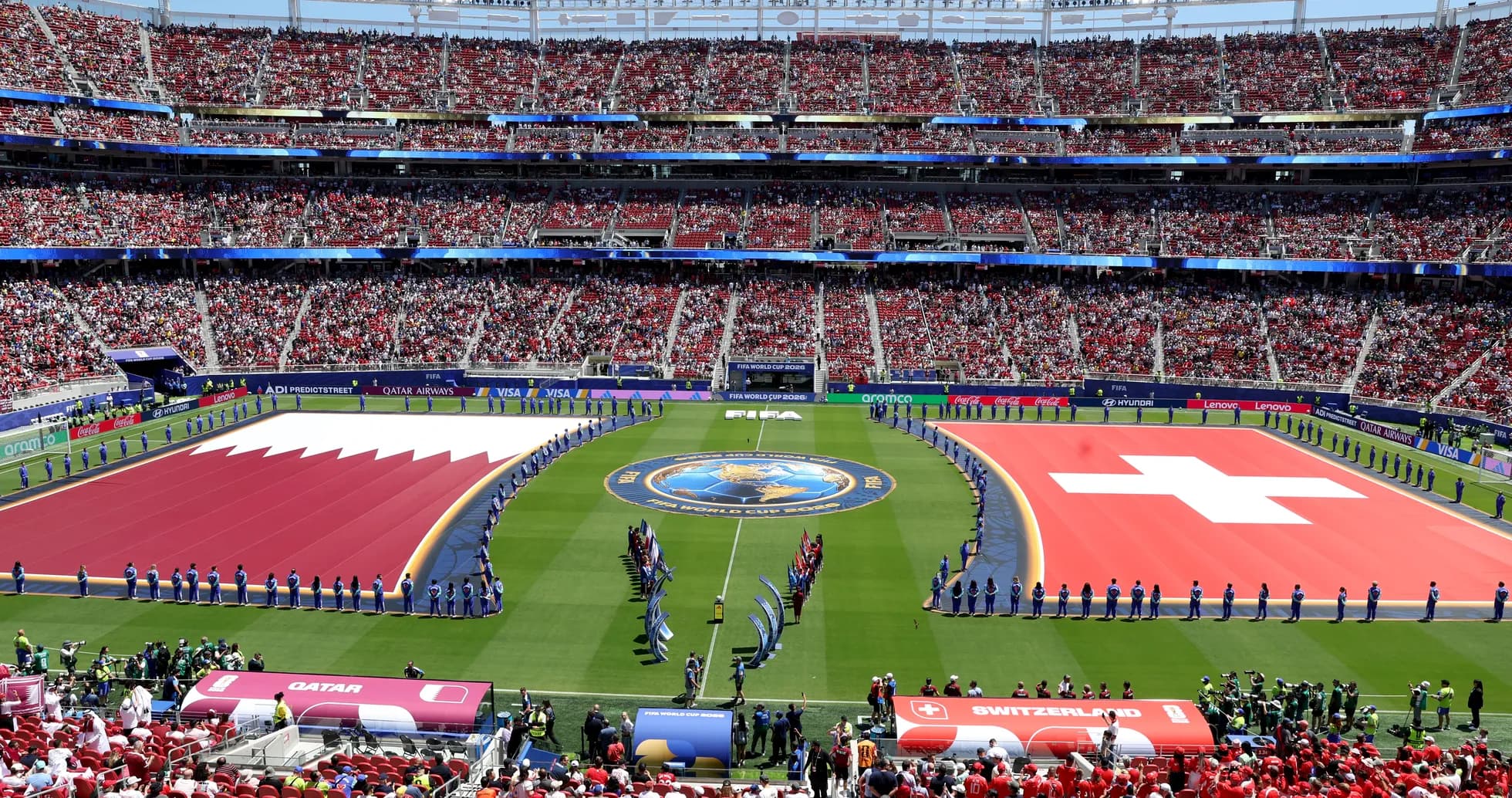
Qatar’s 1-1 draw with Switzerland at Levi's Stadium was a classic example of tactical survival against a territorially dominant opponent. Switzerland, in a 4-3-3 under Murat Yakin, controlled 68% of the ball, produced 26 shots and generated 3.24 xG, yet failed to kill the game. Qatar, also in a 4-3-3 under Julen Lopetegui, accepted a deep, low-possession game (32% possession, 7 shots, 0.76 xG) and relied on compact defending, disciplined central protection, and set-piece threat to steal a point in stoppage time.
Defensive Structure
Structurally, Qatar’s back four of Homam Al-Amin, Boualem Khoukhi, Pedro Miguel and Ayoub Al Oui sat narrow and conservative. The midfield trio of Issa Laye, Assim Madibo and Jassem Gaber Abdulsallam operated almost as a screen rather than a true possession unit, prioritising vertical compactness over pressing height. With Switzerland building through Granit Xhaka, Remo Freuler and Michel Aebischer, Qatar’s first line of pressure – Akram Afif, Yusuf Abdurisag and Edmilson Junior – rarely engaged high; instead, they dropped to form a 4-5-1 or even 4-1-4-1 block, allowing Swiss centre-backs time on the ball but denying easy access into the half-spaces.
Switzerland's Strategy
Switzerland’s 4-3-3 was built around central control and wide overloads. Xhaka anchored the structure, dictating tempo and recycling possession, while Freuler and Aebischer pushed into advanced pockets to connect with the front three of Rubén Vargas, Breel Embolo and Dan Ndoye. The shot profile tells the story: 18 of Switzerland’s 26 attempts came inside the box, underlining how consistently they managed to penetrate the final third and create territorial siege. The 9 blocked shots reflect both Qatar’s emergency defending and Switzerland’s willingness to shoot through traffic when clean looks were denied.
Penalty Sequence
The early penalty sequence encapsulated the tactical dynamic. After sustained Swiss pressure, a VAR-confirmed penalty at 16' – checked on Remo Freuler – rewarded Switzerland’s aggressive occupation of central zones. Breel Embolo converted at 17', giving Yakin’s side the ideal platform: a lead against a team structurally set up to defend. From that point, Switzerland could maintain a high defensive line, with Manuel Akanji and Nico Elvedi comfortable defending large spaces behind them because Qatar’s transitions were sporadic and often underloaded.
Qatar's Offensive Plan
Qatar’s offensive plan was necessarily low-volume but targeted. With only 275 total passes (196 accurate, 71%), they focused on quick vertical releases to Afif and Edmilson Junior, looking to exploit any disorganisation when Switzerland’s full-backs, particularly Ricardo Rodríguez, advanced. However, Switzerland’s rest defence, with Denis Zakaria tucking in from right-back and Xhaka holding his position, largely smothered these counters. Switzerland’s 575 passes with 522 accurate (91%) underline how rarely they were forced into rushed long balls; they circulated patiently, probing for gaps.
Turning Point
The turning point in Qatar’s tactical approach came with the triple substitution on 60'. Ahmed Alaaeldin (IN) came on for Yusuf Abdurisag (OUT), Karim Boudiaf (IN) came on for Jassem Gaber Abdulsallam (OUT), and Ahmed Fathi (IN) came on for Ayoub Al Oui (OUT). Lopetegui effectively refreshed both flanks and the midfield engine, adding legs and slightly more on-ball composure. Boudiaf’s introduction in particular stabilised Qatar’s second phase, allowing them to hold the ball marginally longer and move the block a few metres higher, which reduced the constant wave effect of Swiss attacks.
Swiss Substitutions
Switzerland’s own changes at 65' – Johan Manzambi (IN) for Dan Ndoye (OUT) and Fabian Rieder (IN) for Michel Aebischer (OUT) – were aimed at injecting freshness and creativity rather than altering the structure. The shape remained a 4-3-3, but with slightly different profiles between the lines. Later, Zeki Amdouni (IN) for Rubén Vargas (OUT) at 79', Miro Muheim (IN) for Ricardo Rodríguez (OUT) at 89', and Ardon Jashari (IN) for Remo Freuler (OUT) at 89' kept Switzerland physically strong but did not fundamentally change the pattern: sustained pressure, incomplete finishing.
Goalkeeping and Defensive Execution
Goalkeeping and defensive execution were central to the outcome. Mahmud Abunad (Qatar) made 5 saves and, crucially, registered 0.43 goals prevented, matching Switzerland’s keeper in that metric. His interventions, especially against close-range efforts, allowed Qatar to survive the Swiss onslaught inside the box. Gregor Kobel (Switzerland), with 3 saves and 0.43 goals prevented, had a quieter evening but was beaten once in added time, when a rare defensive lapse from a set-phase allowed Boualem Khoukhi to equalise at 90+4' from a Homam Al-Amin assist. That moment highlighted Qatar’s latent aerial and dead-ball threat: even with minimal open-play control, they carried danger on restarts.
Discipline and Game Management
Discipline and game management also fed into the tactical story. Mahmud Abunad’s early yellow card at 16' for "Time wasting" underlined Qatar’s intent to slow the game and disrupt Switzerland’s rhythm once behind. Jassem Gaber Abdulsallam’s booking at 23' for "Foul" was the by-product of aggressive central protection as Qatar tried to contain Swiss midfield rotations. On the Swiss side, Denis Zakaria’s 42' yellow card for "Foul" reflected his dual role as a defender stepping into midfield duels to prevent Qatari counters.
Final Analysis
The raw numbers frame the verdict: Switzerland’s 3.24 xG versus Qatar’s 0.76, plus a 10-3 corner advantage and overwhelming shot volume, indicate that Yakin’s side produced enough to win comfortably in most scenarios. Yet Qatar’s compact 4-3-3, low block and last-ditch defending, combined with Mahmud Abunad’s shot-stopping and 0.43 goals prevented, allowed them to bend without breaking. Switzerland’s inability to convert territorial and statistical dominance into a second goal turned the match into a classic control-vs-efficiency contrast: one team dictating almost every metric, the other maximising limited moments and set-pieces to escape with a draw that, tactically, felt like a victory for their game plan.