.svg&w=384&q=75 "Pitchgist logo")
Manchester United's Tactical Mastery in 3-0 Victory Over Brighton
Manchester United’s 3-0 win at Amex Stadium was a clinic in control without the ball and ruthless exploitation of key zones. Both sides lined up in a 4-2-3-1, but the visiting structure – and their execution in both boxes – decided the match more than the marginal 49–51 possession split suggested.
Brighton’s 4-2-3-1 under Fabian Hurzeler was built on short circulation and a high technical base. With P. Gross and J. Milner as the double pivot and M. Wieffer nominally at right-back, Brighton tried to create a three-plus-two build-up: M. Wieffer often tucked inside to form a narrow line with J. P. van Hecke and L. Dunk, while F. Kadioglu advanced aggressively from left-back. This was designed to free the “three” – D. Gomez, J. Hinshelwood and M. De Cuyper – between Manchester United’s lines and connect into D. Welbeck.
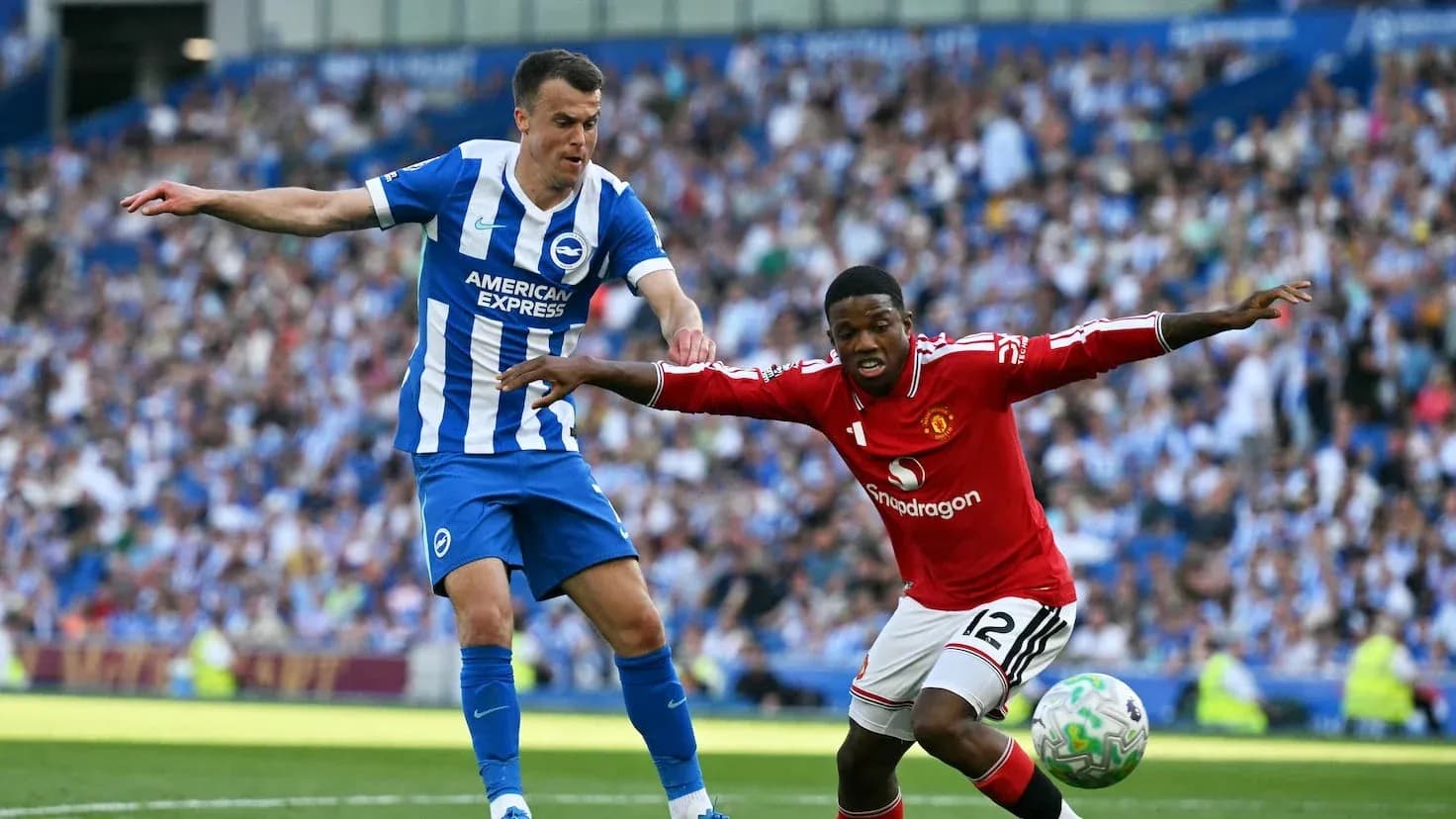
In practice, that structure produced sterile dominance. Brighton completed 463 passes to United’s 447, with an impressive 397 accurate (86%), but the final-third patterns lacked penetration and vertical speed. The Seagulls generated 13 total shots, 9 from inside the box, yet only 2 were on target and 5 were blocked. United’s compact 4-4-1-1 defensive shape, with B. Mbeumo working back and the wide midfielders tracking full-backs, consistently forced Brighton to shoot through traffic rather than attack clear lanes.
Manchester United’s 4-2-3-1 under Michael Carrick was more direct and purpose-driven. K. Mainoo and M. Mount formed a mobile double pivot, comfortable stepping out to press or dropping to help progression. Ahead of them, B. Fernandes operated as a true free 10, drifting laterally to overload whichever side Brighton tried to build through. A. Diallo and P. Dorgu started as the wide “10s”, but their roles were asymmetrical: Diallo often came inside to combine, while P. Dorgu’s width and depth were central to United’s transition threat.
Goals
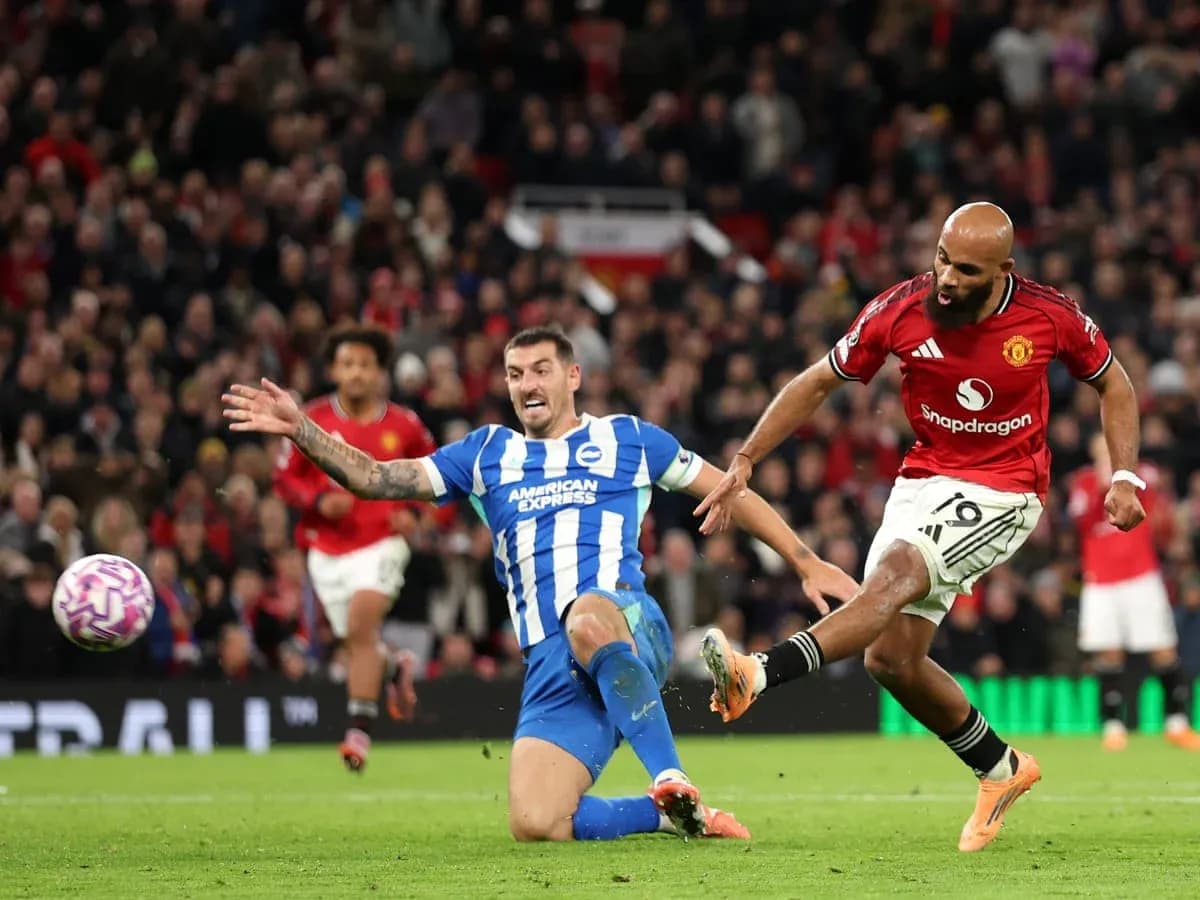
The opening goal at 33' encapsulated the away side’s plan. United invited Brighton’s first line forward, then broke through the half-spaces. With Brighton’s full-backs advanced, United attacked the exposed channels, and P. Dorgu finished after B. Fernandes found him – a classic pattern of drawing the press, then exploiting the vacated wide corridor. The second goal at 44', scored by B. Mbeumo from an A. Diallo assist, again came from United attacking quickly once Brighton’s rest defence was stretched, underlining how often Brighton’s structure left their centre-backs defending large spaces.
At 2-0 down by half-time, Brighton’s in-possession tweaks were evident after the interval. The early substitution at 46' – Y. Minteh (IN) came on for M. De Cuyper (OUT) – was an attempt to add directness and one-versus-one threat on the flank. Minteh’s presence pushed the wide line higher and tried to pin United’s full-backs deeper, but it also increased Brighton’s risk on turnovers, because their counter-press lacked the bite to protect the exposed pivot.
United’s third goal at 48', B. Fernandes finishing from a P. Dorgu assist and confirmed by VAR at 50', effectively ended the contest and highlighted their attacking hierarchy. P. Dorgu’s positioning – high and wide, but with the intelligence to underlap – repeatedly dragged Brighton’s back line out of shape, while B. Fernandes timed his arrivals into the box against a retreating defence. United’s xG of 1.82 reflects a game plan that prioritised a smaller volume of higher-quality chances, compared to Brighton’s 0.81 from more, but less dangerous, shots.
Defensive Structure
Defensively, United’s back four were rarely pulled apart. N. Mazraoui and L. Shaw balanced their forward runs with good rest-defence positions, allowing H. Maguire and L. Martinez to hold a relatively aggressive line without being isolated. The midfield screen from K. Mainoo and M. Mount was disciplined; their foul count (United committed only 8 to Brighton’s 11) and a single yellow card – Kobbie Mainoo for “Foul” at 45+3' – underline that they controlled space more by positioning than by last-ditch interventions.
In goal, B. Verbruggen (Brighton) was busy and exposed. He made 5 saves and, by the data, prevented 0.32 goals, which speaks to the quality of chances United created when they did break through. His shot-stopping kept the scoreline from becoming heavier, but he had limited influence over the structural issues in front of him. At the other end, S. Lammens (Manchester United) faced only 2 shots on target and made 2 saves; the away side’s defensive organisation ensured he was rarely asked to rescue them.
Brighton’s Adjustments
Brighton’s attacking adjustments on 59' – S. March (IN) for D. Gomez (OUT), C. Baleba (IN) for J. Milner (OUT), and C. Kostoulas (IN) for D. Welbeck (OUT) – aimed to refresh energy and add more verticality and dribbling. Later, G. Rutter (IN) for J. Hinshelwood (OUT) at 74' further tilted the side towards a more aggressive, forward-facing front line. Yet these changes did not significantly alter the shot quality profile; United’s compact block and good box defending meant Brighton’s late pressure remained mostly speculative.
Carrick’s substitutions were primarily about game-state management. S. Lacey (IN) for P. Dorgu (OUT) at 62' protected one of United’s key outlets and added fresh legs for defensive work on the flank. The triple change on 74' – J. Zirkzee (IN) for B. Mbeumo (OUT), L. Yoro (IN) for N. Mazraoui (OUT), and T. Fletcher (IN) for M. Mount (OUT) – rebalanced the side, with Zirkzee offering a hold-up focal point, Yoro shoring up the back line, and Fletcher adding energy in midfield. T. Malacia (IN) for L. Shaw (OUT) at 82' was a final step to lock down the left side and preserve the clean sheet.
Statistical Overview
Statistically, the match reinforces a tactical story: Brighton’s 51% possession and superior total shot count did not translate into threat because United controlled where those shots came from and how clean they were. Brighton’s 0 corner kicks to United’s 3 underline how rarely they forced United into emergency defending in their own box. United, by contrast, married a slightly lower possession share with higher xG, more shots on target (7 to 2), and a defensive structure that limited S. Lammens (Manchester United) to routine interventions while demanding far more from B. Verbruggen (Brighton).
The tactical verdict is that Manchester United’s 4-2-3-1, with its disciplined mid-block, sharp transitions, and intelligent use of P. Dorgu and B. Fernandes between and beyond the lines, was perfectly calibrated to punish Brighton’s ambitious but fragile positional play. Brighton’s passing fluency and territorial control were evident, but without a more secure rest defence and clearer mechanisms to create unopposed shots, their structural boldness played into United’s hands.