.svg&w=384&q=75 "Pitchgist logo")
Liverpool vs Brentford: Tactical Analysis of a 1-1 Draw
Liverpool’s 1-1 draw with Brentford at Anfield was a territorial siege that never quite turned into the decisive win the underlying numbers suggested. Arne Slot’s side imposed their 4-2-3-1 structure, generated 24 shots and 2.9 xG, and forced Brentford into a deep, reactive block, yet Keith Andrews’ team emerged with a point thanks to compact defending, a ruthless equaliser and strong goalkeeping.
Both teams lined up in mirrored 4-2-3-1 shapes, but with very different intentions. Liverpool’s back four of C. Jones, I. Konate, V. van Dijk and A. Robertson played almost entirely in Brentford’s half, supported by the double pivot of R. Gravenberch and Alexis Mac Allister. Ahead of them, M. Salah, D. Szoboszlai, R. Ngumoha and C. Gakpo created a fluid attacking band, constantly rotating between half-spaces and wide channels.
The territorial pattern is clear in the numbers: 60% possession, 503 passes (434 accurate, 86%) and 14 corners for Liverpool against Brentford’s 40% share, 331 passes (262 accurate, 79%) and just 2 corners. Liverpool’s shape resembled a 2-3-5 in settled attack, with Robertson and Jones high and wide, Gravenberch stepping into the right half-space and Mac Allister orchestrating from the left interior channel.
Brentford’s 4-2-3-1 was effectively a 4-4-1-1 without the ball. Full-backs M. Kayode and K. Lewis-Potter tucked narrow to protect the box, while J. Henderson and V. Janelt formed a tight screen in front of the centre-backs S. van den Berg and Nathan Collins. The front four of D. Ouattara, M. Jensen, K. Schade and I. Thiago were tasked with closing central lanes rather than pressing high, which is reflected in Liverpool’s high pass completion in non-threatening zones.
Key Tactical Hinge
The game’s key tactical hinge was how Liverpool attacked Brentford’s low block. Of their 24 shots, 17 came from inside the box, indicating that Slot’s side repeatedly managed to penetrate into dangerous areas rather than settling for long-range efforts. The 8 blocked shots underline Brentford’s commitment to last-ditch defending, with the centre-backs and double pivot collapsing aggressively towards the penalty spot.
Liverpool’s opener at 58’ crystallised their positional play. C. Jones, nominally at left-back, had license to step into midfield and underlap, while Robertson’s earlier width had stretched Brentford’s right side. When the ball reached M. Salah between the lines, Brentford’s compactness finally broke: Salah found Jones on the move, and the defender finished to cap a pattern of overloads down Liverpool’s left, right through the heart of Brentford’s mid-block.
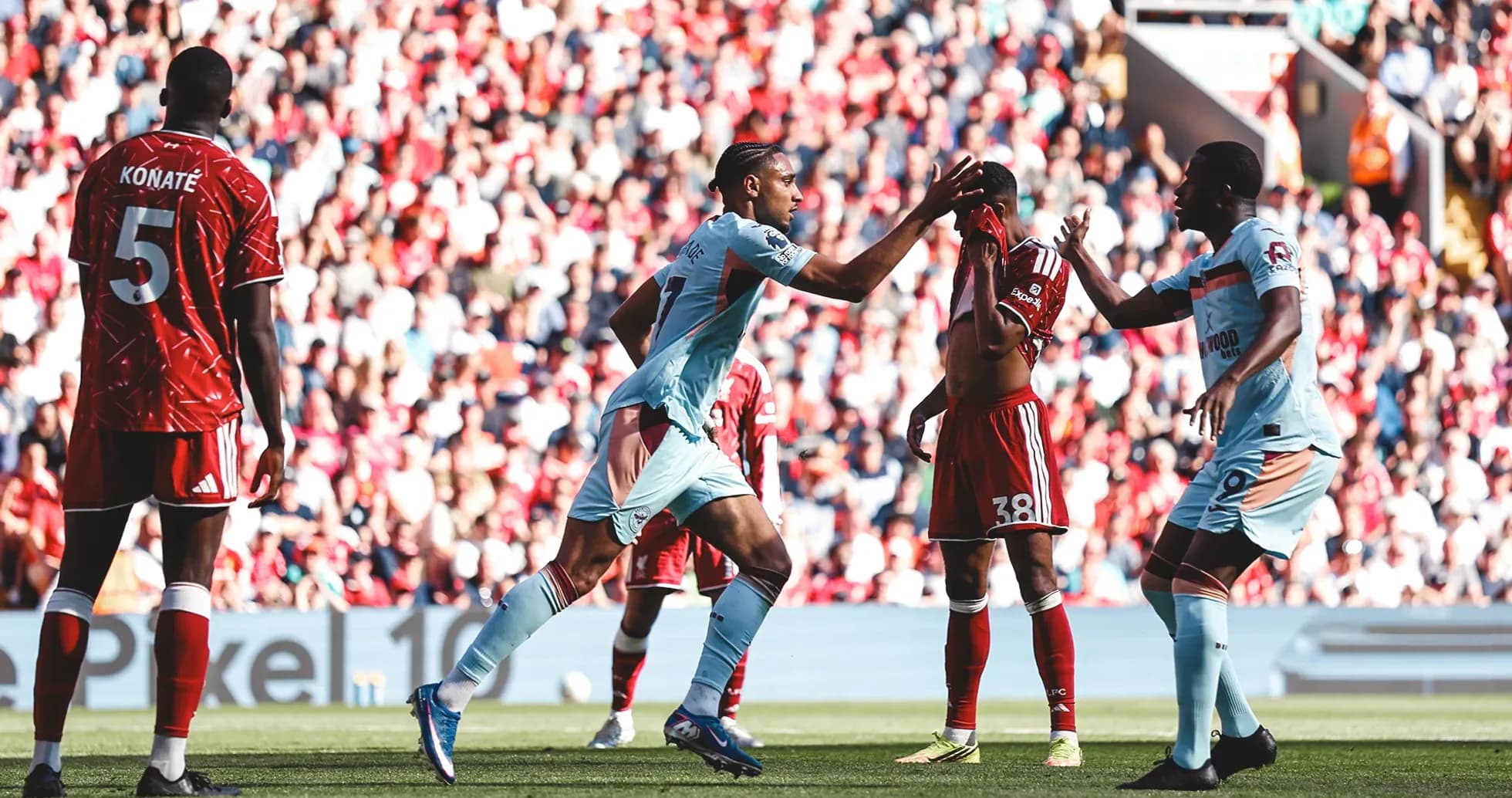
Brentford’s response at 64’ through K. Schade came from the other side of the tactical coin: efficiency in transition. With only 11 total shots and 1.22 xG, their plan hinged on a few high-quality moments. The equaliser reflected their intent to spring quickly once the first line was beaten, exploiting the space behind Liverpool’s advanced full-backs. It punished Liverpool’s aggressive rest-defence structure, where Konate and van Dijk were often left 2v2 or 2v3 against Brentford’s front line.
Substitutions
From there, substitutions became tactical tools rather than simple rotations. At 60’, A. Hickey (IN) came on for J. Henderson (OUT), adding more natural defensive instincts at full-back and shoring up Brentford’s flank. For Liverpool, F. Wirtz (IN) for R. Ngumoha (OUT) at 73’ and J. Frimpong (IN) for M. Salah (OUT) at 74’ signalled a push for more directness and one‑v‑one threat from wide areas, as Slot looked to break a tiring block with fresh dribblers and runners.
The double change at 83’ — M. Kerkez (IN) for A. Robertson (OUT) and T. Nyoni (IN) for R. Gravenberch (OUT) — maintained Liverpool’s aggressive full-back profile while adding new legs in midfield to keep the tempo high. J. Gomez (IN) for I. Konate (OUT) at 89’ was a late defensive refresh, ensuring the back line retained physical presence against any Brentford counters or set-pieces.
Discipline and Emotional Tone
Discipline also shaped the game’s emotional tone. Jordan Henderson’s early yellow card for “Argument” set a combative tone for Brentford, even before kick-off time in the event log. Later, Ibrahima Konaté’s yellow at 79’ for “Foul” and Alexis Mac Allister’s at 90+2’ for “Foul” reflected Liverpool’s aggressive counter-press and occasional desperation to stop transitions. Brentford’s late cards — Nathan Collins at 90+5’ and Vitaly Janelt at 90+4’, both for “Argument” — captured the tension of defending a point under heavy pressure.
Goalkeeping Performance
In goal, Alisson (Liverpool) was largely a spectator in terms of shot-stopping, officially making 1 save, which aligns with Brentford’s 2 shots on target and the fact that one of those went in. His contribution was more about sweeping and starting attacks, fitting Liverpool’s high line and dominance of territory. At the other end, C. Kelleher (Brentford) faced 8 shots on target and is credited with 7 saves, a decisive factor in preserving the draw. The goals prevented metric reinforces this: both teams are credited with 1.4 goals prevented, but Kelleher’s workload was far more intense, given the volume and quality of Liverpool’s chances.
Statistical Overview
Statistically, Liverpool’s 2.9 xG versus Brentford’s 1.22 xG underlines a match where the hosts created enough to win by more than one goal. The 14-2 corner count and 60-40 possession split confirm a sustained siege, with Liverpool circulating the ball and repeatedly forcing Brentford deeper. Yet Brentford’s 3 yellow cards to Liverpool’s 2, combined with their 9 fouls matching Liverpool’s 9, show a side willing to disrupt rhythm and contest every duel despite spending long spells without the ball.
In tactical terms, Liverpool’s structure and chance creation were broadly successful, but the lack of clinical edge and a single lapse in rest-defence turned a dominant performance into a frustrating 1-1. Brentford, by contrast, executed a clear plan: concede territory, protect the central lane, rely on C. Kelleher’s shot-stopping, and strike with precision when the chance arose. The draw at Anfield is less an even contest than a testament to how a disciplined, compact 4-2-3-1 can survive against a structurally superior opponent when the fine margins in both boxes fall its way.