.svg&w=384&q=75 "Pitchgist logo")
Liverpool vs Brentford: A Season-Defining Draw
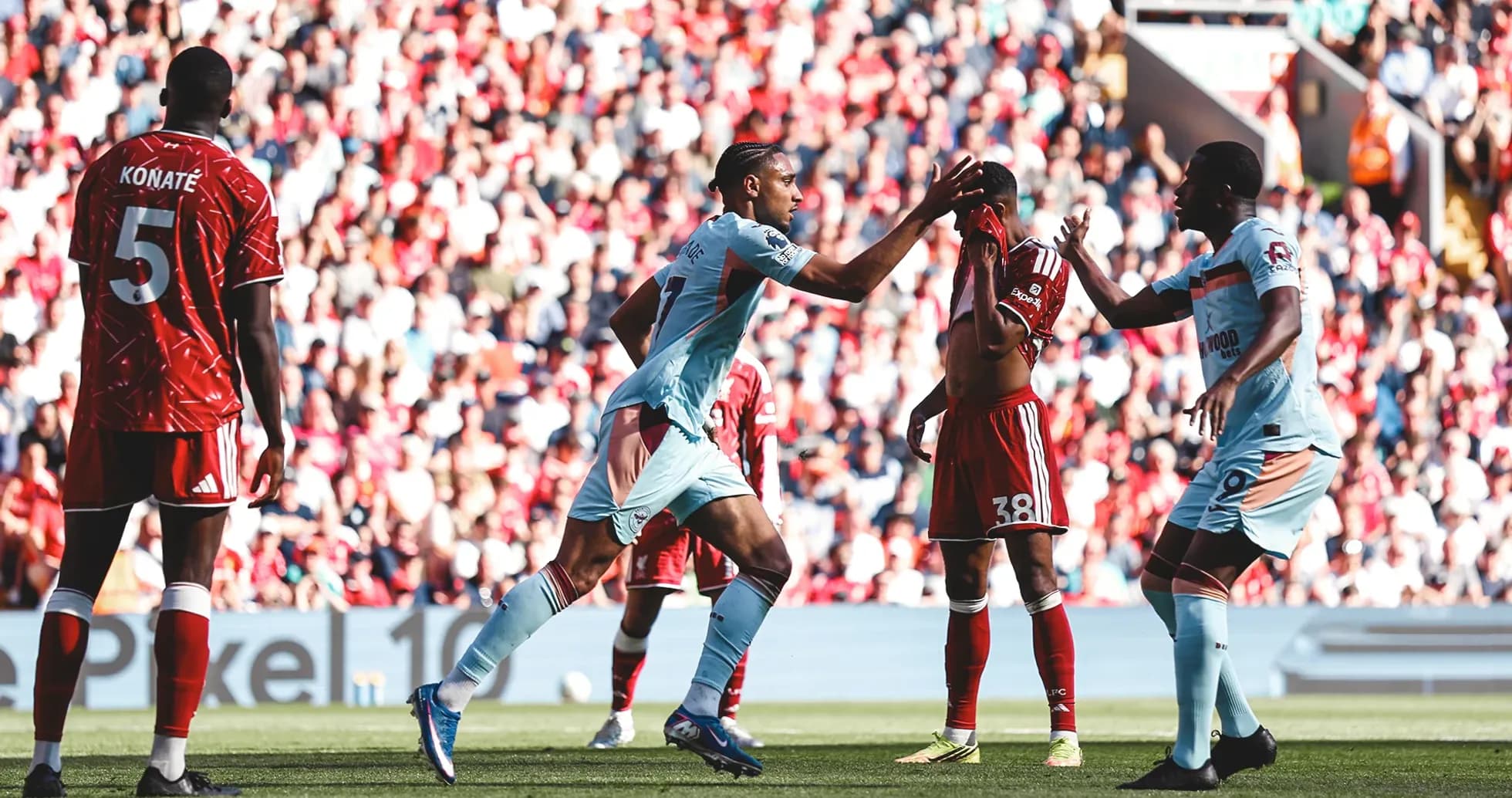
Anfield’s final act of the 2025–26 Premier League season ended not with a roar but with a murmur of frustration. Liverpool, chasing a statement win to underline their return to the Champions League places, were held 1-1 by a Brentford side that has spent the campaign punching above its weight. Following this result, Liverpool close the season 5th on 60 points, Brentford 9th on 53 – a draw that neatly mirrors how their seasons have been defined by fine margins.
I. The Big Picture – Structures and Seasonal DNA
Both managers leaned into their most trusted shape. Arne Slot sent Liverpool out in a 4-2-3-1, the formation he has used in 34 league matches this season. Alisson anchored a back four of C. Jones, Ibrahima Konaté, Virgil van Dijk and Andy Robertson, with Alexis Mac Allister and Ryan Gravenberch as the double pivot. Ahead of them, a fluid band of three – Mohamed Salah, Dominik Szoboszlai and the young R. Ngumoha – worked behind Cody Gakpo as the central forward.
Keith Andrews mirrored the system with his own 4-2-3-1, but with a very different intention. On their travels this season Brentford have averaged 1.2 goals for and 1.6 against; the shape here was about compactness and counter-punching. Caoimhín Kelleher, returning to Anfield in Brentford colours, stood behind a back four of M. Kayode, S. van den Berg, Nathan Collins and K. Lewis-Potter. The double pivot of J. Henderson and Vitaly Janelt was tasked with stemming Liverpool’s central flow, while Dango Ouattara, Mathias Jensen and Kevin Schade supported the league’s second-top scorer, Igor Thiago.
Across the season, Liverpool’s overall goal difference of 10 (63 scored, 53 conceded) tells of a side that can outgun most but rarely control games entirely. At home they have been more ruthless: 34 goals for and 20 against at Anfield, averaging 1.8 scored and 1.1 conceded. Brentford, by contrast, have lived on the edge: overall they have scored 55 and conceded 52, a goal difference of 3, with a noticeable drop-off away from home where they have shipped 31.
II. Tactical Voids – Absences and Discipline
Both squads arrived with key absentees that subtly reshaped the contest. Liverpool were without S. Bajcetic (hamstring), C. Bradley (knee), H. Ekitike (Achilles tendon) and G. Leoni (knee). The loss of Ekitike was particularly significant: 11 league goals and 4 assists from an attacker who offers vertical threat and penalty-box presence. Without him, Gakpo shouldered the central scoring burden, while Slot’s bench leaned on the creativity of F. Wirtz and the direct running of F. Chiesa and Alexander Isak as potential game-changers rather than like-for-like replacements.
Brentford’s absentees skewed their depth more than their starting XI. F. Carvalho (knee), Rico Henry (hamstring) and A. Milambo (knee) all missed out, thinning Andrews’ options in wide and full-back areas. That absence of a natural, experienced left-back option beyond Lewis-Potter – nominally more of an attacking player – framed how Liverpool targeted that flank, with Salah and Szoboszlai frequently rotating into the right half-space to overload him.
In disciplinary terms, both sides carried season-long warning signs into the fixture. Liverpool’s yellow-card profile shows a pronounced late-game surge: 31.58% of their bookings have arrived between 76-90 minutes, with another 17.54% in 91-105. Brentford are similarly combustible late on, with 26.09% of their yellows between 76-90 and 21.74% in the 61-75 window. The risk of a chaotic finale was baked into the matchup, and both managers knew that fatigue and emotion could tilt the final quarter-hour.
Red cards, too, had a narrative weight. Szoboszlai’s season includes a dismissal, a reminder that his aggressive pressing edge can spill over. On the Brentford side, Schade has also seen red, and his 6 yellow cards underline how much he lives on the disciplinary line. That tension between intensity and control was central to the way the wide areas played out.
III. Key Matchups – Hunter vs Shield, Engine Room vs Enforcer
The headline duel was clear: Igor Thiago versus Liverpool’s defensive axis. With 22 league goals and 8 penalties scored, plus 1 missed, he arrived as the division’s most prolific penalty-box hunter outside the very top bracket. His movement between Konaté and van Dijk was designed to exploit Liverpool’s vulnerability on their travels; yet at home, Liverpool concede only 1.1 goals on average, and van Dijk’s positioning remains the shield around which Slot builds.
Liverpool’s own attacking constellation revolved around Salah, Szoboszlai and Gakpo. Salah’s 7 goals and 7 assists in the league, coupled with 49 key passes, make him both finisher and creator. Szoboszlai, with 6 goals, 7 assists and 78 key passes, is the side’s metronome and long-range threat – but also the player who missed a penalty this season, a small crack in Liverpool’s otherwise perfect penalty record (1 scored from 1 in the league data). Gakpo, with 7 goals and 5 assists, offers a blend of hold-up play and channel runs that drag centre-backs into awkward zones.
Their task was to unpick a Brentford defensive structure that, while leaky away, is well-drilled. Collins and van den Berg had to manage Gakpo’s dropping movements while tracking Salah’s diagonal darts. Behind them, Kelleher’s familiarity with Anfield’s dimensions and Liverpool’s patterns gave Brentford a subtle psychological edge; he knows where the shots usually come from.
In midfield, the engine-room battle pitched Mac Allister and Gravenberch against Henderson and Janelt. Mac Allister’s role as the first passer out of pressure was vital in drawing Brentford’s 4-2-3-1 out of shape, while Gravenberch’s carrying threatened to break lines. Henderson, back on Merseyside in opposition colours, was Brentford’s organiser, dictating pressing triggers and trying to funnel Liverpool wide, away from central combinations between Szoboszlai and Salah.
Out wide, the most volatile duel came on Brentford’s left. Schade, with 8 goals, 3 assists and a history of both productivity and disciplinary flashpoints (1 red, 6 yellows, plus a missed penalty from the spot despite winning 2), had to track Salah and Jones while still providing outlet runs. His battle with Jones – a nominal defender here – was a tug-of-war between risk and restraint.
IV. Statistical Prognosis – A Draw Written in the Numbers
Following this result, the 1-1 scoreline feels almost preordained by the season-long data. Liverpool’s overall scoring average of 1.7 goals per game and Brentford’s 1.4, set against identical overall concessions of 1.4 for both, point towards narrow margins rather than a rout. At Anfield, Liverpool’s 1.8 goals for against Brentford’s away concession of 1.6 creates a statistical expectation of a tight home edge, but Brentford’s ability to keep 5 clean sheets away and Liverpool’s tendency to concede late yellow cards hinted at a game that might slip from their grasp.
Without explicit xG numbers, the shape of the contest can still be inferred. Liverpool’s shot volume and territory, driven by Szoboszlai’s creativity and Salah’s gravity, likely tilted the Expected Goals in their favour. Yet Brentford’s structure, Henderson’s game management and Thiago’s ruthless efficiency ensured that the visitors turned fewer chances into comparable threat.
In narrative terms, this was a meeting of a side still learning to dominate under a new coach and a team utterly comfortable in the role of spoiler. Liverpool’s Champions League return is secured, but this draw is a reminder that their next step – from good to ruthless – will depend on turning these statistically dominant but finely balanced games into wins. Brentford, meanwhile, leave Anfield with a point and a statement: their place in the league’s top half is no accident, and with a 22-goal striker and a disciplined 4-2-3-1 core, they are built to keep troubling the established order.