.svg&w=384&q=75 "Pitchgist logo")
Australia Defeats Türkiye 2-0 in World Cup Opener
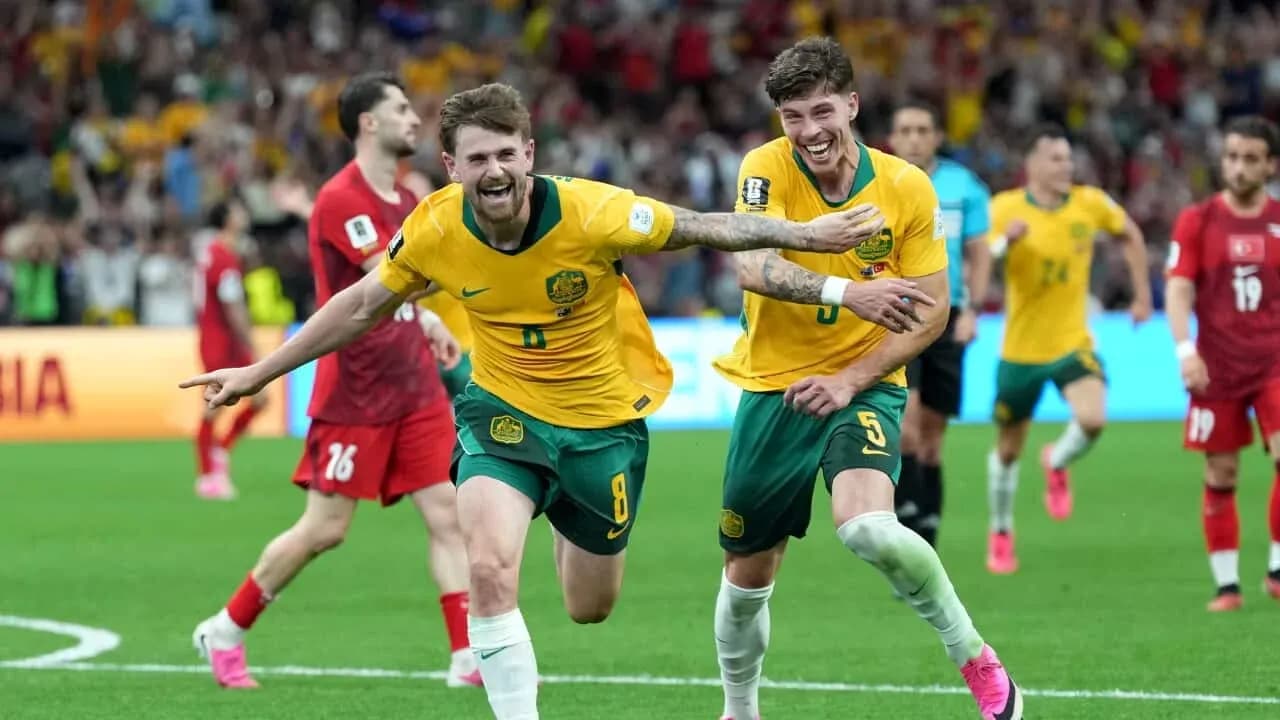
BC Place in Vancouver felt less like neutral ground and more like a proving ground as Australia opened their 2026 World Cup with a controlled 2-0 win over Türkiye, a result that immediately reshaped the balance of Group D.
I. The Big Picture – Structure, Scoreline, Stakes
Heading into this game, the numbers painted a clean slate; following this result, they tell a story of clarity. Australia sit 2nd in Group D with 3 points, a goal difference of +2 (2 goals for, 0 against) from 1 match played. Türkiye, by contrast, are 3rd with 0 points and a goal difference of -2 (0 goals for, 2 against) after their single outing.
Australia’s seasonal DNA, even at this early stage, is sharply defined. Overall they have played 1 match, won 1, drawn 0, lost 0. At home in this tournament context, they have played 1, won 1. They average 2.0 goals for at home and 2.0 overall, with 0.0 goals against both at home and overall. One clean sheet in total underlines a defensive base that matches the scoreline.
Türkiye’s numbers are the mirror opposite. Overall they have played 1 match, away from home in this dataset, and lost it. Their goals for total is 0, with an overall and away average of 0.0. Goals against stand at 2 overall, all conceded on their travels, for an away and total average of 2.0. There is no clean sheet yet, and they have already failed to score once.
On the tactical board, it was 5-4-1 for Tony Popovic against Vincenzo Montella’s 4-2-3-1. The scoreline suggests control from Australia, but the formations show how they built it: density at the back, direct threat ahead, and a midfield built to run and duel rather than simply circulate.
II. Tactical Voids and Discipline – Where the Edges Appeared
There is no explicit list of absentees, so the squads we see are the squads both coaches chose to trust. For Australia, the bench depth across all lines is notable: three goalkeepers (Mathew Ryan, Paul Izzo, Patrick Beach starting), a cluster of defenders like Aziz Behich, Miloš Degenek and Kai Trewin, and attacking variety in Nishan Velupillay, Tete Yengi and Mathew Leckie. Popovic had options to change shape without sacrificing defensive stability.
Türkiye’s bench is similarly deep in defensive and attacking profiles – Çağlar Söyüncü, Ozan Kabak, Kaan Ayhan at the back; Kenan Yıldız, Yunus Akgün, Deniz Gül and Oğuz Aydın further forward – but the way the match unfolded meant these weapons were chasing, not shaping, the game.
Disciplinary patterns matter in tournament football, and Türkiye’s early snapshot is worrying. Their yellow-card distribution shows a late-game spike: 100.00% of their bookings so far have arrived between 76-90 minutes. That lone caution belongs to Yunus Akgün, who came off the bench, played 35 minutes and picked up 1 yellow card. It hints at frustration and reactive defending once the game state turned against them. Australia, by contrast, have no yellow or red cards recorded across any time range so far, underscoring a controlled, low-risk approach.
III. Key Matchups – Hunter vs Shield, Engine Room vs Enforcer
Hunter vs Shield for Australia begins with Nestory Irankunda. From midfield, he has 1 goal in total this tournament, scoring in his only appearance. In 61 minutes he produced 2 shots, both on target, and completed 1 dribble from 1 attempt. His rating of 7.5 underlines his influence: a vertical runner from the line of four who turns Australia’s 5-4-1 into a 5-2-3 in transition.
Behind him, the “Shield” is collective rather than individual. In total this campaign, Australia’s back line has conceded 0 goals. The three centre-backs – Jordan Bos wide-left, Cameron Burgess and Harry Souttar central, with Alessandro Circati and Jacob Italiano completing the five – created a compact second line that Türkiye’s lone forward, Kerem Aktürkoğlu, struggled to unpick.
On the Turkish side, the Hunter is more theoretical than statistical at this point: they have 0 goals for overall. The creative weight falls on Arda Güler, Orkun Kökçü and Kerem Aktürkoğlu, supported by Hakan Çalhanoğlu from deeper. Structurally, Montella’s 4-2-3-1 is built to feed a central striker, but without a goal yet and with 0.0 goals for on their travels, that attacking unit remains potential rather than production.
The Engine Room duel was more clearly defined. For Australia, Paul Okon-Engstler quietly dictated their tempo. In his single appearance he has 1 assist, 32 total passes with 2 key passes and an 81% accuracy, alongside 3 tackles, 2 successful blocks and 3 interceptions. This is a two-way midfielder who both builds and breaks play. When he stepped out of the line of four, the structure became a 3-4-2-1, with Connor Metcalfe and Aiden O’Neill shuttling to cover.
Opposite him, İsmail Yüksek and Hakan Çalhanoğlu formed Türkiye’s double pivot. Their job was to screen the back four of Zeki Çelik, Merih Demiral, Abdülkerim Bardakcı and Ferdi Kadıoğlu while also connecting to the advanced trio. The fact Türkiye have already conceded 2 goals overall and average 2.0 goals against on their travels suggests that screen was pierced too often, particularly when Australia broke from deep.
IV. Statistical Prognosis – What This Performance Projects
With no explicit xG values in the data, the prognosis leans on structure and outcomes. Australia’s 2-0 home win is not just a one-off; it aligns perfectly with their season snapshot: 1 win from 1, 2.0 goals for at home, 0.0 against, 1 clean sheet and 0 matches where they failed to score. Their most-used formation is already fixed – 5-4-1 played once – and it has delivered balance.
Türkiye’s early profile is more fragile. On their travels they have played 1, lost 1, conceded 2 and failed to score. Their most-used setup, 4-2-3-1, has yet to generate a single goal in total and has left them exposed to direct attacks through the channels once the full-backs push on.
From a tactical lens, Australia’s conservative block, spearheaded by Mohamed Touré as the lone forward, looks sustainable. They can lean on Irankunda’s directness and Okon-Engstler’s all-round midfield craft, while their back five and Patrick Beach in goal protect a perfect defensive record.
For Türkiye, the data demands recalibration. The late spike in yellow cards, the 2.0 goals against average away from home, and the lack of goals for all point to a side that is chasing games rather than controlling them. Montella may need to tilt his 4-2-3-1 either towards greater protection for his centre-backs or greater verticality to better exploit Arda Güler and Kerem Aktürkoğlu.
Following this result, the numbers say Australia have established a clear identity: compact, disciplined, and ruthlessly efficient. Türkiye, meanwhile, stand at a crossroads, their talent evident on the teamsheet but still searching for a statistical and tactical foothold in Group D.