.svg&w=384&q=75 "Pitchgist logo")
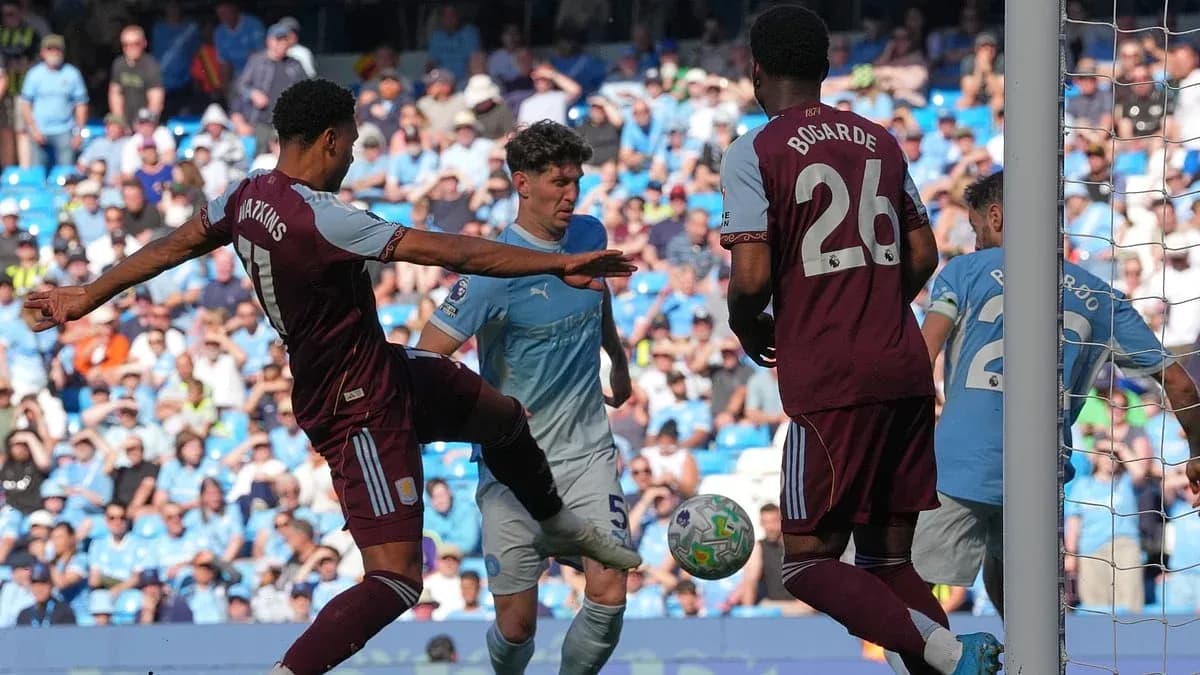
Aston Villa's Tactical Masterclass Over Manchester City
Manchester City’s 4-2-2-2 at Etihad Stadium produced territorial control but not scoreboard dominance, as Aston Villa’s compact 4-2-3-1 under Unai Emery turned a 1-0 deficit into a 2-1 away win. The game was defined by Villa’s vertical efficiency and City’s difficulty in converting sustained pressure into clear, repeatable chances.
City’s structure with J. Trafford in goal, a back four of R. Lewis, J. Stones, R. Dias and N. Ake, and a double pivot of Nico and B. Silva aimed to create central overloads and wide isolation for Savinho and A. Semenyo behind the front pair of P. Foden and T. Reijnders. The early phases reflected that plan: City finished with 52% possession, 458 passes and 88% accuracy (458 passes, 405 accurate, 88%), using short circulation to pin Villa back. The 10 shots inside the box out of 16 total underline that City did manage to access dangerous zones, largely through half-space combinations and second-phase pressure after corners (9 corner kicks).
The breakthrough on 23 minutes from A. Semenyo came as a logical outcome of City’s territorial control. With Villa’s 4-2-3-1 compressed centrally, City’s wide midfielders received in advanced pockets, dragging Villa’s full-backs out and opening seams between centre-back and full-back. Semenyo’s goal reflected City’s ability to attack those channels from their dual “number 10” band. However, the lack of a recorded assist hints at a more broken, second-ball sequence than a clean pattern, consistent with City’s 6 blocked shots: Villa often got first contact but failed to fully clear, allowing City to recycle.
Defensively, City’s rest defence was built on Stones and Dias holding a high line with Nico and B. Silva screening. With only 8 fouls and a single yellow card (Rico Lewis for “Foul” on 82'), City tried to defend proactively through positioning rather than aggression. Yet Aston Villa’s transition threat, especially via O. Watkins, exposed the fragility of that structure once the first line was broken. Trafford (Manchester City) made 3 saves, which, combined with Villa’s 5 shots on goal, indicates that some efforts were either off target or blocked; crucially, Villa still generated 1.58 xG, higher than City’s 1.25, showing their chances were of superior quality despite lower volume.
Aston Villa’s 4-2-3-1, with M. Bizot in goal, a back four of A. Garcia, V. Lindelof, T. Mings and I. Maatsen, and a double pivot of L. Bogarde and Douglas Luiz, initially sat deeper, absorbing pressure. Their 48% possession and 436 passes (436 passes, 394 accurate, 90%) show they were not purely reactive; instead, they were selective, choosing moments to play through City’s press. The key tactical lever was Watkins’ movement: he continually stretched the line, creating direct outlets when City’s full-backs pushed high.
The equaliser at 47' from O. Watkins was emblematic. Coming immediately after half-time—and after Aston Villa introduced M. Cash (IN) for A. Garcia (OUT) at 46'—Villa attacked quickly, catching City while their structure was still re-establishing. The lack of an assist suggests a direct or transitional situation, likely exploiting space behind City’s advanced full-backs. From that point, Villa’s attacking band of L. Bailey, R. Barkley and E. Buendia operated closer to Watkins, compressing distances for quicker combinations.
The second Watkins goal on 61', assisted by R. Barkley and confirmed by VAR at 63', showcased Villa’s best attacking pattern: progression through midfield into the half-spaces, then a decisive final ball into the box. Barkley’s assist points to his role as the vertical connector, stepping between City’s lines to receive and release early. With only 12 total shots and 9 inside the box, Villa were highly selective: they avoided speculative efforts from distance, preferring to engineer clear looks for Watkins inside the area.
Substitutions further shaped the tactical battle. For City, R. Cherki (IN) for A. Semenyo (OUT) at 58' and M. Kovacic (IN) for B. Silva (OUT) at 59' signalled a shift towards more ball-carrying and late-box arrivals from midfield. Later, J. Doku (IN) for T. Reijnders (OUT) at 77' added direct 1v1 threat, while R. Ait-Nouri (IN) for N. Ake (OUT) and J. Gvardiol (IN) for J. Stones (OUT) at 77'-78' freshened the back line and left flank. Despite these changes, City’s shot profile did not dramatically spike, and they remained stuck at 3 shots on goal, underlining that Villa’s block adapted well to each new threat.
Emery’s changes were more about game management and consolidating the lead. On 73', Y. Tielemans (IN) for Douglas Luiz (OUT), P. Torres (IN) for V. Lindelof (OUT) and A. Onana (IN) for L. Bogarde (OUT) collectively refreshed the spine, adding ball retention and aerial security. Later, J. McGinn (IN) for R. Barkley (OUT) at 86' reinforced Villa’s defensive work-rate and pressing resistance in the final minutes. That Villa finished with only 4 fouls and no cards highlights how well they controlled duels positionally rather than through last-ditch interventions.
In goal, M. Bizot (Aston Villa) made 2 saves. Given City’s 3 shots on goal and 1.25 xG, this suggests that one of City’s on-target efforts was the Semenyo goal, with Bizot otherwise well protected by his block. Both goalkeepers posted 0.28 goals prevented, indicating that the shot quality they faced broadly aligned with the goals conceded; the decisive edge came from Villa’s attackers outperforming City’s in the final third rather than extraordinary goalkeeping on either side.
Statistically, City’s 52% possession, higher shot volume (16 vs 12) and corner count (9 vs 4) tell the story of a side that controlled territory but not the decisive zones inside the area. Their 10 shots inside the box did not translate into high xG relative to volume, hinting at crowded shooting situations and blocked lanes (6 blocked shots). Villa, by contrast, produced fewer but cleaner looks: 9 shots inside the box from 12 total, 5 on target, and 1.58 xG. Their 90% pass accuracy, slightly higher than City’s, underlines how secure they were when they chose to play, especially after taking the lead.
Discipline was also asymmetric: Manchester City received 1 yellow card, Aston Villa none, with total cards at 1. The late VAR intervention at 90+2', where a potential goal by Phil Foden was disallowed, encapsulated City’s frustration: structurally dominant, but repeatedly denied by Villa’s compactness, clinical transitions and a game plan that maximised every attacking phase.