.svg&w=384&q=75 "Pitchgist logo")
Behind the Scenes of the World Cup Portraits
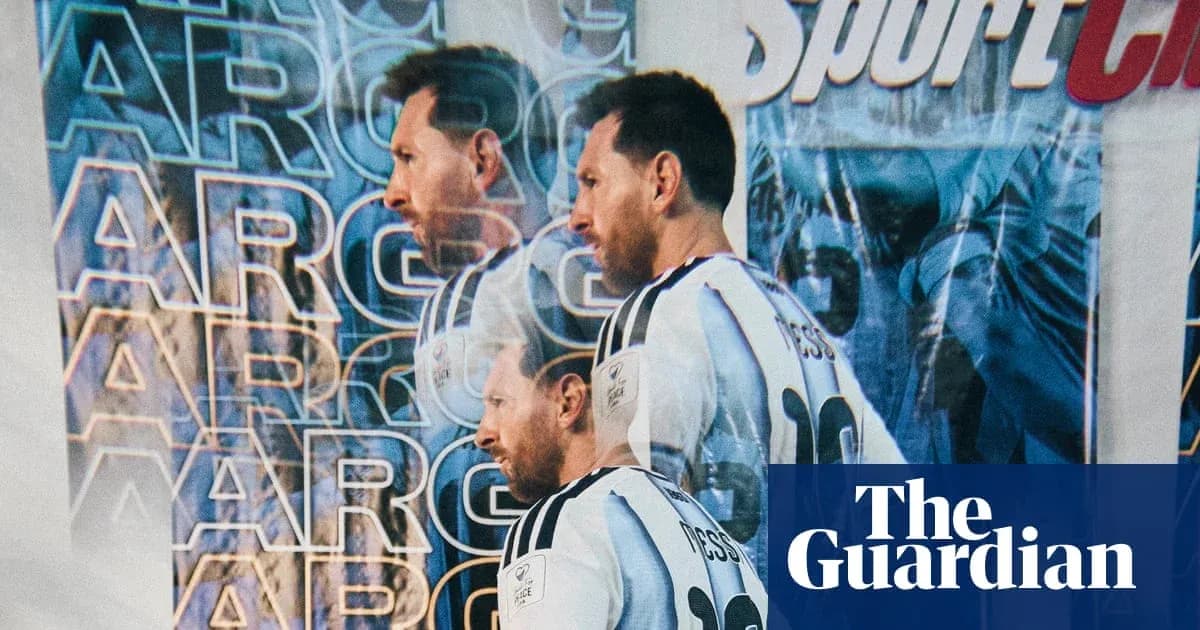
Lionel Messi freezes. Shoulders square, eyes locked, body rigid in front of the lens. A still life in sky blue and white.
A few doors down, Marc Cucurella is all movement – hair flicking, body swaying, as if the studio floor has turned into a dancefloor. Diego Moreira raises his forearm to his face, hiding his eyes and revealing an unsettling tattoo. Harry Kane drops awkwardly to one knee, caught between catalogue pose and captain’s duty.
Welcome to the World Cup’s quietest circus: the official portrait session.
There are 1,248 players and 48 managers at this tournament. None of them gets a pass. Before a ball is kicked, every one of them files through a makeshift studio, stands on a taped cross and gives the world a few seconds of themselves – or at least, the version they’re prepared to share.
Production line of personalities
Getty Images, working on behalf of Fifa, has spent recent weeks shuttling squads through these tightly timed shoots. The results are everywhere: a gallery of faces, stances and micro-expressions that say as much about modern football as any tactical board.
Behind-the-scenes frames, released by Getty, show how ruthlessly efficient the operation has to be. Two photographers per team. Two different sets – one plain, one with a bit more character – so players and coaches can be spun from one to the other with minimal fuss.
The lighting is deceptively simple. A big studio strobe with a softbox to soften the hit, a couple of rim lights to carve out shoulders and jawlines from the backdrop. No elaborate rigs, no Hollywood theatrics. The trick lies elsewhere.
For this World Cup, the backgrounds are more muted than the saturated, poster-ready look of 2022. The drama comes from the glass in front of the sensor: special lens filters that bend and fracture the light, throwing up streaks, blurs and kaleidoscopic flares. Messi’s portrait, with its dreamlike distortions, is a product of those experiments – all done in camera, not stitched together later on a laptop.
“You only get a few minutes”
Tom Jenkins, The Guardian’s long-serving sports photographer, knows what this conveyor belt feels like.
“With these kinds of shoots, you only get a few minutes with each player and you have to bash out various pictures and think incredibly quickly,” he says. It’s not a gentle portrait sitting; it’s speed chess with world stars.
The checklist is non-negotiable. One or two shots that could have been taken in any era – straight, school-photo style, the kind clubs used to pin in programmes and on dressing-room walls. Then something else: more expressive, more playful, something that nods to the era of Instagram and personal brands.
“A lot of players will have their own poses and goal celebrations already but you’ve also got to have a list in mind,” Jenkins explains. The photographer becomes director, coaxing, suggesting, occasionally dragging something more interesting out of a reluctant subject.
That power comes with a jolt of pressure.
“The interesting thing is that you’re in control of these superstars and every aspect of the shoot. There’s a lot of pressure that comes with that. You have to make sure you’ve set things up and tested everything before they arrive, so that when the shoot starts you can just focus on them.”
When the door opens and a Ballon d’Or winner walks in, there is no time to fiddle with a light stand.
Image-savvy players, unforgiving audiences
Every player has a name card ready, even Messi – a small, almost comic insurance policy against the unthinkable: someone in post-production mislabelling the most recognisable footballer on the planet.
Once the shutter rattles, many of them head straight to the monitor. They are not just subjects; they are curators of their own image.
“Most football players are very aware of their own image these days and they know how powerful it can be, especially through Instagram,” Jenkins says.
They’ve rehearsed this world. Eberechi Eze has fronted a Burberry campaign. Declan Rice has stood under the lights for L’Oreal. The studio, the pose, the micro-adjustments to jawline and shoulders – it’s familiar territory now, not an intrusion.
“Actually they’re much more comfortable with being in front of the camera and some of them really enjoy it.”
Comfort, though, doesn’t guarantee mercy once the pictures hit social media.
Some of England’s squad found that out quickly. Rice’s sunburn became a punchline. Anthony Gordon’s portrait spawned comparisons to Princess Diana. Dean Henderson’s side-eye look drifted from quirky to unsettling in the court of public opinion.
The more inventive frames – Jude Bellingham and others warped through filters and reflections – show what can be done when the camera does the heavy lifting and the player simply turns up. Even when the subject offers little spark, the technique can still light the fuse.
Bielsa, as ever, refuses to play the game
Yet the standout portrait of this World Cup does not feature a star forward or a golden-boot contender. It belongs to a coach who has never cared for the spotlight.
Marcelo Bielsa, Uruguay’s head coach, sat down for Michael Regan at the team’s base in Cancún, Mexico. The rules were the same: face the camera, give them something usable, move on.
Bielsa chose a different script.
Instead of lifting his head and engaging the lens, he looked down at his feet. No grand gesture, no theatrical rebellion. Just a quiet refusal to perform. The frame that emerged is stark and oddly powerful – a man in his own world, even as the biggest show in football swirls around him.
“I’m not a model,” he protested afterwards. He didn’t need to be. The image works precisely because he declined the role.
For Jenkins, that is the point of the entire exercise.
“Ultimately I think the best portrait is one that displays the individual’s personality, and that’s why the Bielsa picture is so brilliant. It’s perfectly him.”
In a tournament built on systems, patterns and data, a few seconds in front of a camera still reveal something that can’t be measured: how these people choose to face the world – or, in Bielsa’s case, whether they choose to face it at all.