.svg&w=384&q=75 "Pitchgist logo")
USA's Tactical Mastery in 2-0 Victory Over Bosnia & Herzegovina
USA’s 2-0 win over Bosnia & Herzegovina at Levi's Stadium in this World Cup Round of 32 tie was a study in controlled verticality versus cautious containment. Mauricio Pochettino’s 4-3-3 delivered just eight total shots and 48% possession, yet produced two goals and a far higher attacking threat than the raw volume suggests. Sergej Barbarez’s 5-3-2, with three centre-backs and aggressive wing-backs, saw more of the ball (52%) and more shots (10), but generated only 0.25 xG against USA’s 0.92 and never truly destabilised the American block, even after a second-half red card left the hosts with ten men.
I. Executive Summary
The match pivoted on USA’s capacity to compress space centrally while attacking quickly into the channels. Folarin Balogun’s strike on 45' and Malik Tillman’s clincher on 82' framed a performance in which the USA were more efficient than dominant. Bosnia & Herzegovina circulated the ball with patience, but their 5-3-2 struggled to convert territorial phases into clean box entries, repeatedly running into a disciplined back four and a compact midfield trio. The numerical advantage after 64' did not translate into structural superiority, as USA simply dropped into a lower 4-4-1 and protected central zones.
II. Scoring Sequence & Disciplinary Log
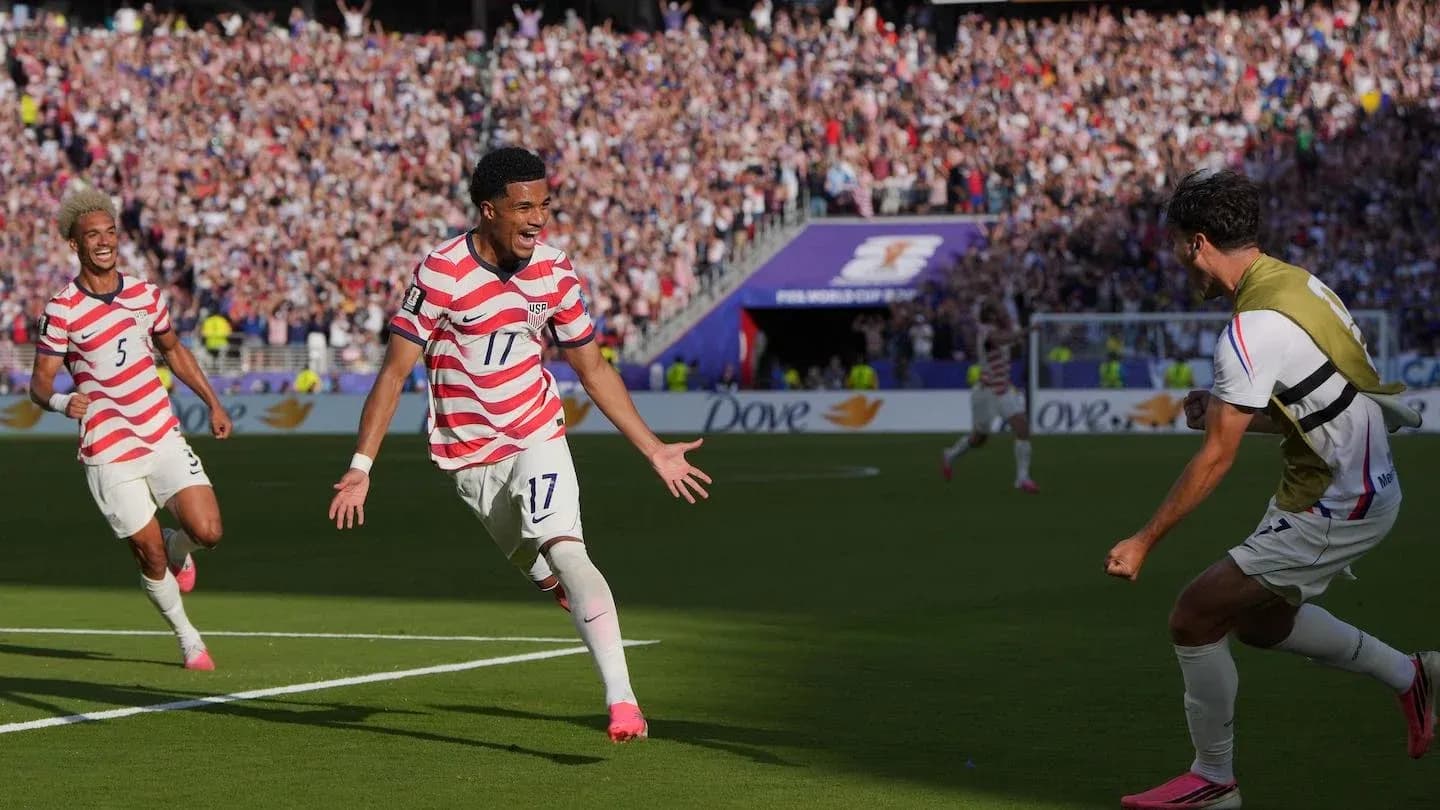
The opener arrived right on 45': Folarin Balogun (USA) found space to finish a “Normal Goal” with no registered assist, capping a first half in which USA’s front three constantly looked to exploit gaps between Bosnia & Herzegovina’s wide centre-backs and wing-backs. That goal set a 1-0 half-time scoreline.
The decisive second goal came on 82', again for the hosts: Malik Tillman (USA) scored a “Normal Goal”, unassisted, at a stage when USA were already managing the game with ten men and prioritising transitions over sustained possession. The full-time score of 2-0 reflected clinical execution rather than sustained dominance.
Disciplinary events were few but significant. On 64', Folarin Balogun (USA) received a straight red card — “Serious foul” — forcing USA into a structural reconfiguration and a long defensive shift. Bosnia & Herzegovina’s bench then entered the referee’s notebook at 80', when coach Sergej Barbarez was shown a yellow card (no additional info provided). Moments later, also on 80', Stjepan Radeljić (Bosnia & Herzegovina) was booked — “Holding” — underlining the visitors’ increasing desperation as USA continued to threaten on the break despite being a man down.
Card totals therefore finished as: USA: 1 red, 0 yellows; Bosnia & Herzegovina: 1 yellow for a player plus a separate yellow to the coach, total 2 yellows. Combined, the match produced one red card and two yellow cards.
III. Tactical Breakdown & Personnel
Pochettino’s 4-3-3 for USA was cleanly structured. Matthew Freese (USA) started in goal behind a back four of Alexander Freeman, Chris Richards, Tim Ream and Antonee Robinson. In front, Tyler Adams anchored as the central midfielder, flanked by Weston McKennie and Malik Tillman, with Sergiño Dest and Christian Pulišić supporting Folarin Balogun across the front line.
The USA’s possession share of 48% and 415 total passes (346 accurate, 83%) paint a picture of a team content to cede small territorial edges in exchange for better shot quality and more direct progression. Their 8 total shots included 6 from inside the box, showing a clear emphasis on working the ball into dangerous central or half-space zones rather than relying on speculative efforts. The 2 shots on goal both became goals, indicating a ruthless edge but also hinting at the low-volume, high-value nature of their attacks.
Out of possession, the front three led the press by screening Bosnia & Herzegovina’s double pivot of Ivan Šunjić and Armin Gigović, channelling play wide where Freeman and Robinson could engage the wing-backs. Adams’ positioning was crucial: he consistently dropped to form a situational back three in build-up, then stepped out to screen Edin Džeko and Ermedin Demirović between the lines. After Balogun’s red card, USA morphed into a 4-4-1 with Pulišić and Dest alternately tucking back into the midfield line, while Tillman’s late goal came from precisely the kind of counter-attacking lane this shape was designed to spring.
For Bosnia & Herzegovina, Nikola Vasilj (Bosnia & Herzegovina) was protected by a back five of Amar Dedić, Nikola Katić, Tarik Muharemović, Stjepan Radeljić and Sead Kolašinac. The midfield trio of Gigović, Šunjić and Kerim Alajbegović sat behind the strike pair of Džeko and Demirović. Their 5-3-2 aimed to create width via wing-backs while keeping three central defenders tight against USA’s front line.
Statistically, Bosnia & Herzegovina’s 446 passes (364 accurate, 82%) and 52% possession show a side comfortable in circulation, but their 10 total shots yielded only 3 on goal and a meagre 0.25 xG. The USA back line, especially the central pairing of Richards and Ream, managed Džeko’s aerial presence and Demirović’s channel runs by holding a relatively high line and compressing space between defence and midfield. This forced Bosnia & Herzegovina into more shots from outside the box (5) and limited the quality of their 5 shots inside the box.
In goal, Matthew Freese (USA) made 3 saves, aligning with Bosnia & Herzegovina’s 3 shots on target and underlining his solid, if unspectacular, contribution. Nikola Vasilj (Bosnia & Herzegovina), by contrast, recorded 0 saves, with USA converting both of their shots on goal. Both goalkeepers are assigned a goals prevented figure of -1.73, which, in context, suggests that the finishing on both sides deviated from the model’s expectations: USA outperformed their 0.92 xG by scoring twice, while Bosnia & Herzegovina’s low xG reflects the limited danger they posed despite their shot count.
Substitution patterns further clarified the tactical story. Barbarez’s triple change at 51' — Armin Gigović (OUT) for Esmir Bajraktarević (IN), Ivan Šunjić (OUT) for Benjamin Tahirović (IN), and Edin Džeko (OUT) for Ermin Mahmić (IN) — was a clear attempt to inject energy and creativity, but the structure remained broadly similar. Later, at 75', Sead Kolašinac (OUT) made way for Haris Tabaković (IN), and Nikola Katić (OUT) was replaced by Amar Memić (IN), pushing Bosnia & Herzegovina into a more aggressive posture with additional attacking presence. However, these moves opened spaces that USA exploited on the counter, culminating in Tillman’s 82' goal.
Pochettino’s changes were late and conservative, aimed at game management rather than altering the structure. At 87', Sergiño Dest (OUT) was replaced by Sebastian Berhalter (IN), adding fresh legs and defensive reliability. On 88', Christian Pulišić (OUT) made way for Ricardo Pepi (IN), preserving a vertical threat. Finally, at 90+5', Weston McKennie (OUT) was substituted for Giovanni Reyna (IN), a time-management move that also offered ball retention in the closing seconds.
IV. The Statistical Verdict
From a data perspective, this was a match where scoreline and metrics broadly aligned. USA’s 2-0 win from 0.92 xG reflects clinical finishing rather than sustained siege, while Bosnia & Herzegovina’s 0.25 xG underlines how effectively USA protected their own box. The hosts’ 8 shots, 6 from inside the area, were of significantly higher quality than the visitors’ 10 attempts, many of which came under pressure or from distance.
Possession (48% vs 52%) and passes (415 vs 446) show Bosnia & Herzegovina with a slight control edge, but USA’s lower foul count (7 vs 13) and marginally better passing accuracy (83% vs 82%) suggest a side that managed the tempo and transitions more efficiently. Corner kicks (4 vs 3) were essentially balanced, reinforcing the sense of a game decided not by volume but by execution in key moments.
Discipline also shaped the narrative: USA’s single red card forced a tactical reconfiguration yet did not swing the underlying chance quality, while Bosnia & Herzegovina’s two yellows (one to coach, one to player) reflected frustration more than sustained pressure. Ultimately, USA’s structural clarity in a 4-3-3, their ability to compress central zones, and their ruthlessness on the limited shots they created made the difference in a controlled, professional Round of 32 performance at Levi's Stadium.