.svg&w=384&q=75 "Pitchgist logo")
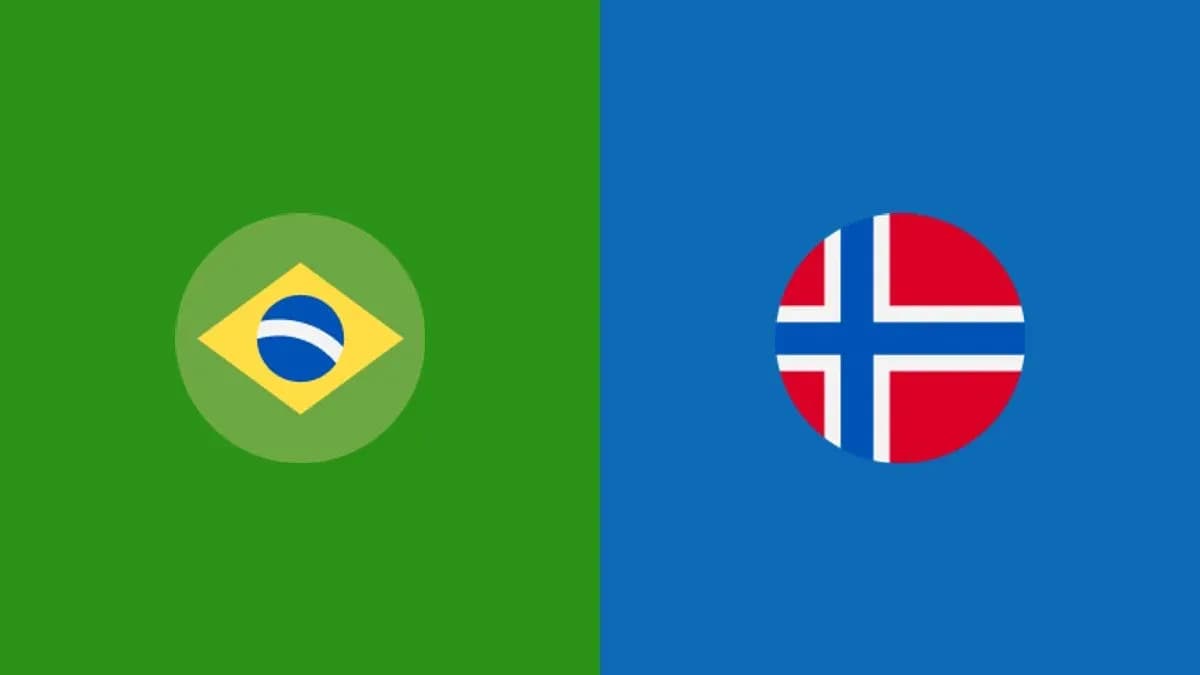
Brazil vs Norway: A World Cup Clash of Cultures
Brazil against Norway. Five world titles against a nation tasting the sharp edge of knockout football for the first time. On 5 July 2026, at 16:00 EST and 21:00 GMT, two very different football cultures walk into the same storm.
One side is chasing history. The other is busy trying to write it.
Brazil: Ancelotti’s high-wire act
Nothing with Brazil is ever straightforward. They topped Group C, scored freely, wobbled defensively, and still look like they might go all the way.
Carlo Ancelotti has given the Selecao something they’ve lacked since 2002: structure with just enough freedom for genius to breathe. His team opened with a 1-1 draw against Morocco, then flicked through the gears with routine 3-0 wins over Haiti and Scotland. Efficient. Assured. But not yet irresistible.
Then came Japan. That was chaos.
Brazil trailed, looked rattled, and flirted with disaster before Arsenal’s Gabriel Martinelli arrived in the 95th minute to slam in the latest normal-time goal in World Cup knockout history and snatch a 2-1 win. It was also the first time since 2002 that Brazil had come from behind to win a World Cup knockout game. A small detail on paper. A huge one for a team trying to remember what it feels like to be truly ruthless again.
At the heart of it all is Vini Jr. The Real Madrid star scored in all three group matches, a talisman in yellow just as he is in white. He stretches defences, forces double-marking, and drags games into his orbit. If Brazil get close to a sixth title, his fingerprints will be all over it.
Behind him, Ancelotti leans on experience. Alisson in goal. Marquinhos and Gabriel at the back. Casemiro and Bruno Guimarães patrolling midfield. Bruno already leads the tournament with four assists; only Pelé has ever produced more for Brazil at a single World Cup. That is the calibre of distribution feeding a forward line bursting with pace and invention.
And then there is the Neymar question.
Neymar on the periphery, Endrick on the rise
Neymar is 34 now, back at Santos, and still a fault line in the national debate. He made the squad despite fitness concerns but has barely figured: 14 minutes against Scotland, nothing at all versus Japan.
His absence has opened a door. Endrick has walked through it.
The 19-year-old Real Madrid forward has been eased in – half an hour against Haiti, a late cameo against Scotland – but the tone changed against Japan. Ancelotti gave him the entire second half. That kind of trust in a knockout match is never accidental. It feels like a turning of the page.
Alongside him, another 19-year-old, Bournemouth’s Rayan, is pushing to start wide. With Lucas Paqueta’s injury leaving his World Cup future in serious doubt, Brazil suddenly look younger, quicker, and more direct in the final third. The likely XI – Alisson; Danilo, Marquinhos, Gabriel, Santos; Bruno Guimarães, Casemiro, Endrick; Rayan, Cunha, Vini Jr – hints at a blend of steel and audacity.
Ancelotti still has Raphinha back in training to tilt the picture again if he chooses. Options everywhere. Pressure everywhere too. The drought since 2002 grows heavier with every passing tournament.
Norway: Haaland’s World Cup, at last
Norway have arrived with noise, colour and goals. Their fans have turned stands into echo chambers of red and blue, and their matches have been wild: four games, 18 goals. This is not a team trying to sneak through the back door.
Ståle Solbakken gambled in the group, resting several key players in a 4-1 defeat to France. They came back fresh and angry for the Round of 32, where Ivory Coast felt the full force. Antonio Nusa bent in a stunning curler, and then, in the 86th minute, Erling Haaland did what Erling Haaland does. A late winner. A 2-1 victory. Norway’s first-ever World Cup knockout win.
Haaland’s numbers almost defy belief. Five goals already at this World Cup. For Manchester City, 112 Premier League goals in 132 games. For Norway, 60 goals in 53 caps. Those are video-game figures, but they’re very real, and they hang over every defensive meeting room Brazil have occupied this week.
Martin Ødegaard is the other half of the equation. Norway’s captain and Arsenal’s conductor has assisted in three consecutive World Cup matches, the first player to do that since Dirk Kuyt in 2010. He sets the rhythm, picks the passes, and gives Haaland the kind of service that can turn any game into a shootout.
Solbakken hasn’t nailed down his XI publicly, but the likely shape is clear: Nyland; Pedersen, Ajer, Heggem, Møller Wolfe; Ødegaard, Berge, Berg; Sørloth, Haaland, Nusa. There is height, power and a surprising amount of craft in that front three. One cross, one slip, one misjudged line, and Haaland is away.
Gabriel vs Haaland: rivalry renewed
This isn’t just Brazil vs Norway. It is Gabriel Magalhães vs Erling Haaland, exported from the Premier League and dropped into the World Cup’s knockout furnace.
At Arsenal and Manchester City, they have clashed in title races defined by inches. Gabriel relishes the physical duel, steps tight, and refuses to be bullied. Haaland welcomes that challenge, shrugs off contact, and attacks the box with a sprinter’s hunger.
Now they meet again, with a nation’s hopes strapped to their backs. One mistake from Gabriel and Haaland is celebrating. One clean tackle, one dominant performance, and Brazil’s path to the quarter-finals looks a lot clearer.
There is competitive fire there, but also respect. They know exactly how good the other is. That edge should light up every long ball, every corner, every early cross Norway hang into the Brazilian area.
A thin history, a thick sense of occasion
These two nations barely know each other on this stage. The only previous meeting in the data is a 1-1 friendly in Norway back in August 2006. That game has no real bearing here. This is a different generation, a different Brazil, and a Norway that has finally grown into its own potential.
Brazil arrive as Group C winners. Norway come in as runners-up from Group I, already having shattered one barrier with that first knockout win over Ivory Coast. They have nothing to defend, only something to chase.
The stakes are brutally simple. For Brazil, anything short of a deep run will be framed as failure. For Norway, every step from here is uncharted territory.
One side is trying to end a 24-year wait for a sixth star. The other is trying to prove that this is not just Haaland’s moment, but Norway’s era.
Only one of them gets to keep that story alive.