.svg&w=384&q=75 "Pitchgist logo")
Mexico Dominates Ecuador in Round of 32 Clash
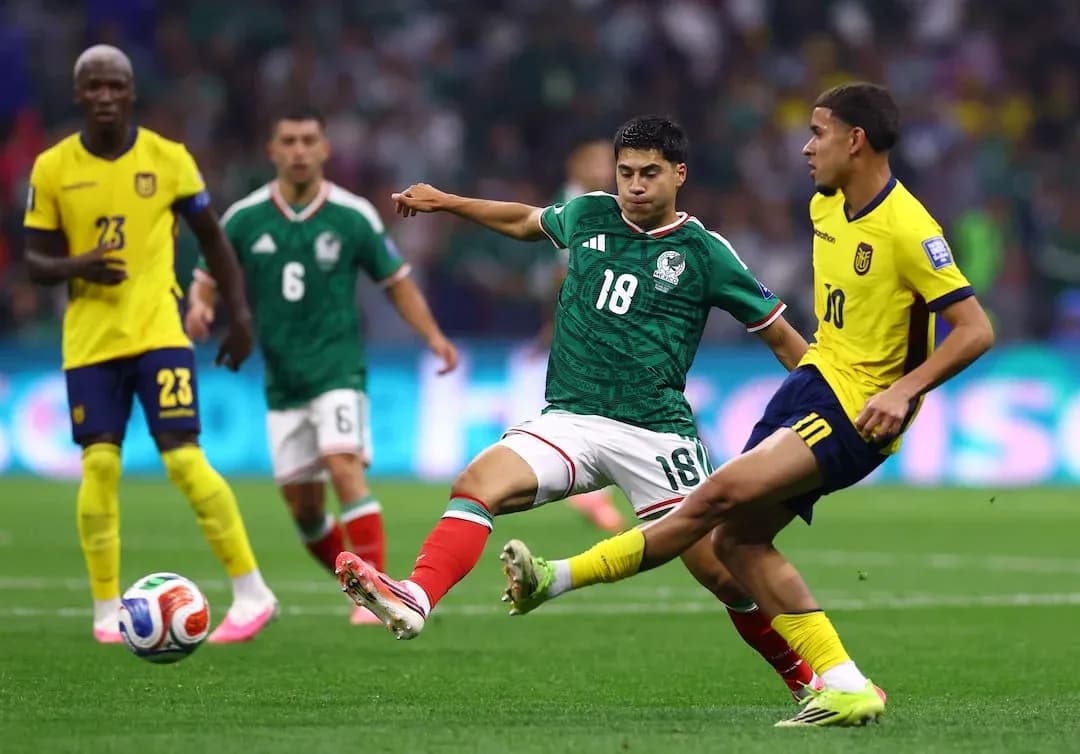
Under the lights of Estadio Banorte in Mexico City, Mexico’s Round of 32 meeting with Ecuador felt less like a clash of equals and more like a stress test of two very different football identities. By the final whistle, the scoreboard read 2–0 to Mexico, a scoreline that echoed the broader arc of their World Cup so far: controlled, ruthless, and structurally sound.
I. The Big Picture – A Perfect Machine Meets a Fragile Contender
Heading into this game, Mexico were the form side of the tournament. They topped Group A with 9 points from 3 matches, scoring 6 and conceding none. That gave them an overall goal difference of +6, built on a defensive record that had not been breached in the group stage. Across the entire campaign, Mexico had played 4 matches, winning all 4. At home they had played 3 fixtures and won all 3, scoring 5 and conceding 0; on their travels they had played 1, won 1, scored 3 and again conceded 0. Overall, that meant 8 goals for and 0 against, a total goal difference of +8. Their attacking output was steady rather than wild: at home they averaged 1.7 goals per game, away they averaged 3.0, for an overall average of 2.0. Defensively, they were immaculate: 0.0 goals conceded on average in every dimension.
Ecuador arrived with a more precarious profile. Third in Group E with 4 points from 3 matches, they had scored 2 and conceded 2, an overall group-stage goal difference of 0. Over the whole tournament, they had played 4 matches: 2 at home, 2 away. At home they had 1 win, 1 draw, no defeats, scoring 2 and conceding 1. Away, they had lost both matches, scoring 0 and conceding 3. That split was brutal: at home they averaged 1.0 goal for and 0.5 against; away, 0.0 for and 1.5 against, for overall averages of 0.5 scored and 1.0 conceded. Their single clean sheet came at home; on their travels, they had yet to keep one and had failed to score in both away games.
On neutral World Cup soil, those patterns mattered. Mexico’s campaign had been built on territorial control and defensive suffocation. Ecuador’s had been defined by resilience at home and fragility away from their comfort zone.
II. Tactical Voids – Discipline and the Edges of Control
There were no explicit injury absences listed, so both coaches, Javier Aguirre and Sebastian Beccacece, could lean into their preferred structures. Aguirre doubled down on continuity, naming the 4-3-3 that had become Mexico’s default: R. Rangel in goal; a back four of J. Gallardo, J. Vasquez, C. Montes, and J. Sanchez; a midfield trio of L. Romo, E. Lira, and G. Mora; and a front line of J. Quiñones, R. Jimenez, and R. Alvarado.
Beccacece matched up in a 4-4-2 that tried to compress the central lanes: H. Galindez behind a back four of P. Hincapié, W. Pacho, J. Ordoñez, and A. Franco; a midfield band of N. Angulo, P. Vite, M. Caicedo, and J. Yeboah; and a front pair of G. Plata and E. Valencia.
Discipline had been a quiet subplot of both teams’ tournaments. Mexico’s card profile was sparse but sharp: their yellow cards were split evenly, with 50.00% arriving between 16–30 minutes and 50.00% between 61–75 minutes. Their only red card in the competition had come late, between 91–105 minutes, and belonged to C. Montes, who nonetheless started here. That late-game dismissal history hinted at a side that pushed intensity to the edge in closing phases.
Ecuador’s card distribution was more scattered and more frequent. Their yellow cards were concentrated in the heart of games: 25.00% between 31–45 minutes, 25.00% between 46–60, and then 12.50% each in the 61–75 and 76–90 windows, before another 25.00% in the 91–105 period. Their red card also came in the 91–105 window, and it belonged to P. Hincapié, who still anchored the back line here. That profile painted a picture of a team that grew increasingly stretched and reactive as matches wore on.
III. Key Matchups – Hunter vs Shield, Engine Room vs Enforcer
The most compelling duel on the pitch was the “Hunter vs Shield” confrontation between Mexico’s offensive spearheads and Ecuador’s embattled away defence.
Mexico’s attacking structure revolved around J. Quiñones and R. Alvarado. Quiñones, listed as a midfielder but deployed high on the left of the front three, had emerged as one of the tournament’s elite finishers: 3 goals and 1 assist in total, from 9 shots with 5 on target. His 7.73 average rating, 106 completed passes, and 7 key passes told of a player equally comfortable finishing moves and initiating them. He had also attempted 8 dribbles, succeeding with 6, a direct threat to full-backs in wide isolation.
On the opposite flank, Alvarado was the tournament’s creative metronome. With 3 assists in total, 140 passes at 82% accuracy, and 10 key passes, he was Mexico’s primary chance architect. His 4 successful dribbles from 4 attempts suggested a player who picked his moments rather than dribbling for its own sake, often arriving in the half-spaces to connect with R. Jimenez.
Against that, Ecuador’s “shield” was built around P. Hincapié and A. Franco. Hincapié, a top figure in both yellow and red card charts, was a high-impact, high-risk defender: 12 tackles, 2 blocked shots, and 4 interceptions across the tournament, plus 47 duels contested and 24 won. He was aggressive in stepping out of the line, but his disciplinary record – 1 yellow and 1 red – hinted at the cost of that front-foot defending.
Franco, Ecuador’s top yellow-card collector, had committed 7 fouls and been booked twice. Yet his underlying defensive work was strong: 8 tackles, 1 blocked shot, and 4 interceptions, underpinned by 125 passes at a remarkable 96% accuracy. He was the right-back asked to survive repeated one‑v‑one duels with Mexico’s wide men.
In the “Engine Room” battle, Mexico’s trio of L. Romo, E. Lira, and G. Mora faced the double pivot of M. Caicedo and P. Vite. Mexico’s season data showed a side that never failed to score – 0 matches without a goal – and had 4 clean sheets in total, 3 at home and 1 away. That balance came from a midfield that screened as well as it circulated. Ecuador, by contrast, had failed to score in 3 of their 4 matches overall, including both away games. The onus on Caicedo was enormous: break up Mexico’s rhythm, then spring transitions to E. Valencia and G. Plata.
IV. Statistical Prognosis – Why Mexico’s Structure Prevailed
Even without explicit xG figures, the statistical currents pointed firmly towards Mexico. A team averaging 2.0 goals per match overall and conceding 0.0 was facing an opponent averaging 0.5 scored and 1.0 conceded, with a complete attacking blackout away from home.
Mexico’s defensive record – 8 goals scored and 0 conceded in total – combined with 4 clean sheets suggested that their underlying xG against was consistently low. Their ability to win both at home and on their travels without conceding indicated that R. Rangel’s goal was rarely exposed to high‑quality chances, thanks to a back line led by the aerial dominance and positioning of C. Montes and the two-way work of full-backs like J. Gallardo.
Ecuador’s away splits were the warning sign: 0 goals for, 3 against, no wins, and no clean sheets. Their 2–0 away defeat in their biggest loss reflected a side that struggled to progress the ball and protect their box simultaneously when removed from familiar conditions. With no penalties awarded to either side across the tournament, there was no set-piece volatility to tilt the odds; this was always likely to be decided in open play and structured phases, where Mexico’s patterns were sharper and more rehearsed.
In narrative terms, this Round of 32 tie was Mexico’s chance to confirm that their flawless group stage was no mirage. The 2–0 scoreline, built on early control and sustained defensive calm, aligned perfectly with the statistical story: a side that never failed to score, never conceded, and had its creative and finishing axes – Alvarado and Quiñones – in form against an Ecuador team that faded away from home, carried disciplinary baggage in key defensive roles, and too often lacked a cutting edge.
Following this result, Mexico’s campaign remains defined by structural superiority and emotional control. Ecuador, by contrast, leave with the sense of a team whose ceiling at this tournament was capped not by talent, but by the inability to translate home solidity into neutral‑venue resilience.