.svg&w=384&q=75 "Pitchgist logo")
USA vs Belgium Tactical Analysis: 4-3-3 Meets 4-2-3-1
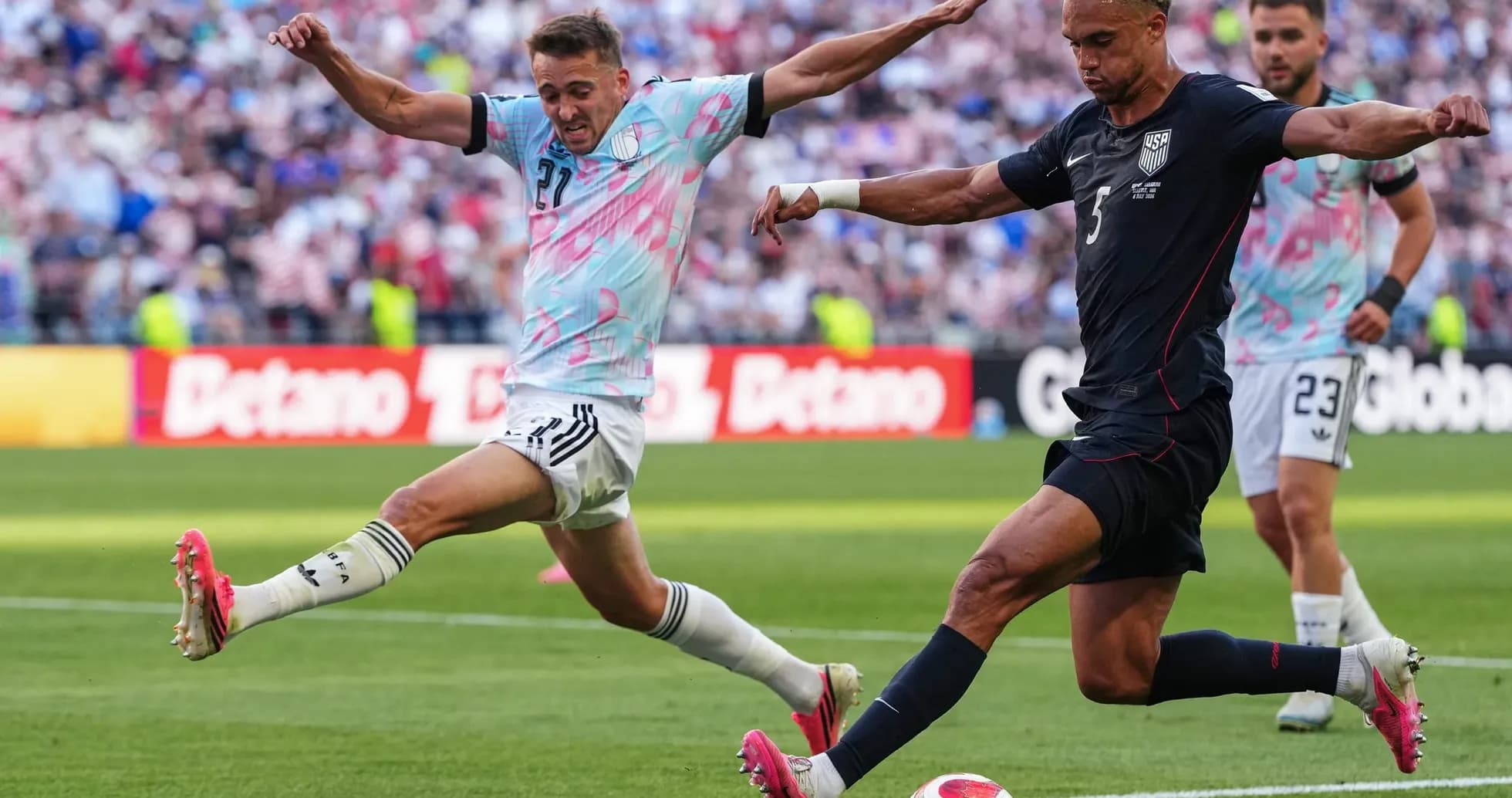
USA’s 4-3-3 against Belgium’s 4-2-3-1 at Lumen Field produced a tactically sharp Round of 16 tie where Belgium’s structure, efficiency in the final third and in-game adjustments decisively outweighed USA’s territorial control. Despite USA leading possession 56%–44% and completing more passes (527 vs 410 at 87% vs 81%), Belgium ran out 4-1 winners, underpinned by superior shot quality (15 total shots to 7, with 10 from inside the box) and a clear edge in xG (2.15 vs 0.67).
USA’s initial plan was ball-dominant and left-sided. Mauricio Pochettino’s 4-3-3 placed Christian Pulišić and Antonee Robinson as the primary progression lane, with Malik Tillman stepping inside from the left of the midfield three. Tyler Adams anchored centrally, with Weston McKennie higher as the right-sided interior. The front line of Sergiño Dest, Folarin Balogun and Pulišić aimed to stretch Belgium horizontally, but with only 7 total shots and 2 on goal, USA struggled to convert circulation into true penetration.
Belgium’s 4-2-3-1, orchestrated by Rudi Garcia, was more direct and vertical. Amadou Onana and Nicolas Raskin formed the double pivot, with Dodi Lukebakio and Leandro Trossard wide, Youri Tielemans between the lines and Charles De Ketelaere as the nominal striker. The structure was fluid: De Ketelaere frequently dropped off the last line, allowing Trossard to attack the half-spaces and fullbacks Timothy Castagne and Maxim De Cuyper to advance selectively.
First Half
The first phase showed the core tactical pattern: USA built with a back four plus Adams, but Belgium’s front four pressed in a staggered 4-4-2/4-2-3-1 hybrid, funneling USA into central areas then springing transitions. Belgium’s first goal at 9' (C. De Ketelaere from N. Raskin) was emblematic: Raskin, from the double pivot, stepped into a pocket to receive and play forward, exploiting the space behind Adams and beside the USA centre-backs. Belgium’s ability to find the striker between lines, then attack the backpedaling defence, repeatedly destabilized USA’s 4-3-3.
USA’s equaliser at 31' through M. Tillman came from one of the few sequences where their positional play broke Belgium’s mid-block. With Belgium’s wide midfielders tucked in, USA managed to connect through the interior, allowing Tillman to arrive in an advanced pocket. However, this remained the exception rather than the rule; Belgium were largely comfortable conceding controlled possession in front of their block.
Belgium’s immediate response at 33'—again via C. De Ketelaere, this time assisted by L. Trossard—highlighted their superior occupation of the attacking third. Trossard, nominally the left midfielder in the line of three, drifted into the half-space to combine with De Ketelaere. USA’s back line of Alexander Freeman, Chris Richards, Tim Ream and Antonee Robinson struggled to maintain compactness when tracking these rotations; the lack of blocked shots (0 for USA vs 4 for Belgium) underlines how often Belgium were able to shoot without intense pressure.
Out of possession, USA’s pressing was intermittent rather than systematic. With 11 fouls to Belgium’s 9 and two yellow cards, their attempts to disrupt Belgium’s rhythm often came as late interventions rather than coordinated traps. McKennie’s yellow for “Tripping” at 35' and Tillman’s similar booking at 69' reflect individual duels lost rather than a cohesive pressing structure. Belgium, by contrast, managed to maintain aggression without drawing any cards, a sign of better-timed challenges and more stable defensive spacing.
Second Half
The second half was defined by Belgium’s in-game management. At 21', even in the first half, Garcia had already made a proactive midfield change: H. Vanaken (IN) came on for A. Onana (OUT). This subtly reweighted the double pivot toward more playmaking and late box arrivals. That shift paid off after the break. At 57', Vanaken scored, assisted by De Ketelaere, to make it 3-1. The pattern: De Ketelaere again dropped to link play, drawing USA’s centre-backs out, while Vanaken advanced beyond the midfield line to finish—another example of Belgium overloading central channels against a USA midfield that struggled to track runners from deep.
Substitutions from USA were largely reactive and did not alter the tactical balance. At 46', G. Reyna (IN) came on for S. Dest (OUT), reshaping the right side but not the overall structure. Later, S. Berhalter (IN) for C. Pulisic (OUT) at 59' and R. Pepi (IN) for T. Adams (OUT) at 72' suggested a shift toward more attacking profiles, but by then Belgium were entrenched in a compact, counter-ready block. Late changes—H. Wright (IN) for F. Balogun (OUT) and M. Arfsten (IN) for A. Robinson (OUT) at 90+2'—were too late to influence the tactical narrative.
Belgium’s own attacking refresh at 67', with J. Doku (IN) for D. Lukebakio (OUT) and R. Lukaku (IN) for C. De Ketelaere (OUT), preserved their vertical threat while adding a pure penalty-box reference. The final goal at 90+3', R. Lukaku finishing from H. Vanaken, encapsulated the game’s tactical arc: USA pushed numbers forward, Belgium exploited the stretched structure with a direct, high-quality transition.
In goal, Matthew Freese (USA) made 3 saves, while Thibaut Courtois (Belgium) was required to make only 1. That disparity, combined with Belgium’s 7 shots on goal to USA’s 2, reflects how Belgium’s block limited USA to lower-quality, less frequent chances despite the Americans’ possession advantage. Both goalkeepers are credited with -0.69 goals prevented, underlining that the difference lay not in shot-stopping but in the volume and quality of chances each defence allowed.
Statistically, Belgium’s 2.15 xG against USA’s 0.67 aligns closely with the 4-1 scoreline in directional terms: Belgium consistently generated better looks, particularly from inside the box (10 shots vs USA’s 5). USA’s passing superiority—527 total passes, 458 accurate at 87%—translated into control but not incision. Belgium’s 410 passes with 333 accurate (81%) were fewer but more vertical and purposeful, often breaking lines to find the advanced midfielders and striker quickly.
Set plays and rest defence also tilted toward Belgium. They earned more corners (5 vs 3) and, crucially, their structure behind the ball when attacking was more secure, allowing them to absorb counters and immediately re-press or transition. USA, with 0 offsides to Belgium’s 1, rarely threatened the space in behind, preferring to play in front of Belgium’s defence—exactly where Garcia’s side wanted them.
Overall, the tactical story is of a USA side that controlled phases of possession but lacked mechanisms to consistently penetrate a disciplined 4-2-3-1, while Belgium combined structural solidity, intelligent rotations and impactful substitutions to repeatedly access dangerous central zones and punish defensive disorganisation.