.svg&w=384&q=75 "Pitchgist logo")
England Edges Mexico in Dramatic World Cup 1/8 Final
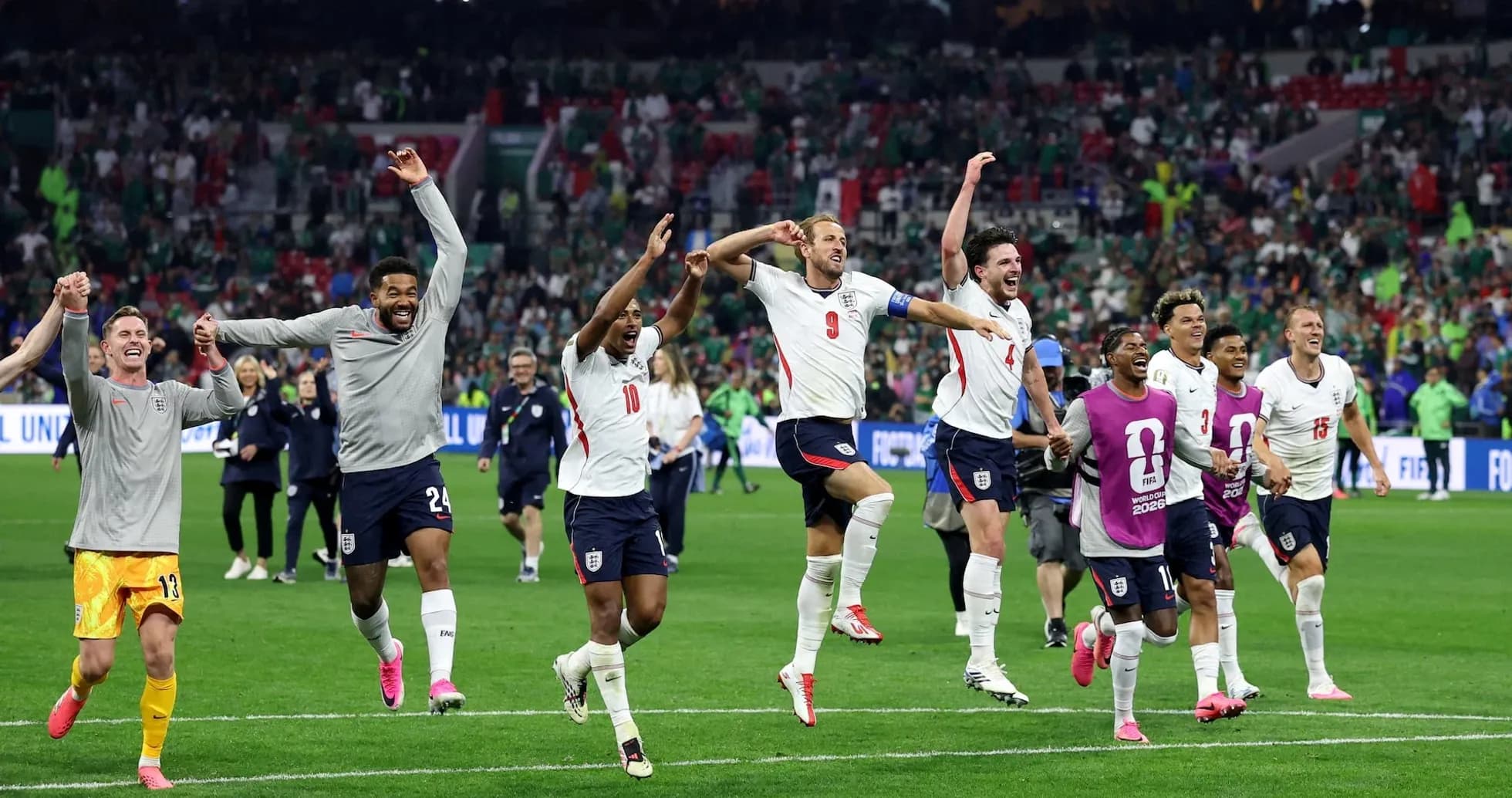
The World Cup 1/8 final in Mexico City delivered the kind of knife‑edge drama that rewrites tournament narratives. Under the lights of Estadio Banorte, Mexico’s perfect group‑stage run met an England side that had not tasted defeat in the competition. After 90 breathless minutes, England edged a 3–2 victory, a scoreline that felt like the collision of two fully formed identities rather than a one‑off cup tie.
Heading into this game, both sides had arrived as group winners. Mexico had taken 9 points from 3 matches in Group A, with a flawless defensive record: 6 goals scored and none conceded, giving them a goal difference of 6. England, top of Group L with 7 points from 3, had scored 6 and conceded 2 for a goal difference of 4. The season’s broader numbers only underlined the contrast: Mexico had played 5 fixtures overall, winning 4 and losing 1, with 10 goals for and just 3 against. England, also unbeaten overall with 4 wins and 1 draw from 5, had 11 goals scored and 5 conceded.
I. The Big Picture – Structure and Intent
Mexico lined up in their now‑familiar 4‑3‑3, Javier Aguirre doubling down on the shape that had carried them through the group. R. Rangel in goal sat behind a back four of J. Gallardo, J. Vasquez, C. Montes and J. Sanchez. The midfield trio of L. Romo, E. Lira and G. Mora was built for balance: Romo as the deeper organiser, Lira as the metronome, Mora as the connector into the front line. Ahead of them, R. Alvarado and J. Quiñones flanked R. Jiménez in a front three that had been one of the tournament’s most productive units.
Across from them, Thomas Tuchel kept faith with England’s 4‑2‑3‑1, a system that had underpinned their overall average of 2.2 goals scored per game and 1.0 conceded. J. Pickford started in goal, shielded by a back four of N. O’Reilly, M. Guehi, E. Konsa and J. Quansah. In front, D. Rice and E. Anderson formed the double pivot, with B. Saka and A. Gordon wide of J. Bellingham, and H. Kane as the lone striker.
The first half’s 2–1 scoreline in England’s favour reflected the logic of the setups. England’s 4‑2‑3‑1 gave them an extra body between the lines, and Bellingham exploited that space relentlessly, linking with Kane and pulling Mexico’s midfield triangle out of shape. Mexico’s 4‑3‑3, for all its attacking promise, often left Lira and Romo dealing with Bellingham plus one of Saka or Gordon drifting inside.
II. Tactical Voids – Discipline and Risk
Neither side came into this tie with major absentees flagged, so the tactical voids were more about temperament and structural risk than missing personnel.
Mexico’s disciplinary profile in the tournament had been relatively controlled but with clear hot spots. Across their campaign, 25.00% of their yellow cards had come between 16–30 minutes, and 50.00% between 61–75 minutes. They had also seen a red card deep into extra time in another match, with 100.00% of their reds arriving in the 91–105 window. C. Montes embodied that edge: in his four appearances, he had been sent off once, even as he maintained a 90% passing accuracy and blocked 1 shot. The decision to start him again at the heart of defence was a bet on his aerial dominance and composure on the ball, despite the disciplinary shadow.
England’s card map told a different story: a steady drip of yellows throughout the game, with 14.29% of their bookings in each of the 0–15, 16–30, 31–45 and 46–60 ranges, and a spike to 28.57% between 61–75 minutes. Crucially, their only red card this tournament had also come between 46–60 minutes, and that belonged to J. Quansah. Tuchel’s decision to start Quansah at right‑back in such a high‑stakes tie was a calculated gamble: his 10 duels won from 13 and 87% passing suggested reliability under pressure, but the prior red hinted at volatility when games became stretched.
III. Key Matchups – Hunter vs Shield, Engine Room Battles
The headline duel was always going to be H. Kane against Mexico’s defensive core. Kane entered this tie as one of the World Cup’s deadliest forwards: 6 goals and 1 assist in 5 appearances, with 10 of his 15 shots on target and a rating of 7.6. His penalty record in this tournament – 2 scored from 2 taken – gave England a ruthless edge in high‑leverage moments. Mexico’s defensive record overall, with only 3 goals conceded in 5 matches and 4 clean sheets, had been elite, but this was a different level of striker.
Montes and Vasquez were tasked with compressing the space Kane loves to drop into. Montes’ 176 completed passes at 90% accuracy and his 2 interceptions showed he was more than just a stopper; he was the first line of Mexico’s build‑up. But against Kane’s movement, any hesitation risked being fatal. The 3–2 final score suggests that, for all their solidity, Mexico’s back line struggled to fully contain England’s number 9 and the runners around him.
On the other side, Mexico’s attacking “hunter” was split between J. Quiñones and R. Jiménez. Quiñones, with 4 goals and 1 assist in 5 games and an impressive 7.76 rating, had been one of the tournament’s breakout stars, his 9 successful dribbles from 15 attempts and 20 duels won from 45 making him Mexico’s chaos agent between the lines. Jiménez, with 3 goals from 4 appearances and 7 shots on target from 14, brought penalty‑box gravity and aerial presence.
They were up against an England defence that, overall, had conceded 5 goals in 5 matches, averaging 1.0 per game both at home and on their travels. Guehi and Konsa had quietly anchored that platform, allowing England to maintain an aggressive front four without collapsing in transition. The fact that Mexico still found 2 goals here underlines the quality of their forward line rather than any systemic English fragility.
In midfield, the “engine room” battle pitted Bellingham and Rice against Romo and Lira. Bellingham’s tournament numbers – 4 goals, 1 assist, 161 completed passes at 81% accuracy, and 12 tackles – framed him as a complete midfielder. Rice, with 166 passes at 91% accuracy and 12 key passes, was the stabiliser and distributor. Together, they formed a double axis that could both protect and progress.
Mexico’s response was more collective. Romo’s role as the deeper conduit, Lira’s positional discipline, and Mora’s shuttling were designed to compress central spaces and force England wide. Yet England’s wide creators, especially Saka, tilted the balance. Saka’s 3 assists in the tournament, 56 completed passes at 82% accuracy, and 18 duels won from 28 marked him as England’s primary supply line from the flank. His presence against Gallardo and Vasquez repeatedly stretched Mexico’s block and opened channels for Bellingham and Kane.
IV. Statistical Prognosis – How the Numbers Met the Narrative
From a seasonal perspective, this was always likely to be a high‑event match. Mexico’s overall average of 2.0 goals scored per game and only 0.6 conceded suggested control and efficiency. England’s 2.2 goals scored and 1.0 conceded pointed to a more open, front‑foot approach. The 3–2 outcome sat neatly at that intersection: England’s attacking ceiling slightly higher, Mexico’s defensive wall finally breached more than once.
Penalties were an undercurrent rather than a headline. Mexico had taken 1 penalty this tournament and scored it, with no misses. England had taken 2 and converted both. There were no spot‑kicks here, but the underlying numbers spoke to a shared composure in high‑pressure finishing situations – one more reason why a single‑goal margin felt inevitable rather than surprising.
Discipline, too, followed the script. England’s tendency to pick up yellows in the 61–75 minute band aligned with the phase of games where Tuchel’s side often raise the tempo and press higher. Mexico’s own spike in bookings in that same window meant the middle third of the second half was always likely to be chaotic. In a match that finished 3–2 in regular time, that chaos suited England’s vertical instincts slightly more than Mexico’s structured possession.
Following this result, Mexico’s near‑perfect defensive tournament gave way to the brutal reality of knockout football. Their 4‑3‑3, built on a platform of clean sheets and controlled aggression, met an England side whose 4‑2‑3‑1 was powered by elite individual form – Kane’s finishing, Bellingham’s all‑court influence, Saka’s creativity. The margins were thin, the storylines rich, but the numbers and the tactical shapes both pointed in the same direction: in a game where both teams were likely to score, England’s extra layer of attacking quality was always the slight favourite to decide it.