.svg&w=384&q=75 "Pitchgist logo")
Brazil vs Norway: World Cup 1/8 Final Tactical Preview
MetLife Stadium in East Rutherford stages a World Cup 1/8 final that feels like a collision of footballing eras: Brazil, the tournament aristocrats, against Norway, the new-money disruptors built around a generational No. 9. The group-stage snapshot is clear. Brazil came through Group C as rank 1 with 7 points and a goal difference of 6, scoring 7 and conceding 1 in 3 matches. Norway emerged from Group I as rank 2 with 6 points and a goal difference of 1, with 8 goals for and 7 against.
Across the whole campaign, Brazil’s numbers still carry the weight of a favourite. Overall they have played 5 fixtures, winning 3, drawing 1 and losing 1. At home they have played 4 times, with 2 wins, 1 draw and 1 defeat; on their travels they have 1 win from 1. The attacking output is steady rather than explosive: in total this campaign they have scored 10 goals, with 7 at home and 3 away. That translates to 2.0 goals per match overall, 1.8 at home and 3.0 away. Defensively, they have conceded 4 in total, all at home, for an overall average of 0.8 goals against per match and 1.0 at home. Two clean sheets in total and no game where they failed to score underline a side that, even when imperfect, always threatens.
Norway arrive with more volatility. Overall they have played 5 fixtures, winning 4 and losing 1, with no draws. At home they have 2 games (1 win, 1 loss), while on their travels they have 3 straight wins. In total this campaign they have scored 12 goals, split as 4 at home and 8 away, for an overall average of 2.4 per match, 2.0 at home and 2.7 away. The flip side: they have conceded 9 in total, 6 at home and 3 away, which is 1.8 goals against per match overall, 3.0 at home and 1.0 away. There are no clean sheets, and yet they have never failed to score. Norway live on the knife edge: they outgun you or go down swinging.
I. The Big Picture – Tactical Identities on the Board
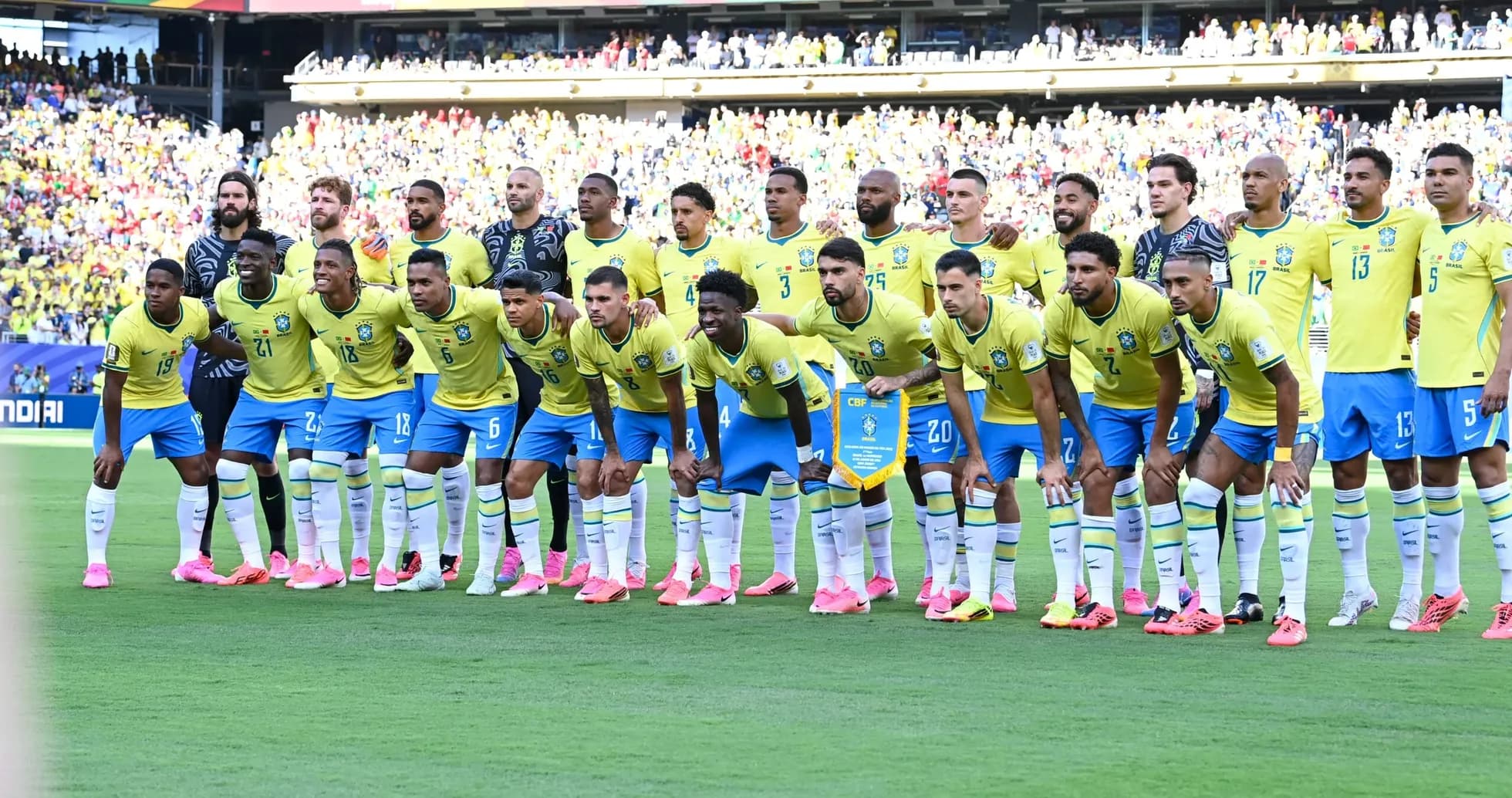
Carlo Ancelotti sets Brazil in a 4-4-2 for this knockout tie, a departure from the 4-3-3 that has been their most-used shape this tournament (3 matches) and the 4-2-3-1 they have used once. The back four of Danilo, Marquinhos, Gabriel and Douglas Santos protects Alisson, with a midfield line of Rayan, Bruno Guimarães, Casemiro and G. Martinelli behind a front two of M. Cunha and Vinicius Junior.
Ståle Solbakken stays loyal to Norway’s 4-3-3, the formation they have used in 4 of 5 games. O. Nyland is in goal, behind a defence of J. Ryerson, K. Ajer, T. Heggem and D. Wolfe. The midfield three of M. Ødegaard, S. Berge and P. Berg serves a devastating front line: A. Sørloth, E. Haaland and A. Nusa.
Brazil’s seasonal DNA is controlled aggression. Bruno Guimarães is the metronome: in 5 appearances he has completed 191 passes at 86% accuracy, with 10 key passes and 4 assists, while also tackling 11 times and blocking 1 shot. Casemiro is the enforcer and insurance policy, with 14 tackles, 4 successful blocks and 6 interceptions in 5 games. His 2 yellow cards and status atop the yellow-card charts for this tournament underline the edge he plays with.
Norway’s identity is more direct, built around E. Haaland’s gravity. In 4 appearances he already has 7 goals from 15 shots (12 on target), supported by 6 key passes and 4 successful dribbles. He has contested 37 duels, winning 18, and drawn 3 fouls. Around him, M. Ødegaard and A. Schjelderup provide guile and supply: Ødegaard has 263 passes at 90% accuracy and 3 assists, while Schjelderup, in just 183 minutes, has 3 assists and 5 key passes.
II. Tactical Voids – Absences and Discipline
Brazil’s squad sheet hides a quiet crisis between the lines. Raphinha and Lucas Paquetá are both ruled out with hamstring injuries. Raphinha’s absence strips Brazil of a natural right-sided winger who could have stretched D. Wolfe and pinned Norway’s left-back deep. Paquetá’s injury removes a hybrid midfielder who could have linked Casemiro and Bruno Guimarães with the forwards, forcing Ancelotti to trust Rayan and G. Martinelli as wide midfielders rather than pure wingers.
Disciplinary patterns matter in knockout football. For Brazil, yellow cards are spread, but there is a clear spine of aggression: Casemiro and Danilo both sit high on the card charts with 2 yellows each. Brazil’s card timing shows a late-game spike: 25.00% of their yellows arrive between 31-45 minutes, another 25.00% between 61-75, and 12.50% in each of the 0-15, 46-60, 76-90 and 91-105 windows. This suggests a side that ramps up intensity as halves close – and risks giving Norway dangerous set-piece platforms around those periods.
Norway’s yellows are concentrated early and just after the restart: 50.00% in the first 15 minutes and 50.00% between 46-60. That hints at a team that starts halves aggressively, possibly over-committing in duels as they try to press high and feed Haaland quickly.
Both teams carry penalty scars. Brazil have earned 2 penalties in total, scoring 1 and missing 1; Bruno Guimarães has a missed spot-kick on his ledger. Norway have had 1 penalty and missed it, with 0 scored and 1 missed for a 0% conversion rate. In a tie likely to be decided by fine margins, neither side can claim a flawless record from the spot.
III. Key Matchups – Hunter vs Shield, Engine Room vs Enforcer
The headline duel is unavoidable: E. Haaland versus Marquinhos and Gabriel, with Casemiro sweeping in front. Haaland’s 7 goals in 4 appearances frame him as the ultimate “hunter”. Brazil’s “shield” is a unit that, in total this campaign, has conceded only 4 goals and kept 2 clean sheets. Marquinhos and Gabriel will need to manage Haaland’s movement between the lines, while Casemiro drops into the back line to contest second balls and cut off direct passes into the No. 9.
On the flanks, A. Nusa against Danilo is a battle of youth and daring versus experience and discipline. Danilo has 7 tackles, 1 successful block and 7 interceptions, but also 7 fouls committed and 2 yellow cards. If Nusa can isolate him, Norway may draw the kind of free-kicks and bookings that tilt the game.
In the “engine room”, Bruno Guimarães and Casemiro face M. Ødegaard and S. Berge. Bruno’s 10 key passes and 4 assists make him Brazil’s creative pivot, while Ødegaard’s 3 assists and 4 key passes power Norway’s positional play. Casemiro, with his 14 tackles and 6 interceptions, must disrupt Ødegaard’s rhythm; Berge, in turn, has to track Bruno’s forward runs and protect Norway’s back four from Vinicius Junior drifting inside.
Vinicius is Brazil’s chaos agent. In 5 appearances he has 4 goals, 1 assist, 14 shots (11 on target), 36 dribble attempts with 16 successes, and 10 fouls drawn. His duel count – 61 contests, 29 won – shows how often he is targeted. Matched up primarily against J. Ryerson and K. Ajer when he cuts inside, Vinicius will test Norway’s ability to defend space rather than just the man.
IV. Statistical Prognosis – Where the Game Tilts
From a numbers perspective, this tie feels like Brazil’s control against Norway’s volatility. Brazil’s overall goal difference of 6 in the group stage (7 scored, 1 conceded) and just 4 goals against in 5 matches point to a defensive structure that, while occasionally tested, rarely collapses. Norway’s total of 12 goals for and 9 against in 5 games suggests a more open, high-event profile.
The card distributions create a critical intersection in time. Brazil’s tendency to collect cards between 31-45 and 61-75 minutes overlaps with the phases when Norway, with their aggressive starts to halves, are most likely to push. Those windows could see Casemiro and Danilo walking a disciplinary tightrope against Haaland’s and Nusa’s direct running.
Expected-goal trends are not explicitly listed, but the raw shot and goal volumes hint at a Norway side that converts high-quality chances through Haaland, versus a Brazil team that creates sustained pressure through Vinicius and Bruno’s supply. Norway’s lack of any clean sheet in total, combined with Brazil’s record of never failing to score, tilts the underlying probabilities toward Brazil finding the net at least once.
Yet Norway’s away profile – 3 wins from 3, with 8 goals scored and only 3 conceded on their travels – suggests they are comfortable in hostile environments, soaking pressure and striking through their front line.
In a pure statistical prognosis, Brazil’s defensive solidity and multi-source attack give them a marginal edge over 90 minutes. But the presence of Haaland, backed by Ødegaard’s precision and Schjelderup’s impact from the bench, means that any lapse in Brazil’s concentration – particularly around the end of each half – could flip the narrative from controlled dominance to a high-drama shootout at MetLife Stadium.