.svg&w=384&q=75 "Pitchgist logo")
Spain Triumphs Over Argentina in World Cup Final 1–0
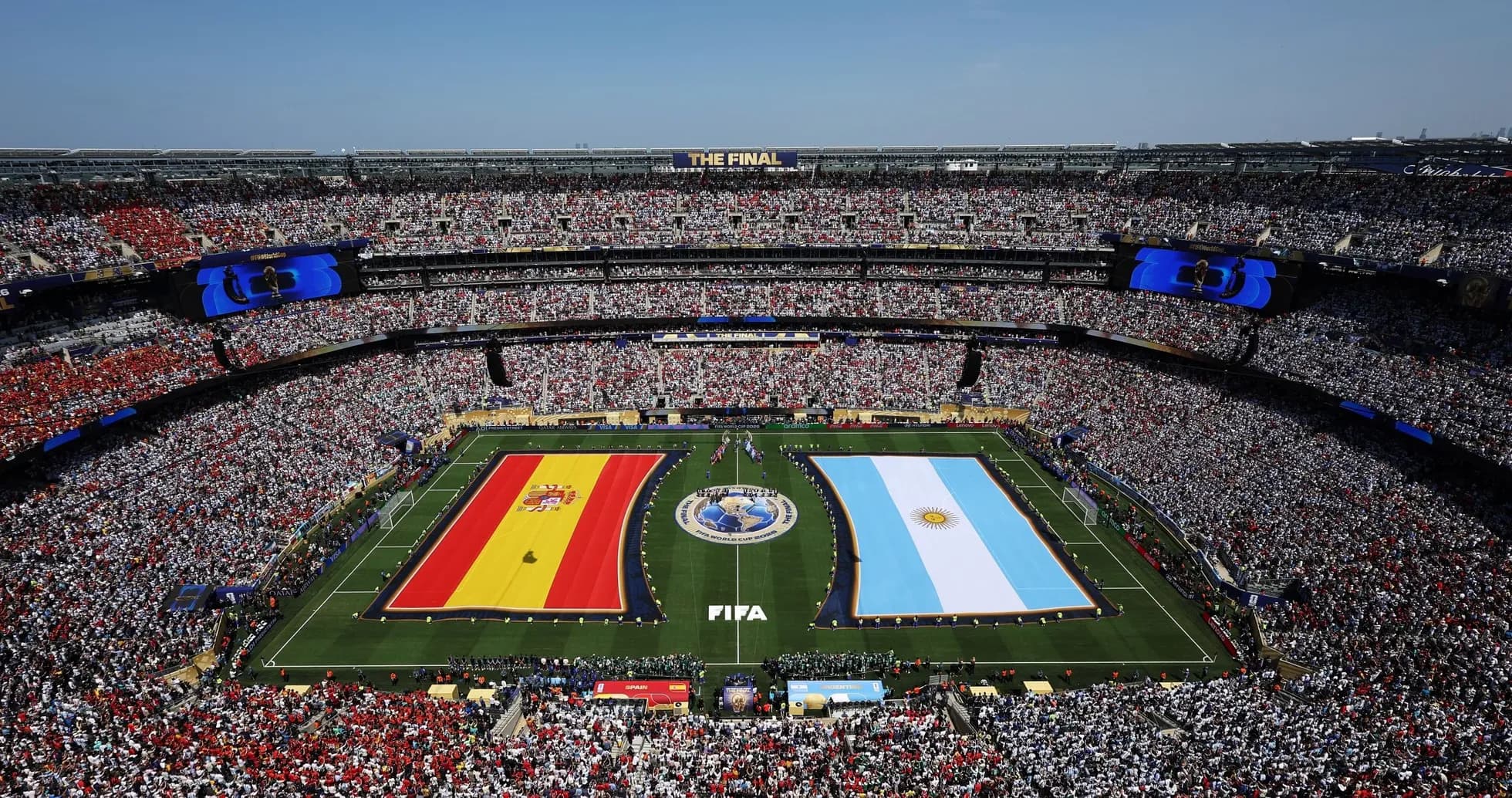
MetLife Stadium in East Rutherford has already witnessed the ending: Spain 1–0 Argentina after extra time, a World Cup final that stretched to 120 minutes and demanded every ounce of tactical discipline from two very different footballing identities. To understand how Spain climbed to the summit and how Argentina were held at arm’s length, you have to start with the season-long profiles that converged on this night.
Spain arrived as the tournament’s most controlled machine. Heading into this game they had played 8 matches in total, winning 7 and drawing 1, with no defeats. Their attack was steady rather than explosive: 14 goals in total, built on 10 at home and 4 on their travels. The averages tell the story of balance rather than chaos: 2.0 goals at home, 1.3 on their travels, 1.8 overall. Defensively, they were almost ascetic: only 1 goal conceded in total all campaign, 1 at home and none on their travels, an overall average of 0.1 per match. Seven clean sheets in total, four at home and three on their travels, underpinned a side that trusted its structure more than any individual flourish.
Argentina, by contrast, came as the tournament’s great accelerant. Heading into this final they also had 8 matches in total, with 7 wins and just 1 defeat. They had scored 19 goals in total, 14 at home and 5 on their travels, averaging 2.8 at home, 1.7 on their travels and 2.4 overall. But that attacking power came with a price: 8 goals conceded in total, split evenly between home and away, for a total average of 1.0 per match. Where Spain’s campaign was about suffocation, Argentina’s was about overwhelming you and living with the risk.
Spain's Lineup
Luis de la Fuente’s lineup was a statement of continuity. Spain’s most-used shape this tournament was 4-2-3-1, deployed 6 times in total, and he leaned on it again. Unai Simón stood behind a back four of Pedro Porro, Pau Cubarsí, Aymeric Laporte and Marc Cucurella. In front of them, Rodri and Fabián Ruiz formed the double pivot, the silent metronomes of a side that had failed to score only once all campaign and yet rarely left itself open. Ahead of them, the trio of Lamine Yamal, Dani Olmo and Álex Baena orbited around Mikel Oyarzabal, Spain’s leading scorer in this World Cup with 5 goals in total and 1 assist. His 21 shots in total, 12 on target, and 154 total passes at 82% accuracy framed him as both finisher and link man rather than a pure poacher.
Argentina's Lineup
Opposite him, Lionel Scaloni reverted to the structure that had carried Argentina deepest: 4-4-2, their most common shape with 5 uses in total. Emiliano Martínez anchored a back line of Gonzalo Montiel, Cristian Romero, Lisandro Martínez and Nicolás Tagliafico. In midfield, Rodrigo de Paul, Enzo Fernández, Alexis Mac Allister and Nicolás González were tasked with supplying and protecting the front two of Lionel Messi and Julián Álvarez.
The tactical voids were more psychological than personnel-based; there was no formal list of absentees, but the disciplinary profiles hinted at where this final could tilt. Spain’s yellow-card pattern showed a late-game edge: 2 yellows between 31–45 minutes, 1 between 46–60, and then a spike with 3 between 91–105 minutes, a sign that when games stretched into extra time, Spain were willing to foul to preserve control. Yet they had no reds at any point in the tournament, a side that flirted with the line but never stepped over it.
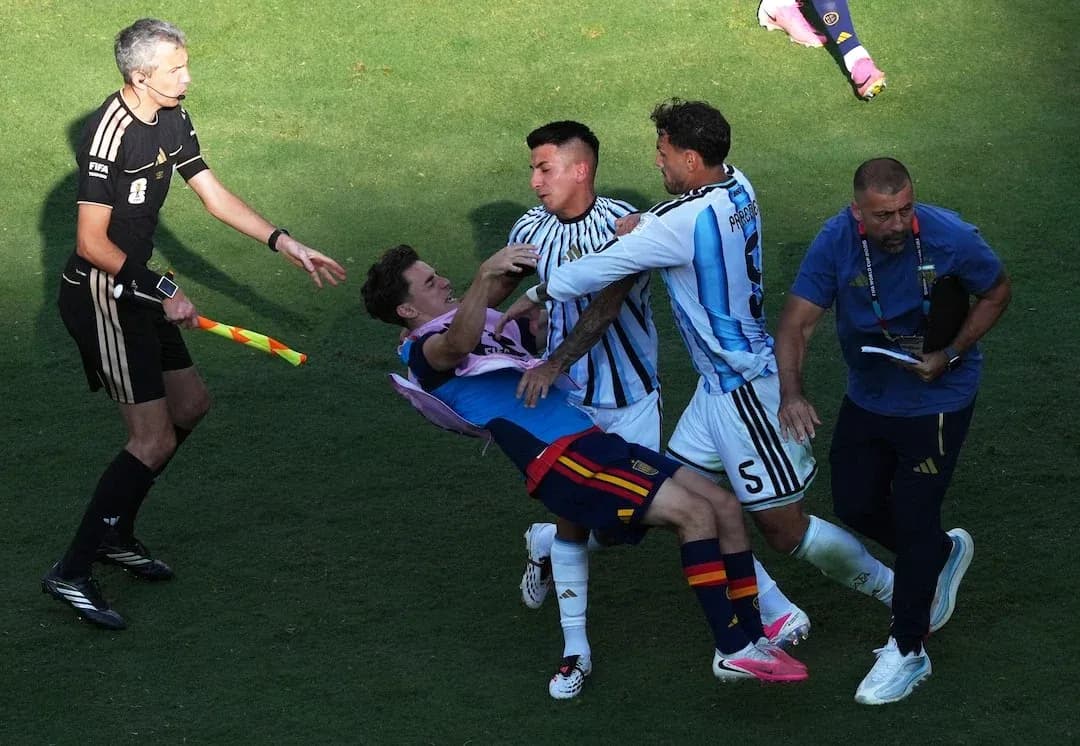
Argentina’s disciplinary map was more volatile. Across the tournament they accumulated yellow cards in waves: 2 between 31–45, 2 between 46–60, 2 between 76–90, then a heavy 5 between 91–105 and 3 more between 106–120. There was also a single red card between 91–105. This is a team that, as matches get stretched and emotional, is drawn into duels and confrontations. That temperament, married to a high-risk attack, made them exhilarating but fragile in a final that lasted 120 minutes.
The Duel
Up front, the “Hunter vs Shield” duel was brutally clear. On one side, Messi entered as the tournament’s most complete attacker: 8 goals and 4 assists in total, from 28 total shots with 18 on target. He had created 26 key passes and completed 27 dribbles from 38 attempts, drawing 20 fouls. Alongside him, Lautaro Martínez mirrored that production line in the data, also listed with 8 goals and 4 assists in total. Between them, Argentina possessed two forwards who had dominated both the top scorers and top assists charts.
But they were running into the most parsimonious defence in the competition. Spain’s overall goal difference heading into this match was +13, calculated from 14 goals for and 1 against. That shield was not just structural; it was embodied in individuals. Rodri’s presence as the single reference in front of Pau Cubarsí and Laporte allowed Spain to compress space between the lines, protecting against Messi’s tendency to drop into pockets. Cucurella and Porro, nominal full-backs, were asked to be aggressive in wide pressing but always with the insurance of that double pivot.
Midfield Battle
In the engine room, the confrontation between creativity and control was decisive. For Argentina, Enzo Fernández’s World Cup had been defined by volume and edge: 512 total passes at 93% accuracy, 11 tackles, 1 successful block and 5 interceptions. But his disciplinary line was thin: 12 fouls committed, 1 yellow card and 1 yellow-red combination in total. He was the player most likely to step into a challenge that could change a match’s tone. Leandro Paredes, coming from the bench options, had 566 total passes at 93% accuracy, 10 tackles and 3 successful blocks, but also 9 fouls committed and 2 yellows. If introduced, he would tilt the midfield towards confrontation and vertical passing.
Spain’s answer lay in the calm repetition of their patterns. Fabián Ruiz, Rodri and Dani Olmo offered three different passing rhythms, allowing Spain to recycle possession and drag Argentina’s midfield line out of shape. Lamine Yamal, from the right, represented the chaos factor: a winger who could isolate Tagliafico and force Romero or Lisandro Martínez to step out, opening central lanes for Oyarzabal’s diagonal runs.
Defensive Core
Set against that, Argentina’s defensive core had been both heroic and stretched. Cristian Romero’s tournament numbers – 15 tackles, 3 successful blocks, 10 interceptions, 50 total duels with 33 won – painted him as the last-ditch firefighter. Lisandro Martínez mirrored that intensity with 12 tackles, 1 successful block, 6 interceptions and 46 total duels with 30 won. But both carried 2 yellow cards in total, and in a final that went to 120 minutes, each aggressive step forward risked tilting the balance.
There was another, subtler storyline: penalties. Spain had taken 1 penalty in total this World Cup and scored it, a clean 100% record with no misses. Argentina, astonishingly for a side with Messi and Lautaro, had a fractured relationship with the spot. Across the tournament they had 3 penalties in total, scoring only 1 and missing 2. Messi himself had missed 2 penalties in total, with none scored, a rare psychological weight for a player otherwise in imperious form. Lautaro Martínez also carried 2 misses in total in the data. In a final that ended 1–0 after extra time and never reached a shootout, that underlying fragility from the spot hung like a ghost over Argentina’s approach: they could not rely on penalties as a safety net.
Final Analysis
Statistically, the final played out as the purest expression of Spain’s identity. Over the campaign they had failed to score in only 1 match in total, and they found their breakthrough in extra time here, leaning on their superior physical and tactical management of long games. Their yellow-card surge between 91–105 minutes in the tournament data foreshadowed a side willing to darken the game just enough to protect a lead once they found it.
Argentina, for all their attacking firepower and the brilliance of Messi, ran into a defensive wall that had conceded just 1 goal in total all tournament. Their own defensive average of 1.0 goals conceded per match, and only 2 clean sheets in total, suggested that if they could not blow Spain away early, they would eventually be dragged into a narrow, attritional contest – exactly the kind of match Spain were built to win.
Following this result, the numbers and the narrative align. Spain’s meticulous 4-2-3-1, their season-long defensive parsimony and their capacity to manage extra time were not just statistical quirks; they were the blueprint for lifting the World Cup. Argentina’s volatility – their late-game cards, their uneven penalty record, their reliance on individual brilliance – made them compelling protagonists, but in a final this finely balanced, the team with the stronger structure and the calmer relationship with risk prevailed by the narrowest, most fitting margin: 1–0 after 120 minutes.